E-Paper



Govt committed to restoring peace in Manipur: Amit Shah
Amit Shah visited border regions and talked to groups on both sides of the ethnic divide on the third day of his trip to the strife-torn state

 Prefer HTon Google


The government is committed to restoring peace in Manipur as soon as possible and ensuring the return of refugees to their homes, Union home minister Amit Shah said on Monday, completing the third day of his trip to the strife-torn state by visiting border regions and talking to groups on both sides of the ethnic divide.
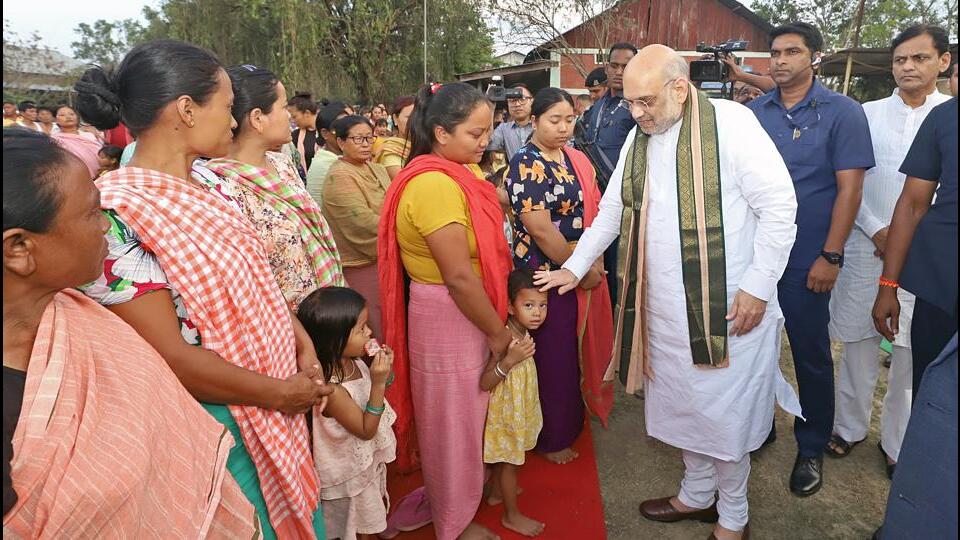
Shah visited the Kuki-dominated town of Moreh on the border with Myanmar and Kangpokpi district, one of the worst hit by the clashes that have left 80 people dead since May 3. He also went to relief camps in Kangpokpi and Imphal, and later held a security review meeting with top officials in the state capital.
“Our resolve remains focused on leading Manipur back to the track of peace and harmony once again and their return to their homes at the earliest,” said a government statement, quoting Shah.
The minister assured people in Moreh and Kangpokpi that the supply of essential items in hill areas and helicopter services for emergency needs in Churachandpur, Moreh and Kangpokpi will be ensured, the statement added.
Shah arrived in Manipur on Monday night and held talks with chief minister N Biren Singh, senior officers, and governor Anasuiya Uikey. On Tuesday, he reviewed the security situation, held an all-party meeting and met delegations from Meitei and Kuki communities that are on either side of the raging conflict.
Manipur has been convulsed by ethnic violence since May 3, with the bulk of the clashes between the Meitei community, which constitutes the majority of the state’s population and lives largely in Imphal, and the Kukis, who comprise 16% of the state and live largely in the hill districts.
The visit is important in a state where ethnic divides run deep and where the local administration has repeatedly failed in quelling violence and building bridges between warring communities. The state government needs to dispel the perception of bias and focus on confidence-building measures and bring both sides to the negotiating table for forging a long-term solution.
Shah’s day began at the border town of Moreh, where deliberations went on for over an hour and civil society and Kuki groups submitted a list of demands, which included a separate administration for Kukis, withdrawal of Manipur police commandoes from Moreh, helicopter services connecting Moreh to Aizawl and Guwahati and outlawing of some controversial Meitei groups.
“We told the home minister that violent incidents are taking place despite his presence in Manipur and only implementation of Article 355 or 356 can stop this,” said Lalboi Hriammi, joint secretary of the Kuki Chiefs’ Association (KSA) who met Shah at Moreh.
“We urged him to let the armed forces use lethal firepower against armed groups from both Kuki and Meitei communities. Let there be no distinction for the sake of peace,” Hriammi added.
Representatives from the Gorkha and Tamil communities also met Shah.
In Kangpokpi, Shah met the Committee on Tribal Unity, Kuki Inpi Manipur, Kuki Student Organisation, Thadou Inpi and civil society members. He also visited a Kuki relief camp and told refugees that the government was committed to ensuring their return home. Shah returned to Imphal later in the afternoon, held a security review meeting and also visited Meitei relief camp where he assured residents that the administration will facilitate their return, the government statement said.
“Home minister also held security review meeting with top officials in Imphal ,directed them to take stern and prompt actions to prevent violence, against armed miscreants and recover looted weapons to bring back normalcy at the earliest,” the statement added.
In a statement, Indigenous Tribal Leader Forum (ITLF), a conglomerate of Kuki tribes, alleged that radical Meitei groups indulged in “coordinated looting of government weaponry in the heart of the state capital” and used those arms to target Kuki villages along the Imphal Valley foothills.
ITLF spokesperson Ginza Vualzong stated that incidents of firing took place at Sugnu in Kaching district on Wednesday as well. But there was no confirmation of any deaths or injuries from the authorities.
At least 80 people have died and another 40,000 displaced by ethnic violence between the tribal Kukis, who mostly reside in the hill districts, and the Meiteis, the dominant community in Imphal Valley.
Clashes between the Kukis and Meiteis first erupted on May 3 during a protest against a court-ordered tweak to the state’s reservation matrix, granting scheduled tribe (ST) status to the latter. Violence quickly engulfed the state where ethnic fault lines run deep, displacing tens of thousands of people who fled burning homes and neighbourhoods into jungles, often across state borders.
The authorities quickly clamped a curfew and suspended internet, pumping in additional security forces to force a break in the spiraling clashes. Internet is still not back in the state.