
 E-Paper



Universal basic income idea gains political traction
A particular version of universal basic income (UBI), a welfare benefit that guarantees a certain threshold sum of money for everyone regardless of whether they work or not, is the next big political-economy idea fast catching up in India.


A particular version of universal basic income (UBI), a welfare benefit that guarantees a certain threshold sum of money for everyone regardless of whether they work or not, is the next big political-economy idea fast catching up in India.
You could call it free money. It is an idea whose origins lie in the so-called Utopian Socialists. In India, UBI first became part of the official discourse when the country’s then chief economic adviser Arvind Subramanian proposed it in the Economic Survey 2016-17.
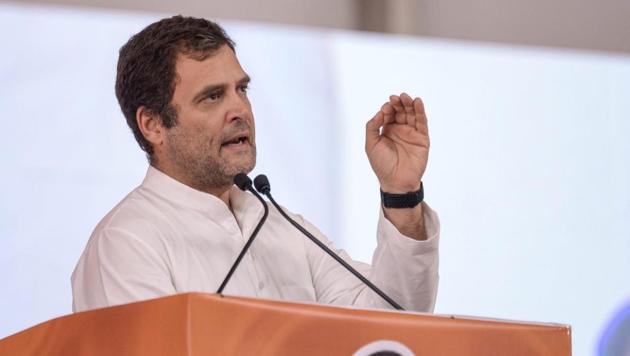
On Tuesday, Congress president Rahul Gandhi put the idea on the forefront of the political agenda by promising a minimum income guarantee to the poor. There is speculation that apart from a farm relief package, the upcoming budget may include some form of UBI, although there is no official confirmation on this.
UBI is a darling of both right-wing economists, who think it will be fiscally efficient, and Left-leaning economists, who feel it will extend the welfare state. The main argument for a quasi-UBI — meaning UBI targeted only at the poor — as posited by the Economic Survey 2016-17, was that current subsidies suffer from massive misallocation.
Under no welfare scheme do districts accounting for 40% of the country’s poor have ever received 40% of resources, the survey states. This means that the share of welfare spending in the poorest districts was never equal to their share of poverty.
Also read: ‘We guarantee minimum income for poor, PM Narendra Modi wants maximum pay for rich’: Rahul Gandhi
The Economic Survey proposed gradually tapering some of the existing benefits or offering a choice to either to opt for UBI or subsidy. This has proved to be controversial.
According to welfare economist Jean Dreze, replacing crucial “hard-won entitlements”, such as subsidised food, could be a “Trojan horse for the dismantling of hard-won entitlements of the underprivileged”.
Two important proponents of UBI in India are economist Pranab Bardhan, professor of economics, University of California, Berkeley, and Vijay Joshi, emeritus fellow at Merton College, University of Oxford.
Both these economists have proposed that the main way to finance UBI is to cut so-called non-merit subsidies, which refer to subsidies that do not go into areas such as education and health and are directed at the non-poor.
Subramanian, a visiting lecturer at the Harvard University now, this week co-authored a paper for a quasi-UBI to 60-80% of the rural poor to offset rural distress. They argue an annual transfer of ₹18,000 ( ₹1,500 a month) can cover three-fourths of the rural population at a cost of 1.3% of gross domestic product (GDP) or ₹2.6 lakh crore at 2019-20 prices.
But many feel the UBI is simply preposterous in India’s case. “The truth is we simply cannot afford a UBI. The only country to try it, Finland, had to give it up. It is too costly. Secondly, if it is quasi-UBI, then it is no longer UBI,” said economist Abhijit Sen.
Dreze argues that even if some “fiscal space” is reclaimed by eliminating undesirable subsidies, there are “many other urgent claims on public expenditure such as education, health care, environmental protection, and essential infrastructure”.
According to Sen, some combination of NREGA, minimum wage and pensions can achieve better poverty-reduction goals. Sen says he does not agree with cutting existing benefits because “you do not start off something which cannot reach everybody by cutting something which is already reaching many people.”


