
 E-Paper



Unsafe lives in unregulated PG rooms of B’luru
Bengaluru's PG accommodations face scrutiny as inspections shut down eight facilities for violations, revealing unsafe conditions for students and migrants.


A sweeping inspection of paying guest accommodations across parts of Bengaluru this month led to the closure of eight facilities, with hundreds more cited for violations, bringing to light the precarious and often poorly regulated living conditions of thousands of students and migrant workers in the city.
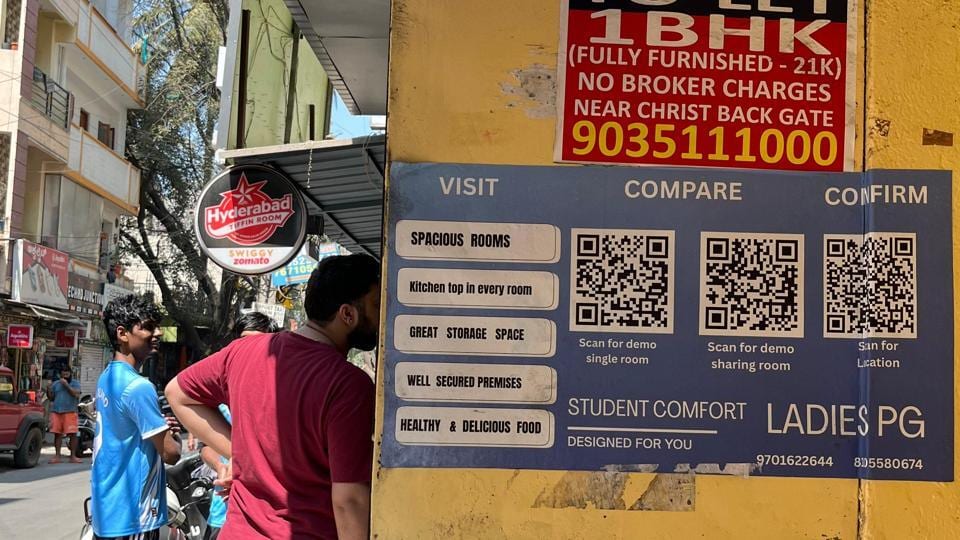
Officials from the Bruhat Bengaluru Mahanagara Palike (BBMP) inspected PGs in the East and West zones and issued notices to about 500 establishments after identifying lapses in hygiene, food quality and safety standards. Authorities imposed fines totalling ₹3.09 lakh on non-compliant operators and said inspections would continue in the coming weeks.
For many residents, the enforcement comes after years of complaints about overcrowded rooms, pest infestations, unreliable security and disputes over deposits.
In Suddagunte Palya, a neighbourhood of tightly packed buildings near Christ University’s central campus, dozens of PGs line narrow lanes that struggle to accommodate both pedestrians and vehicles. The area draws students and young professionals from across India and abroad, many of whom say they accept difficult conditions because they have few alternatives.
One women’s PG in the locality shut down months ago, officially citing a property dispute. Former residents, however, said the closure followed prolonged complaints about sanitation, food and safety. “At the beginning it was good, everything was perfect,” said Vaibhavi Araballi, 19, recalling her first weeks there. “But soon enough everything completely changed for the worse.”
She described a steady decline in maintenance. “There were rats in the dining area because no one cleaned up the leftovers after dinner, cockroaches were everywhere, even the fridge wasn’t clean, the entire place including the area in front of our rooms used to stink,” she said.
Residents said their repeated appeals to wardens and managers resulted only in brief improvements. Panikka Sood, 21, said animals wandered freely through the corridors. “The manager had a dog which used to defecate in front of the rooms. Stray cats and rats were everywhere,” she said.
Security, a particular concern in women’s PGs, was also inconsistent. Municipal guidelines require round-the-clock guards, but residents said the rules were not followed. “There was a security guard who used to whistle at us and make us uncomfortable. When we told the warden she said that action would be taken. He was back the next week,” Araballi said. She added that guards sometimes abandoned their posts to carry out cleaning or kitchen duties.
Parents said they struggled to hold management accountable.
Geetanjali Siriki, 52, said her daughter waited months for her deposit to be returned. “The so-called manager became completely unavailable to my queries, we only received it after countless reminders,” she said.
Students described similar difficulties. “We were given a 20-day notice to vacate, but all other PGs were already booked,” said Sanya Narang, 22, who said she waited six months to recover her deposit. “A lot of kids lost their money. A few went to the police station to complain, only then did some people get the money back.”
Shrushti Shankar, 20, said filing a police complaint was the only way to resolve her case. “After months of hassling with the management, I filed a complaint with the SG Palya police station, only then did they return my deposit,” she said. Others said they were still waiting.
Urban planning experts say the problems are rooted in how PGs are classified.
“The only reason BBMP does not go and shut these PGs is because PGs are not considered housing. PGs are considered as commercial establishments, hence there is no policy or statutory document that talks about them,” said Dr Sai Rama Raju Marella of the Indian Institute for Human Settlements.
He said the classification leaves residents without the protections typically available to tenants. “There are no recommendations, no accountability, how they are built, where they are built, how they run, what is the minimum tax and so on,” he said.
Despite the gaps, PGs remain essential to the city’s workforce and student population. “Nearly 60% of Bengaluru’s population consists of migrants, many of them are students, interns, delivery workers, housekeeping staff and security guards. For them, PGs are the only accessible option,” Marella said. He added that many lack the financial resources or local connections required to rent independent housing.
PGs also tend to be more socially accessible. “They won’t ask where you come from, what religion you follow or what work you do. If you follow the rules, you get a bed,” he said.
The scale of the sector is a sign of its importance. The city has more than 20,000 PGs, but only about 2,500 are registered. A 2024 civic survey cited by Marella found that of 4,513 PGs inspected, more than half were unauthorised and over 1,400 failed to comply with regulations.
He questioned whether inspections fully captured residents’ experiences. “The officials just carry a piece of paper and just treat the inspection as a checklist, but do they go with their checklist and ask the tenants if they feel safe there? Are there any other issues? There are no questions for this,” he said.
Marella said meaningful reform would require new legislation that recognises PGs as housing and establishes accountability. “Once there is an act, owners will also be scared. They will be held accountable if someone’s complaint is verified,” he said. He added that PGs should display clear information directing residents to complaint mechanisms, similar to safety helplines posted in other buildings.
Raghav Mantri, co-founder and director of Millenium Premium Living’s PGs acknowledges this regulatory gray area, “90% of the players do not follow the regulations, they choose to ignore even the basic minimum criteria for cost cutting. If there is a defined regulation it will help players like us who want to ensure that the standards are being met”.


