
 E-Paper



UP outbreak: Kin of Mathura village victims mourn loss
In last one week, Koh has lost nine children to dengue and another 130people have fallen sick to the viral fever that has killed at least 54 people in the region, according to government estimates.


KOH (MATHURA): Koh stirs to life early in the morning. The young men go to factories in Mathura, an hour’s drive away, and other men and women head to the fields or cowsheds. The village of roughly 350 households is a patchwork of red, green, pink and blue brick houses with piles of cow dung, mulch, and water strewn along the few pucca roads. Open drains run alongside.
The locals don’t seem to mind, walking barefoot and skipping over the garbage. The village is built on a slope, so putrid water drains into a large pond on the far edge of the settlement. A temple stands nearby, looking outwards into shrubs and bushes.
Over the past fortnight, however, a blanket of silence has fallen over the usual village chatter, pierced by the occasional wail of a heartbroken mother. In that period, the village has lost nine children to dengue and another 130people have fallen sick to the viral fever that has killed at least 54 people in the region, according to government estimates.
Koh is the among the worst affected areas by the outbreak that first became public on August 18 from Firozabad but quickly spread across the region. The government later clarified that the “mysterious disease” initially reported was, in fact, dengue. A central team later classified a majority of the deaths as being caused by dengue, with the others attributed to scrub typhus and leptospirosis.
In the village, people don’t go out anymore, instead congregating on the courtyard of houses where new victims emerge, mourning and offering condolences to families of victims as young as four. Some distraught relatives make the rounds of the local temple, others call up local moneylenders and banks because most families are poor and financially stretched by hospital costs.
Ved Prakash, 37, is one of them. The labourer’s five-year-old daughter, Honey, died on August 23, while on their way to a hospital.
“On August 5, Honey got a fever but after giving her medicines from the local doctor, her condition worsened. We admitted her to a private hospital in Mathura where she was treated for 20 days. On August 23, we decided to take her to Jaipur to a better hospital but she passed away on the way,” said Prakash, biting back tears. Eleven of the 12 members in his house are down with fever.
“The adults did not need to be admitted but all four of my daughters were. After Honey passed away, my youngest daughter was put on ventilator. For all these admissions at the private hospital, we had to shell out ₹4.5 lakh by taking loans and selling gold jewellery. Even after doing everything, I could not save my gudiya,” he added.
After a visit by chief minister Yogi Adityanath on August 30, the government has also stepped up treatment and mitigation efforts. “In Firozabad, some officers of the health and urban development departments have been found lax in discharging their duties. It should be examined and action should be initiated against guilty officers,” the chief minister said on Monday. But as locals from Koh said the outbreak has also spotlighted poor health infrastructure and public hygiene, especially in the hinterlands where awareness is low.
Inadequate facilities
In Koh, the primary health centre is 10 km away but is poorly staffed. Villagers said they didn’t “trust” the government facilities.
“The first death due to fever was reported at our village on August 11 of four-year-old Ramiya. Her parents had gone to the district hospital in Mathura and had to wait over 1.5 hours just to get and even after getting admission, no doctor attended her for eight hours. She had to be taken to a private hospital and eventually passed away,” said Harender Singh, the village chief.
Between August 11 and 20, three more children died, one of them Singh’s nephew Avneesh.
“My Nandagopal has been snatched away from me, our family’s future is gone,” said Lilawati, the child’s grandmother, clutching a smiling portrait of the nine-year-old and referring to him with one of Lord Krishna’s names. Mathura is considered the birth place of the Hindu God.
“On August 15, Avneesh woke up with fever and cold sweat. Soon, his condition worsened, with red spots on the body. He said he felt a hundred ants were biting him. He was admitted in a private hospital in Farah (a block in Mathura) for two days after which we decided to shift him to a bigger hospital on August 20. However, he died on the way before we could reach the hospital,” said Singh.
He said he informed Mathura chief medical officer Rachna Gupta on August 20but alleged that he didn’t receive a response. “She took the matter lightly. That is when on August 21, I decided to inform a local journalist about it. After the report was published in the local newspaper, a medical team from the CMO office came to our village on August 22,” said Singh.
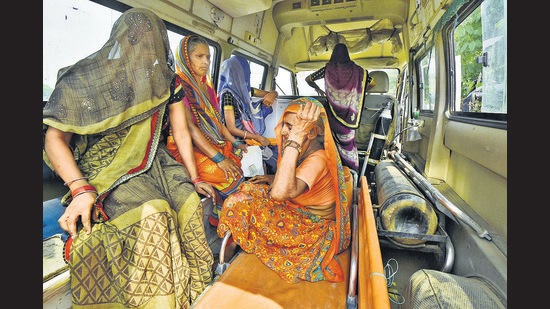
Since then, a medical team comprising a doctor, a pharmacist, a lab technician and a nurse have set up a temporary 24x7 health care centre where all cases of fever are being screened for malaria and dengue. Two ambulances are also stationed at the village to ferry patients to the local community health centre.
“The nine deaths are of paraxia of unknown origin (PUO) who have clinical symptoms of dengue. However, a death audit of these cases is being done to ascertain the exact cause of death,” said Dr Munish Paurush, district surveillance officer, Mathura.
Villagers also say two sanitation workers have sprayed medicine in wild bushes and drains – the first time this has happened in twoyears. But they are still seething. “When hospital bills started increasing, many villagers had to mortgage their lands, jewellery and even their house to pay for the treatments of their children,” said Singh.
Blame game
The spate of deaths has sparked a blame game with villagers alleging the government was initially lax, and the administration refuting the charges. Gupta said that immediate action was taken by the district health department. “The village pradhan decided to inform the media before informing the local health officials about it. However, immediate action was taken by us which has helped control the deaths and the fever cases, as compared to nearby districts which has become an epicentre of the outbreak,” she said.
She added that there was no “mystery fever”.
“While a death audit will ascertain the cause of deaths, there are several infections that people are being screened for, these include Dengue, Malaria, Japanese Encephalitis (JE), Scrub Typhus and Laptopirisis,” said Gupta.
Official data shows the block – which comprises four villages other than Koh – has reported 177 cases of dengue, 16 cases of malaria, 29 cases of scrub typhus, 45 cases of laptopirisis, and 2 cases of Japanese Encephalitis since August 21.
Gupta said 16 of the 352 houses were found to have larvae and stagnant water. “Stagnant water was found in coolers and trays of fridges in people’s houses. Our medical team had to go door to door to get these cleaned and larvae was found as well. District health department regularly carries our awareness programmes to inform people about the dangers of stagnant water in houses,” she added.
She said cases were now under control.
But back at the village, locals say it will take a long time for things to be back to normal. They point to the many locked houses, after at least 40 families fled the village due to fear of the fever. “The families left in the village have sent their women and children to their maternal villages,” said Singh.
Nearby villages have shunned Koh and told local residents that the deaths were the reason of a curse. In response, village elders revived a small temple on the outskirts the village which was shut for a year since its priest passed away. “We feel that we were disrespectful to the gods which is why this is happening to our village,” said Savitri Devi, a resident.
The children still left in the village carry knots of red thread on their arms. “My dadi has given me this to protect me from the evil eye,” said Rinku, 7.
(with inputs from Hemendra Chaturvedi in Agra)


