
 E-Paper



Uproar across US over Roe vs Wade reversal
The international community condemned the verdict and the violation of human rights in the US, with some of America’s closest allies calling it “horrific”, “incredibly upsetting”, and a “big step backwards”


A day after the US Supreme Court overturned Roe v Wade, striking down the fundamental right of women to abort and leaving the decision to states, a divided America woke up to a range of Republican states banning or severely circumventing the right to abort while civil society groups protested against the verdict. President Joe Biden rolled out a set of executive actions to offer abortion-related protections, and Democrats reoriented their campaign focus for the mid-term elections to focus on the issue.
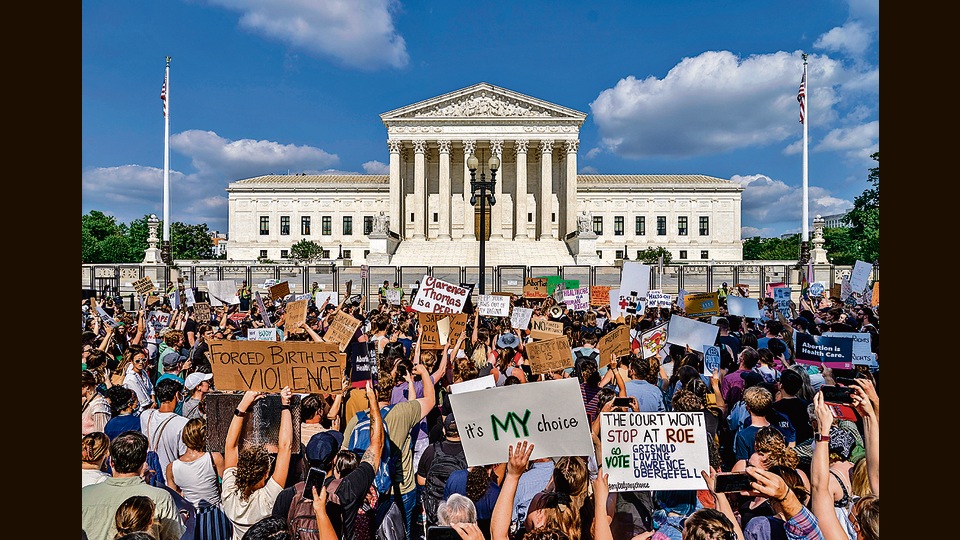
The international community — for once it was the US that was at the receiving end of global concern and criticism — condemned the verdict and the violation of human rights in the US, with some of America’s closest allies calling it “horrific”, “incredibly upsetting”, and a “big step backwards”.
On Friday, in a verdict that both reflected and deepened the divisions in America on the issue of abortion, a conservative-dominated bench of the court rolled back Roe v Wade, declared that the constitution did not offer the right to abort, and left the decisions to states. Three judges dissented and declared that the verdict erodes the equality and freedom available to women and warned that it could potentially inaugurate an attack on other rights located within the right to privacy, such as access to contraception, same-sex relationships, and same-sex marriages.
The SC verdict triggered automatic bans and restrictions in a range of Republican-governed states. By Saturday noon in America, Alabama, Arkansas, Kentucky, Louisiana, Missouri, Oklahoma, South Dakota, and Utah had already banned abortion — and in six of these states, there were no exceptions even for rape or incest. Texas, Idaho, Mississippi, North Dakota, West Virginia, Tennessee, Wyoming, among other states, are expected to roll back abortion in a matter of days.
The decision and the coming into effect of the trigger bans sparked outrage and led to protests across the country.
In Washington DC, both on Friday and Saturday, protesters gathered around the Supreme Court, with slogans such as “This decision must not stand” and “Legal abortion on demand”. Protesters said that their focus was now on legally challenging the verdict, pushing back in states where abortion had not yet been banned, and ensuring the right of women to travel where abortion was not banned. Protests erupted in other liberal cities, from New York to California, as well as in mid-western states, even as anti-abortion activists celebrated the verdict comparing it to the end of segregation and framing it as protecting the human rights of the unborn.
Biden, who on Friday called the verdict a “tragic error” that was cruel and had left him stunned, rolled out a set of actions to offer protections to women. To protect the right of women to travel to seek medical care — women in Republican states where abortion is banned or restricted are expected to travel to Democratic states where abortion rights are set to be protected — the administration made it clear that if any local official tries to interfere with this right, it will fight the “deeply un-American attack”. Biden also directed the Secretary of Health and Human Services to protect women’s access to critical medications for reproductive health care that are approved by the Food and Drug Administration, including essential preventive health care like contraception and medication for abortion, according to a factsheet released by the White House.
The verdict had an immediate political impact, with Democrats reorienting their campaign for the midterms to focus on the issue. Biden, in his remarks on Friday, said that the only way to overturn the verdict and restore the protections embedded in Roe v Wade was through a federal law in the US Congress and urged voters to turn out in large numbers in November to vote for representatives who would do so. The Republican leader, Mitch McConnell, who played a key part in nominating the judges who tilted the balance in the court, called the decision “courageous and correct”.
America’s divisions were also reflected in the editorial positions of top media organisations. The Washington Post called the SC’s decision “wrong-headed, radical and dangerous” which had thrust the court and country into a “perilous new era”, and warned that the decision had showed Americans can no longer take their freedoms for granted. The New York Times called it an insult to women and the judicial system. But The Wall Street Journal said, in an editorial, that the court had finally corrected its “historical mistake”, and said the decision had returned the “profound moral issue of abortion to the states and democratic assent, where it always belonged”.
The SC verdict also sparked international outrage. British Prime Minister Boris Johnson called it a “big step backwards”. Canada’s Prime Minister Justin Trudeau said the news out of the US was “horrific”. “No government, politician or man should tell a woman what she can and cannot do with her body,” he said. New Zealand’s Prime Minister Jacinda Ardern said that watching the removal of a woman’s fundamental right to make decisions was “incredibly upsetting”. French President Emannuel Macron said abortion is a fundamental right for all women. The World Health Organization’s Secretary General Tedros Adhanom Ghebreyesus said that the SC verdict reduced women’s access to rights and health care.


