India and Uzbekistan on Sunday raised their ties to a comprehensive strategic partnership, set a target of $5 billion in annual trade by 2030 and agreed to work for the long-term supply of uranium during talks between Prime Minister Narendra Modi and President Shavkat Mirziyoyev in Tashkent.
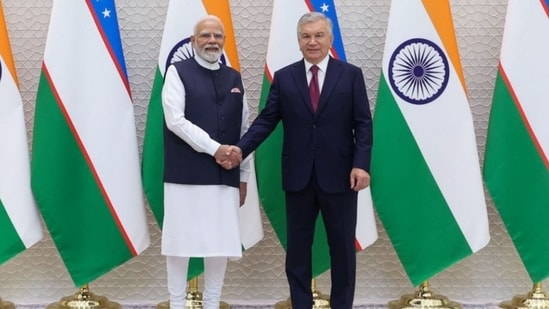
Uzbekistan was the first stop in Modi’s two-nation tour, which will also take him to Kyrgyzstan to attend the Shanghai Cooperation Organisation (SCO) Summit. This was Modi's fourth visit to Uzbekistan, which he described as being at the heart of India's engagement with Central Asia.
The talks between the two leaders focused on enhancing cooperation in trade and investment, defence and security, infrastructure, critical minerals, innovation, AI, pharmaceuticals, digital public infrastructure including India's Unified Payments Interface (UPI), agriculture and education.
Also read: PM Modi Kyrgyzstan Visit highlights: PM lands in Kyrgyzstan, will take part in SCO Summit in Bishkek
Deep Dive
What is the significance of the $5 billion annual trade target set between India and Uzbekistan by 2030?
How will the long-term uranium supply agreement between Uzbekistan and India impact their civil-nuclear energy collaboration?
Why did Uzbekistan introduce a 30-day visa-free regime for Indian citizens during PM Modi's visit?
Follow live updates on PM Modi's Uzbekistan visit here.
{{/usCountry}}Follow live updates on PM Modi's Uzbekistan visit here.
{{/usCountry}}‘Stronger India-Uzbekistan ties force for peace’
“India and Uzbekistan share a deep convergence of perspectives and aspirations,” Modi told a joint media interaction, speaking in Hindi. “A stronger India-Uzbekistan partnership will be a powerful force for peace, progress and prosperity in Central Asia.”
He noted that the two sides were elevating their ties to a comprehensive strategic partnership on the 15th anniversary of their strategic partnership.
Also read: Uzbekistan introduces 30-day visa-free regime for Indian citizens during PM Modi's visit
“Our bilateral trade has crossed $1 billion. We have now set a target of $5 billion in bilateral trade by 2030. To achieve this, we will systematically address issues related to market access, connectivity, banking and payment systems,” Modi said.
At the start of his talks with Mirziyoyev, Modi outlined several steps the two sides planned to take to deepen their relationship. “We will also establish a long-term arrangement for the supply of uranium,” he said.
Sibi George, secretary (West) in the external affairs ministry, told reporters later that the two sides had “positive discussions” on a long-term arrangement for the supply of uranium to India. “We are closing in to the signing of an agreement very shortly,” he said without giving details.
Modi said the two countries will also establish a coordination council led by the foreign ministers to provide direction to all aspects of cooperation, and elevate an existing joint commission from the level of secretaries to the ministerial level.
India ‘reliable strategic partner’: Uzbek Prez
Mirziyoyev described India as a “reliable strategic partner” and noted that New Delhi’s voice and influence in global affairs has grown. Joint ventures between the two countries have increased seven-fold and there are now 14 direct flights every week, he said.
“We are aiming to advance cooperation in sectors such as energy, culture, critical minerals, pharmaceuticals, jewellery and agriculture,” Mirziyoyev said.
“We will prepare roadmaps for each of these sectors. Specific teams from India will come here, and our teams will travel to India, enabling us to clearly define our objectives in these fields,” he added.
Mirziyoyev said the introduction of a 30-day visa-free regime for Indian citizens will make a significant contribution to developing tourism and business exchanges.
Key outcomes from PM Modi's visit
PM Modi pointed out that the close defence and security cooperation between the two sides “reflects the deep mutual trust that underpins our relationship”. The two countries will promote direct linkages, co-production and co-development between their defence industries, he said.
“We believe that terrorism, extremism and separatism pose serious challenges to the entire region,” Modi said. “Our shared resolve to adopt a policy of zero tolerance towards them has been, and will continue to be, unwavering.”
Also Read : PM Modi gets Uzbekistan's highest state honour, Order of Oliy Darajali Do‘stlik
The leaders witnessed the exchange of 11 agreements covering areas such mining, culture, education and tourism. A memorandum of understanding (MoU) between India's ministry of mines and Uzbekistan's ministry of mining industry and geology will focus on cooperation in mineral resources, including rare earths.
An MoU between the ministries of finance of India and Uzbekistan will establish an Economic and Financial Dialogue, while another MoU focuses on cooperation in higher education and scientific research. The external affairs ministry and the Cultural Heritage Agency of Uzbekistan finalised a letter of intent for conserving and restoring the ancient buddhist sites of Fayaz Tepa and KaraTepa at Termez.
India announced a grant of $1 million for afforestation in the Aral Sea region, while India's NPCI International Payments Ltd (NIPL) signed a commercial agreement with Uzbekistan’s National Interbank Processing Centre JSC (NIPC) to enable Indian UPI apps of to scan national QR codes for merchant payments in Uzbekistan. George described this agreement as the first step towards greater inter-operability between the digital payment eco-systems of the two countries.
Also read: Putin to meet PM Modi on August 31 at SCO Summit; talks to continue at BRICS Summit
Mirziyoyev conferred the Oliy Darajali Do’stlik Order, Uzbekistan’s highest honour for foreign leaders, on Modi for his contribution to strengthening the friendship between the two countries. Modi dedicated the award to the 1.4 billion people of India and said the two sides will work jointly to protect the interests of the Global South.
Late on Sunday night, Modi arrived in Kyrgyzstan, where he will participate in the SCO Summit and to hold bilateral meetings with leaders such as Russian President Vladimir Putin.