E-Paper



PM Modi lands in Uzbekistan on two-nation visit; President Shavkat Mirziyoyev receives him
PM Narendra Modi thanked Uzbek President Shavkat Mirziyoyev on social media for the “special gesture” of welcoming him at the airport

 Prefer HTon Google


Prime Minister Narendra Modi arrived in Tashkent on Saturday for Uzbekistan and Kyrgyzstan, where he will hold bilateral meetings and participate in the Shanghai Cooperation Organisation (SCO) Summit to bolster India's strategic partnerships in Central Asia.
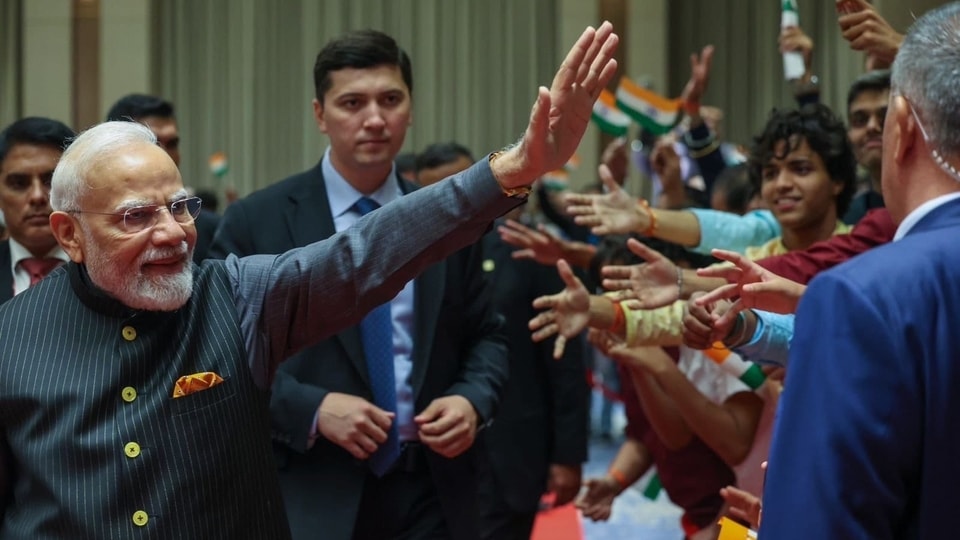
Uzbek President Shavkat Mirziyoyev received Modi on his arrival in Tashkent late on Saturday. The PM’s special aircraft took a longer route through Chinese airspace since Pakistani airspace remains closed to Indian aircraft, people familiar with the matter said.
Modi thanked Mirziyoyev on social media for the “special gesture” of welcoming him at the airport and said his fourth visit to Uzbekistan reflected the depth and growing momentum in bilateral relations.
Deep Dive

Modi to meet Putin, other leaders at SCO Summit
Following his two-day trip to Uzbekistan, Modi will travel to Kyrgyzstan to participate in the SCO Summit and hold bilateral meetings, including with Russian President Vladimir Putin, on the margins of the gathering.
“I am confident that this visit will strengthen India’s strategic partnerships in Central Asia, deepen our civilisational connect with the region, and advance our shared pursuit of peace, stability and prosperity – values that lie at the heart of India’s engagement with the world,” Modi said in a statement ahead of his departure from New Delhi.
Soon after his arrival, Modi laid a wreath at Yangi Uzbekistan Park in Tashkent, emphasising the deep-rooted friendship between India and Uzbekistan.
Also read: PM Modi to visit Uzbekistan, Kyrgyzstan for bilateral talks, SCO Summit
Trade, defence, energy on agenda with Uzbekistan
Modi said in his statement that the India-Uzbekistan strategic partnership has witnessed significant advancement in recent years, and he looked forward to discussions with Mirziyoyev on Sunday that will focus on deepening cooperation in trade, investments, digital connectivity, defence and energy, and on advancing the shared visions of “Viksit Bharat” and “Yangi Uzbekistan”.
He will also visit the Shastri Memorial and the Mahatma Gandhi Centre at the Tashkent State University of Oriental Studies.
Uzbekistan is a partner country in the BRICS grouping, which is currently chaired by India. India is among Uzbekistan's top 10 trade partners, and bilateral defence cooperation has grown over the years, with the seventh edition of the Dustlik joint exercise held in April this year.
Uzbekistan is also the third-largest source country for medical tourism in India and is home to more than 18,000 Indians, including 16,000 medical students.
Also read: Trade, defence and bilateral ties: What’s on PM Modi’s Uzbekistan visit agenda
PM heads to Bishkek for 26th SCO Summit
From Tashkent, Mo will travel to Bishkek on August 31 to participate in the 26th SCO Summit, marking the organisation's 25th anniversary.
“India has been an active and constructive member of the SCO since 2017. I look forward to advancing India’s vision for the region, anchored in Security, Connectivity and Opportunity, and to working with fellow members for a region free from the scourge of terrorism, separatism and extremism, which continue to threaten peace and stability in our neighbourhood and beyond,” Modi said in his statement.
Also read: World's most watched meeting: PM Modi travels to Bishkek, Putin & Xi also set for SCO summit
He also looked forward to meeting Kyrgyz President Sadyr Zhaparov and other SCO leaders and attending the opening ceremony of the World Nomad Games, a celebration of Central Asian heritage.
Besides Russian President Vladimir Putin, Modi is expected to have bilateral meetings with several other leaders on the margins of the SCO Summit.