E-Paper



First flashpoint since Operation Sindoor: Pak Navy vessel collides with Indian warship in Arabian Sea
In the 1980s and 1990s, it was common practice for the Pakistan Navy to “shadow” or “buzz” Indian warships in the Arabian Sea or in the Persian Gulf

 Prefer HTon Google


A Pakistan Navy vessel collided with a frontline Indian warship in the Arabian Sea after manoeuvring in an “unprofessional and unsafe” manner, prompting New Delhi to summon Pakistan’s most senior diplomat on Wednesday to lodge a strong protest over the incident.
The collision was the first reported incident involving the militaries of the two countries since four days of hostilities in May 2025 (Operation Sindoor), triggered by India’s attacks on terror infrastructure in Pakistan in retaliation for the Pahalgam terror attack.
The charge d’affaires of the Pakistan high commission, Saad Warraich, was summoned to the external affairs ministry and a strong protest was registered over the “unacceptable and unprofessional conduct of Pakistani naval units at sea that led to a collision with a unit of the Indian Navy”, the ministry said in a statement.
Deep Dive

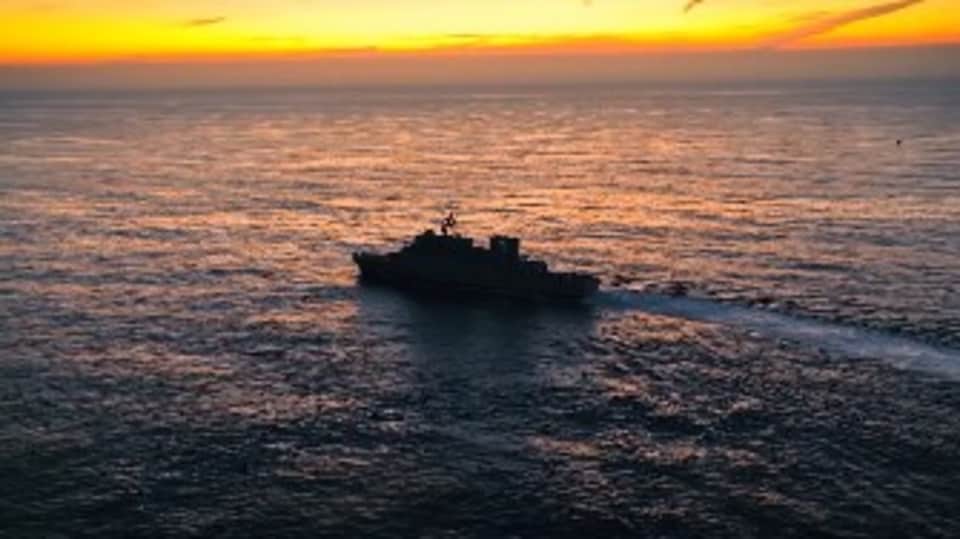
On the evening of September 15, PNS Hunain, a Pakistan Navy corvette, closed in at high speed on an Indian Navy warship on a routine surveillance mission in the north Arabian Sea, officials aware of the matter said. The Pakistani vessel manoeuvred in an unprofessional and unsafe manner, leading to the collision, they said.
The external affairs ministry said the incident, which occurred in international waters, did not cause “any major damage” to the Indian warship, but the “conduct of the Pakistani naval ship was in direct contravention of Article 10 of the Agreement between India and Pakistan on Advance Notice on Military Exercises, Manoeuvres and Troops Movements of April 1991”.
This agreement was among a series of military confidence-building measures between the two countries and largely relates to steps to be taken to prevent any incidents during army, air force and navy exercises. Article 10 of the agreement states that naval ships and submarines should maintain a distance of at least three nautical miles from vessels of the other country “to avoid any accident while operating in international waters”.
The Pakistani charge d’affaires was “advised to convey to the concerned Pakistani authorities the need for all military units to observe due care and respect the provisions of the relevant agreements between the two sides in order to prevent any repeat of such incidents”.
The Indian charge d’affaires in Islamabad was also instructed to lodge a similar protest with Pakistan’s foreign ministry.
Late on Wednesday night, Pakistan’s foreign ministry said it had summoned Indian charge d’affaires Satyanjal Pandey and lodged a strong protest over a “highly provocative and unacceptable action” by an Indian Navy vessel in Pakistan's exclusive economic zone (EEZ). The ministry alleged in a statement that the Indian vessel carried out “aggressive maneuvers in dangerously close proximity” to a Pakistani naval ship, “resulting in contact between the two vessels”.
Pandey was asked to convey to the Indian government that Pakistan “rejects this belligerent Indian action”, and the Indian side was urged to “adhere to international law and bilateral agreements, particularly those aimed at preventing incidents at sea”. The Pakistani charge d'affaires in New Delhi will lodge the same demarche with the external affairs ministry.
The Indian warship involved in the incident was not identified. The officials cited above said the warship had continued with its mission after the incident. They said the Indian captain had shown extreme restraint and acted to prevent a severe accident.
Reports said PNS Hunain, a 2,600-tonne warship commissioned in July 2024, had returned home after sustaining damage. It is among the Pakistan Navy’s newer vessels and was built at a shipyard in Romania by the Damen Group of the Netherlands as part of an order for four warships.
In the 1980s and 1990s, it was common practice for the Pakistan Navy to “shadow” or “buzz” Indian warships in the Arabian Sea or in the Persian Gulf. The last record of a collision between warships of the two countries dates back to 2011, when INS Godavari was marginally damaged by PNS Babur during an anti-piracy patrol in the Gulf of Aden.
At the time, INS Godavari was approaching MV Suez, a merchant vessel hijacked by pirates to ascertain the safety of the crew. PNS Babur closed in on INS Godavari at high speed from astern and carried out a manoeuvre that was in gross violation of relevant regulations on navigational safety, then defence minister AK Antony told Parliament.
In the process, PNS Babur touched INS Godavari, marginally damaging an extended safety net on the helicopter deck. India had lodged a protest with the Pakistan government through the high commission in New Delhi over the incident.
After the Pahalgam terror attack in April 2025, India withdrew all three military attaches from its high commission in Islamabad and declared their Pakistani counterparts in New Delhi as “persona non grata” as part of a package of economic and diplomatic punitive measures. The two sides also have not had high commissioners in each other’s capitals since 2019, when they downgraded diplomatic ties after the Indian government scrapped the special status of Jammu and Kashmir.