
 E-Paper



Use of plasma therapy for Covid may cause adverse events: Study
Plasma therapy was to be used only on those with moderate disease, preferably within seven days of symptom onset, and from a plasma donor with a high concentration of antibodies.


Even with doubtful efficacy, antibody-rich plasma from recovered Covid-19 patients continued to be used for the treatment of those suffering from the infection during the second wave of the pandemic, with people queuing up at plasma banks and looking for donors online. But a recent Canadian study published in the journal Nature has shown that not only did plasma therapy not help in Covid treatment, it increased the risk of severe adverse events, and the number of deaths was also higher among those who received the therapy.
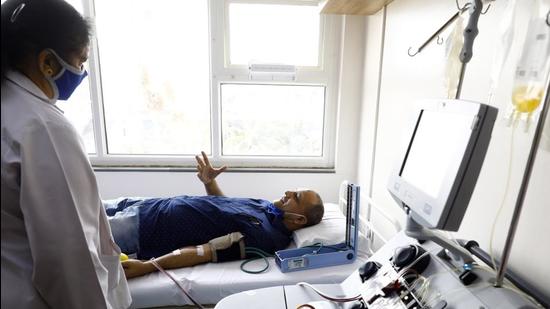
The study titled ‘Convalescent plasma for hospitalized patients with Covid-19: an open-label, randomized controlled trial’ and carried out among 940 patients showed that 33.4% of the participants who received plasma therapy reported serious adverse events like fall in oxygen saturation and respiratory failure as compared to 26.4% in the control group that did not receive the therapy. The proportion of deaths on day 30 was also slightly higher in the people who received plasma therapy — 23% as compared to 20.5% in the control group. But the difference was not significant, according to the study.
Also Read| Convalescent plasma did not stop Covid-19 progression, show NIH trial results
Despite a study by the Indian Council of Medical Research (ICMR) showing that the therapy did not reduce mortality or prevent progression to severe disease as early as September 2020, the therapy continued to be on the national treatment protocol till May 2021 albeit with some restrictions. It was to be used only on those with moderate disease, preferably within seven days of symptom onset, and from a plasma donor with a high concentration of antibodies.
To be sure, in the Canadian study, on an average, the patients received the therapy on day 8 after showing symptoms.
In Delhi, despite the therapy having been dropped from the national treatment protocol, plasma banks that were set up by the state government continue to function. However, they do not actively seek donations anymore.
“The plasma bank is still running. It has benefits only if given on time – it has been used extensively not only in India but in the US as well. None of the studies from India have shown an increase in mortality, even if some of them were doubtful of the benefits. The availability of the therapy has become controlled now, but doctors may prescribe it if they think it will benefit the patient,” said Dr Suresh Kumar, medical director, Lok Nayak hospital where one of the plasma banks are located.
Also Read| Covid: Mandaviya lauds 6 states & UTs for vaccinating all adults with 1st dose
A doctor from the All India Institute of Medical Science, on condition of anonymity, said, “We used to give plasma therapy during the first wave, however, by the second wave we realised that there was no clear-cut benefit of the therapy and stopped giving it. However, the studies we referred to did not talk about any harm from the therapy.”
The ICMR’s PLACID trial conducted across 39 cities in over 400 Covid-19 patients last year showed the therapy did not prevent progression to severe disease or reduce the number of deaths on day 28 of enrolment of patients.


