
 E-Paper



Uttar Pradesh phase 2 polls: Fate of 586 candidates to be sealed today
On Monday, 20 million voters will decide the fate of 586 contestants in the second phase of assembly elections in nine districts comprising 55 assembly constituencies. The Election Commission’s ban on in-person rallies and road shows ended on February 10.

 Prefer HTon Google


The battle for Uttar Pradesh will now shift from the state’s sugarcane bowl to its rice belt in the northwestern part of the state, also known as Rohilkhand.
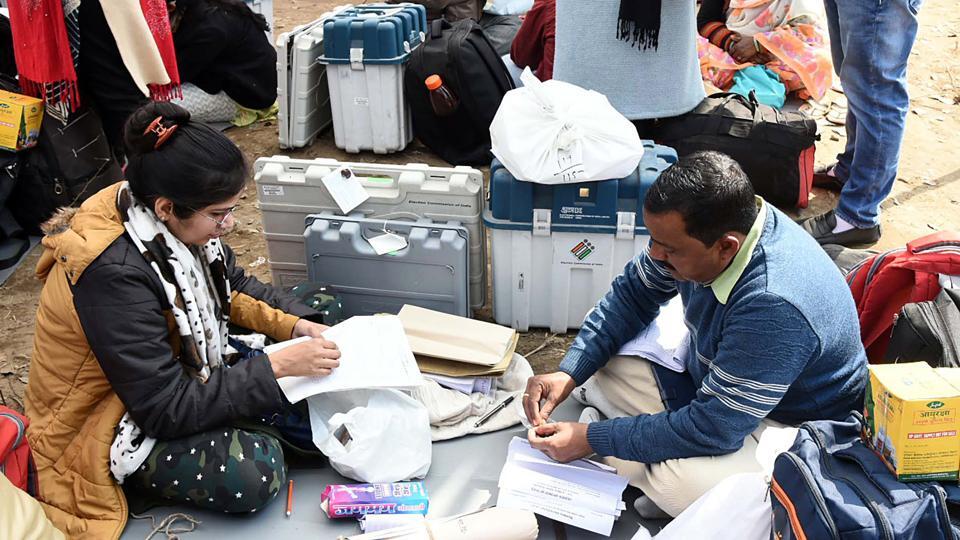
On Monday, 20 million voters will decide the fate of 586 contestants in the second phase of assembly elections in nine districts comprising 55 assembly constituencies. The Election Commission’s ban on in-person rallies and road shows ended on February 10.
Catch latest updates related to assembly elections here
The nine districts going to the polls are Saharanpur, Bijnore, Moradabad, Rampur, Bareilly, Amroha, Sambhal , Badaun and Shahjahanpur, with six of them dominated by a Muslim population ranging between 34.5% and 50% and touching 65-70% in some constituencies.
The other dominant castes include the brahmins and banias, though Jats and Dalits too have a sizeable presence in about a dozen-odd constituencies.
This explains Prime Minister Narendra Modi’s outreach to Muslim women while addressing his first in-person rally in Saharanpur on Thursday, even as the first phase of voting was going on. While remaining silent on the hijab controversy in educational institutions in Karnataka, Modi spoke about the emotive issue of triple talaq, saying his government scrapped it to stop exploitation.
He was appealing to a community which has supported the Bharatiya Janata Party (BJP) in the 2019 general elections in minimal numbers.
The same day, chief minister Yogi Adityanath triggered a debate when he cautioned the voters not to falter in their decision lest the state turn into “another Kerala, Kashmir or West Bengal” -- comments seen to be indicating pandering to Muslims by opponents.
The focus of both leaders remained on law and order while the Samajwadi Party-Rashtriya Lok Dal alliance leaders, Akhilesh Yadav and Jayant Chaudhary, have pitched themselves as sons of farmers and hit out at attempts to polarise society on communal lines with, “it’s a fight between bhaichara (brotherhood) and BJP”.
Also Read | BJP backed by all sections due to issue-based support and PM Modi’s welfare policies: Amit Shah
The region, famous for the wood industry of Saharanpur, brassware of Moradabad, knives of Rampur and cane furniture of Bareilly, had given overwhelming support to the BJP in the 2017 assembly elections, primarily because of fractured vote of the minority community.
The BJP had won 38 of the 55 seats, with SP clinching 15 seats and the Congress winning only two. The Mayawati-led Bahujan Samaj Party had failed to open its account in the region.
This time around, the major opposition parties of the alliance have fielded Muslim candidates on about dozen seats. Political experts believe the decision may work in favour of the BJP.
Though the region is facing multiple issues of law and order, farm law protests, stray cattle (which damage the rice crop and not cane fields), price rise and unemployment, the voting is expected to be more or less on communal and caste lines.
Brahmin leader Jitin Prasada, who switched over to the BJP from the Congress, imprisoned SP leader Azam Khan and Dharmendra Yadav, cousin of SP chief Akhilesh Yadav, will all test their electoral fortunes in this round of polling.
Khan, who is the SP’s candidate from Rampur City, has been in prison since February 2020 and his plea for interim bail to campaign for the polls was rejected by the Supreme Court on February 8. In his absence, his wife and Rampur MLA Tanzeem Fatima have campaigned, aiming to mobilise sympathy votes. Khan’s son Abdullah represents the Suar constituency and is the SP’s candidate for the same seat.
A radical figure, Azam Khan manages Muslim support for the SP and his candidature is likely to play a pivotal role in this phase.
Interestingly, the BJP alliance has also fielded its only Muslim candidate in the state in Suar, with ally Apna Dal fielding Haider Ali against Abdullah.
Jitin Prasada, projected as the Brahmin face of the BJP, was given a cabinet rank to appease a community upset with the state government over promotion of Rajputs by it, though chief minister Yogi Adityanath has strongly rebutted the charge with facts and figures of welfare schemes. Now, Prasada will be expected to deliver in his home district of Shahjahanpur and adjoining areas.
Meanwhile, Dharmendra Yadav will take the SP’s fight to Yadav-dominated Budaun.
Another major focus point for Muslims is the Deoband area, which was won by the BJP in 2017.
Adequate steps have been taken to ensure free, fair and peaceful voting, chief electoral officer Ajay Kumar Shukla said at a media briefing in Lucknow on Sunday. “Voting on 23,404 booths, under 12,544 polling centres, will take place between 7am and 6pm,” he said.


