
 E-Paper



Uttarakhand: At least 9 houses damaged in Srinagar, residents blame rail tunnel blasting
All departments, including RVNL (executing agency of the project), will soon hold discussions to address the issue: Srinagar sub-divisional magistrate

 Prefer HTon Google


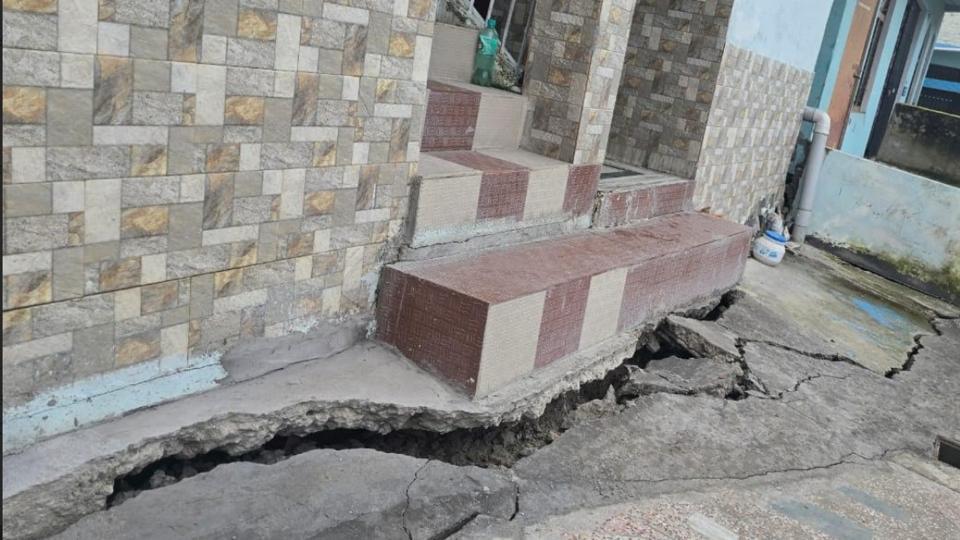
Dehradun: At least nine houses in a locality of Srinagar town in Uttarakhand’s Pauri Garhwal district have developed cracks, with residents blaming the damage on blasting carried out during excavation work for a tunnel for the under-construction Rishikesh–Karnaprayag railway project.
Srinagar sub-divisional magistrate (SDM) Nupur Verma said a meeting of the concerned departments has been convened to find a resolution. “All departments, including RVNL (executing agency of the project), will soon hold discussions to address the issue,” she said.
Vasudev Kandari, a local BJP leader whose house in Teachers’ Colony — barely 200 metres from the tunnel site — was damaged, said, “We could feel vibrations and hear loud blasts. The minor cracks soon widened earlier this month. My house is now completely damaged... the walls have split, the floor has cracked, and even the lintel has bent. We couldn’t sleep at night and eventually had to move to a rented accommodation in the Srinagar market. A railway team did come for inspection, but we want proper rehabilitation.”
“Minor cracks had been appearing for the past one-and-a-half years and worsened last year, though we kept filling them up. We often felt vibrations and heard loud noises. But with the onset of monsoon this year, the cracks began widening and deepening. Last month, the entire courtyard of my house collapsed. I spent around ₹2 lakh to carry out urgent repairs and prevent further damage,” said Rakesh Naithani, another resident.
“But, on September 3, the boundary wall and courtyard of our house collapsed, dislodging the foundation. After that, we had no choice but to shift to a relative’s place in Srikot. We have submitted a memorandum to the local administration demanding rehabilitation, as the damage is beyond repair and the railway project continues to pose a serious threat,” Naithani added.
RVNL’s geologist Vijay Dangwal said, “As soon as we received the information, we visited the site. Residents have expressed apprehensions and alleged that the blasting for our main tunnel passing through Srinagar has caused the cracks. Our experts have inspected the affected area, and if it is established that the damage occurred due to our construction, we will provide full compensation. We do not want the public to suffer because of our project.”
He added that it is yet to be determined whether the railway project was responsible. “The matter will be resolved on the basis of the technical committee’s report,” Dangwal said.
The 125.20 km-long Rishikesh–Karnaprayag railway project will connect Rishikesh in the foothills to Karnaprayag in Chamoli. It will have 35 bridges and 17 tunnels, including a 15.1-km-long tunnel from Devprayag to Lachmoli. Chief minister Pushkar Singh Dhami in January said the first phase of the project is likely to be completed by 2026.
In January, an official at RVNL, requesting anonymity, had told HT, “We have paid compensation for cracks and damages in over 1,500 houses allegedly due to blasting for construction of tunnels in the project. We paid compensation for damages to 601 houses in Pauri Garhwal, 488 in Rudraprayag, 300 in Chamoli, and 150 in Tehri Garhwal on the basis of reports received from the respective district magistrates. As we achieve a breakthrough for tunnels and the blasting process ends, surveys are conducted for damages and the compensation process is initiated.”
In September 2023, Roorkee-based Central Building Research Institute (CBRI) had told HT that they “found issues with the frequency parameter of vibration in the blasting process for tunnelling,” and a detailed investigation is required to understand the effect of blasting on buildings near the tunnels.
“We observed that peak particle velocity in blasting for tunnelling is not the reason for cracks in buildings, but there is some issue with the frequency parameter of the vibration. The way they are measuring the vibration is a bit doubtful. They are putting their sensor on top of loose soil, but it should be on a firm strata. They should dig a one-metre pit and then install the sensor which should touch the ground so that it can properly sense the vibration,” a member of the CBRI team that carried out a ground survey of affected villages said.
“We proposed that we will study the buildings where the tunnelling process is active for a detailed and proper conclusion and will give the remedial measures for strengthening near tunnels where the process of blasting is over,” the CBRI scientist said, adding that “If they don’t go for a detailed study, it could have consequences. Actual things won’t come out if they don’t pursue the detailed study. If courts would intervene, they would have to.”
However, the RVNL said it would have taken approximately three years for a detailed study and decided to directly pay the compensation to the affected people after an assessment.
The Railways has time and again claimed that for the entire project, a geological survey was carried out to ascertain the hazards in advance and mitigation measures. An airborne electromagnetic survey was also carried out by Hyderabad’s National Geophysical Research Institute (NGRI) of the Council of Scientific & Industrial Research (CSIR) to find out the water bodies above the tunnel alignment to preserve groundwater and the environment, it said.
“Tunnelling in the fragile ground is also being executed by adopting controlled blasting — minimum charge per blast, leaving dummy holes all along the profile of the tunnel, and introducing delays to prevent the transmission of ground vibrations around the tunnel, which are much lower than the permissible limits set by the Directorate General of Mines Safety. For underground excavation, where the ground is weak, the excavation is being carried out by mechanical means, ensuring the stability of the tunnel and its surrounding ground,” RVNL senior manager (projects) OP Malguri said.


