
 E-Paper



Uttarakhand rescuers begin work to restart horizontal drilling
Officials maintained that digging horizontally through the debris of the collapsed section of the Silkyara tunnel remains the focus of the rescue mission

 Prefer HTon Google


Rescuers involved in the operation to evacuate 41 workers, who have been trapped inside an under-construction tunnel in Uttarkashi district of Uttarakhand for past 10 days, on Tuesday started welding work on steel pipes in order to restart the horizontal drilling through debris using the US-made auger machine, people familiar with the matter said.
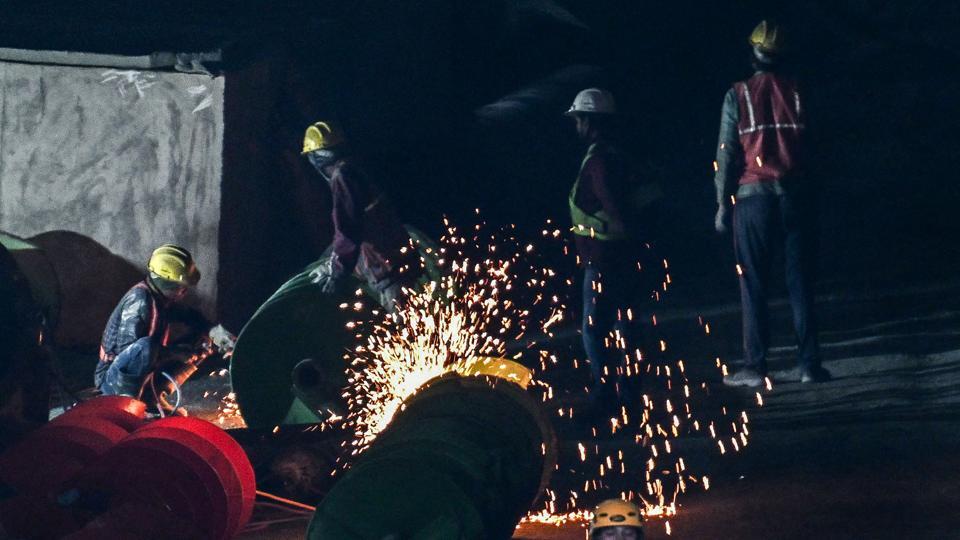
Officials maintained that digging horizontally through the debris of the collapsed section of the Silkyara tunnel remains the focus of the rescue mission, involving various central and state agencies. They added that work on other rescue options, such as drilling vertically from above to reach the trapped workers, was also underway.
“Fabrication of a protective canopy for the drilling machine is underway, with modifications to the augur diameter and welding of the pipeline in progress,” the Union ministry of road transport and highways said in a release.
READ | Uttarakhand tunnel collapse: What are the 5 plans to evacuate trapped workers?
The horizontal drilling work was halted since Friday as the bearings of the US-made auger machine got damaged after drilling 22 metres through the debris. The heavy-duty machine also encountered a hard boulder, forcing officials to think of other options amid deaf of more boulders falling.
“To fit the 900-mm [diameter] pipes with 800-mm pipes and push them through the rubble to create passage for the trapped workers using the auger machine, the welding work is underway,” Uttarkashi district disaster management officer (DDMO) Devendra Patwal said. “For the safety of the workers and machines involved in the rescue operation, we have taken several measures.”
A portion of the 4.5-km-long tunnel being built between Silkyara and Dandalgaon on the Brahmakhal-Yamunotri National Highway — part of the Char Dham all-weather road project — caved in around 9.30 am on November 12 following a landslide, trapping 41 workers inside. The collapsed section is 270 metres from the mouth of the tunnel from the Silkyara side.
READ | Rescuers release video of workers trapped in Uttarakhand tunnel via endoscopic camera
On Tuesday, a video clip captured by an endoscopic camera sent in through a new six-inch wide pipeline brought much-needed hope to relatives of the trapped workers.
The horizontal drilling option involves inserting 800mm- and 900-mm diameter steel pipes as the machine drills through. The workers can then crawl out of the pipeline.
A technician from Trenchless Engineering Services Private Limited (TESPL), the firm that provided the auger machine, said they have begun the welding process for the drilling process. “Four pipes, each measuring 6 metres in length, are already inside. The welding process for the fifth pipe is underway,” he said, requesting anonymity.
Officials familiar with the matter said that a new set of bearings of the auger machine has been brought from Mumbai to set the machine in action. “The SJVNL [public sector undertaking] has also provided two fast welding machines to increase the pace of the overall drilling process,” one of the officials said, also declining to be named.
READ | Uttarakhand tunnel collapse: Trapped 41 workers suggested to walk, do yoga, and talk to each other
Meanwhile, SJVNL’s machine for vertical rescue tunnel construction arrived at the site on Tuesday and its installation was underway.
The “second-best” rescue option involves drilling more than 80 metres vertically from above the tunnel to reach the two-kilometre built-up stretch where the workers are now confined.
Drilling from the tunnel’s Balkot end is another alternative on which the rescue agencies are working, officials said. Drilling parallel tunnels is also being considered.
Explaining the options, Bhupendra Singh, RVNL (Rail Vikas Nigam Limited) official who is involved in rescue operation, said: “The SJVNL will vertically drill 1.2 metre to the depth of 85-90 metres to rescue the trapped men at 320 metres of the tunnel. Approach road for this has been made. Work on this will begin tomorrow (Wednesday). We (RVNL) will horizontally drill 1.2 metres to the depth of 168-170 from side using micro tunneling method. It will meet the tunnel at 280-300 metres of the tunnel. It will act as live-saving tunnel and emergency escape in the future.”
He added: “The Tehri Hydroelectric Development Corporation (THDC) will construct a small-diameter rescue tunnel from Barkot end using the conventional method (drill and blast method). ONGC will do a vertical hole at the end portion of the 2-km stretch where workers are trapped. The NHIDCL will try to drill through the debris using the auger machine from the Silkyara side. They have already penetrated through 22 metres of debris.”


