Very difficult year for G20, says Sitharaman, lays out priorities
Acknowledging that Indonesia has gone through a “very difficult presidency” of the G20 this year and the group failed to come up with a communique at its recent meetings due to persistent differences, Finance Minister Nirmala Sitharaman has said that India’s presidency will be marked by challenges but it will work with the membership to navigate the situation.
Acknowledging that Indonesia has gone through a “very difficult presidency” of the G20 this year and the group failed to come up with a communique at its recent meetings due to persistent differences, Finance Minister Nirmala Sitharaman has said that India’s presidency will be marked by challenges but it will work with the membership to navigate the situation.
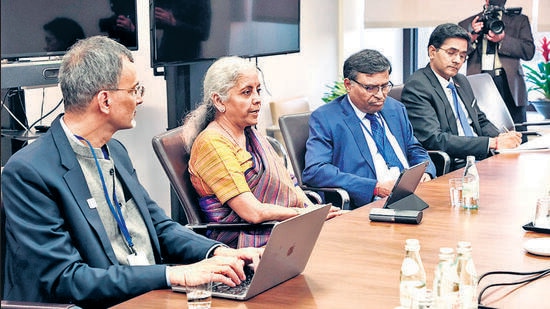
Finance minister Nirmala Sitharaman at a meeting on the sidelines of International Monetary Fund - World Bank Group Annual Meetings 2022, in Washington DC on Friday.
At a press conference on Saturday in Washington DC, Sitharaman said that G20 members have expressed full support for India’s presidency. She also provided a sense of India’s priorities during its presidency. These will include strengthening multilateral development banks, working on debt resolution frameworks, pushing climate finance, and designing new crypto regulations.
Sitharaman has been in DC over the past week, where she attended the G20 finance ministers and central bank governors (G20 FMCBG) meeting, participated in several other interactions with her G20 counterparts, and engaged with many G20 members on a bilateral basis.
In response to a question by HT on G20s’s challenges and priorities as geopolitical tensions rise, Sitharaman said, “We have had discussions bilaterally with very many G20 members and also during the G20 meetings itself. The concern about this whole year when Indonesia had gone through a very difficult presidency in that even in this meeting, none of the meetings, be it the DC (development committee) or G20 FMCBG, couldn’t come up with a communique at all. All of them have ended coming up with a chair statement.”
The FM acknowledged the work of all delegations for their work to arrive at a statement, but indicated that even then, contentious issues had meant a communique was not possible at all. “Very difficult year,” she said.
But Sitharaman credited Indonesia for its leadership. “Indonesia has done its best. They have remained calm and also attempted to get everybody on board for every decision. We will also be taking the presidentship at a time when there are so many challenges. So we will have to work together with the membership to see how we can best navigate this whole thing.”
To another question on India’s priorities at G20 and support of other members, Sitharaman said she hosted a breakfast meeting for her G20 counterparts. “There was a very positive and cooperative mood. Unhesitatingly, I found all of them extending cooperation and saying India’s year as president should take up issues and we are here to support and cooperate with you.”
While not laying out the agenda in great detail, India listed out four broad areas in which it would be interested.
Sitharaman said, “We will certainly want G20 members to discuss how multilateral development banks (MDBs) can better leverage the endowment they have, also think in terms of getting other sources through which their finances can improve. One, they have to be more nimble in reaching out for development funding and two, they have to better effectively deploy the resources they have. That will certainly be one of the things that we will be working out. How that becomes an agenda point and how we will tailor it is subject to taking inputs from everybody”.
The second item, Sitharaman said, was examining the debt situation. “I know solutions were arrived at during the pandemic – the DSSI (Debt Service Suspension Initiative). That period is gone. But now the vulnerabilities of more countries are coming up. Many middle-income countries are at risk.” She said that the common framework (a mechanism that considers debt issues on a case by case basis) had not delivered as much as expected and this would be one issue India wanted membership to discuss and have some kind of outcome. “That is urgently required.”
The FM, separately, had also there were “inherent handicaps” in the common framework and there was a “collective agreement” to make it more nimble. But she said she did not want to get into particular disagreements because that was a part of the whole process of negotiations. India, she said, had made its concerns with some elements of the framework clear last week and had succeeded in getting its point of view across and incorporated in the current text. India opposed OECD’s inclusive forum on carbon mitigation meant to take stock and compare: India had inputs on the capital adequacy framework; and India was wary of conditionalities on private finance on climate. India’s concerns are reflected in the current text, the FM said.
Listing out the third priority item of its G20 presidency, she said India will talk about climate finance. Sitharaman said India believed that a large part of this debate should be within the United Nations Framework Convention on Climate Change (UNFCCC). “So the environment-related issues should emanate from there. But certainly, there will be a role for multilateral bodies.”
India will also work on crypto regulations. Sitharaman said that many institutions associated with G20, or World Bank or International Monetary Fund, were doing their own studies of matters related to crypto assets. “We would definitely want to collate all this, do a bit of study and bring it on to the table of G20 so that members can discuss it, and hopefully arrive at a framework or SOP so that globally, countries can have a technologically driven regulatory framework.”
She said this was derived from the assumption that not one country can effectively regulate crypto in any form.
But implicit in this, Sitharaman said, was that they wanted the technology to survive. “We want tech to survive and be in a position for fintech and other sectors to benefit from it. But if it is a question of platforms, trading on assets which have been created, buying and selling, making profits, and more importantly, are countries are in a position to understand the money trail? Are we in a position to understand for what purposes it is being used? Recent experience in India is we detected substantial money laundering, cases related to crypto assets and trading of assets.” The FM said these concerns had been acknowledged by several G20 members. She said there was an understanding there was a need for some kind of regulation and all countries had to work on it.
Prashant Jha is the Washington DC-based US correspondent of Hindustan Times. He is also the editor of HT Premium. Jha has earlier served as editor-views and national political editor/bureau chief of the paper. He is the author of How the BJP Wins: Inside India's Greatest Election Machine and Battles of the New Republic: A Contemporary History of Nepal.Read More

 E-Paper