
 E-Paper



Viewing human rights with political lens harmful: PM Modi
The PM further asserted that human rights should not be seen separately from duties. “Human rights are not just about rights, but our duties as well. Both are linked and are necessary for human development.”


Prime Minister Narendra Modi on Tuesday said that some people viewed human rights through a political lens, adding that this selective behaviour is harmful for democracy.
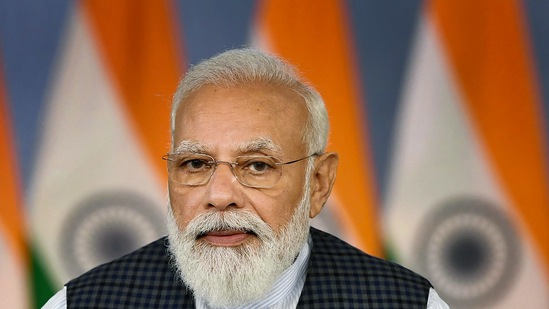
Speaking virtually at the 28th foundation day ceremony of the National Human Rights Commission (NHRC), Modi said: “There is an aspect of human rights which I want to talk about today. In recent years, some people have started interpreting human rights in a way that benefits them. They see violation of human rights in one incident while they don’t see any violation in other, similar incidents. Such mentality also harms the very concept of human rights.”
He added that human rights are grossly violated when they are seen through a political lens. “This selective behaviour is equally damaging for the democracy,” he said.
Modi also drew an analogy between human rights and India’s independence movement, saying that the respect for human rights in the country is largely due to the long freedom struggle that the nation went through. “We fought for our rights across centuries and, as a country and society, always protested against injustice and tyranny,” PM Modi remarked.
India, he said, has always been “committed and sensitive” towards issues concerning human rights.
The PM further asserted that human rights should not be seen separately from duties. “Human rights are not just about rights, but our duties as well. Both are linked and are necessary for human development.”
Modi’s comments come against the backdrop of domestic and international organisations criticising his government’s human rights record, although both the government and the Bharatiya Janata Party (BJP) have maintained that localised crimes are unnecessarily being politicised and that similar instances in states governed by parties other than the BJP are ignored.
This view was reinforced at the meeting on Tuesday by the NHRC chief, justice Arun Mishra, who said “it is now a norm to accuse India of human rights violation at the behest of international forces”.
Echoing this sentiment, BJP spokesperson Sambit Patra later said that a lot of politics is happening around the Lakhimpur Kheri incident where eight people, including four farmers, died. He specifically named Rahul Gadhi and Priyanka Gandhi Vadra of the Congress, who, he said, were trying to project themselves as “champions of Dalits”. Yet, the incident of a young Dalit man in Rajasthan (ruled by the Congress) beaten to death a few days ago has gone uninvestigated and unnoticed, he said.
“If Priyanka Gandhi and Rahul Gandhi go to Hathras or Lakhimpur Kheri, why have they not gone to Kashmir, they will ask. The question why Modi went neither to Hathras and Lakhimpur nor Kashmir, doesn’t occur to them,” Congress spokesperson Pawan Khera said.
Talking about the steps taken by the government to eliminate injustice from the society, Modi said that ‘Sabka Saath, Sabka Vikas’ works on the basic principle of ensuring human rights for all.
Delivering basic needs like toilets, cooking gas, electricity and homes to the poor give rise to their aspirations and make them more aware of their rights, the PM said. Similarly, he said, by bringing the Triple Talaq law, his government ensured rights for Muslim women.
“India is committed and sensitive towards ensuring human rights,” he said.
Speaking at the NHRC meeting, home minister Amit Shah said his government has been working for the welfare of the poor and underprivileged, thereby ensuring their human rights.
Shah said that after the Narendra Modi government came to power, toilets were built in 100 million households, protecting the basic human rights, especially of women. Another 40 million households received electricity connections, and 130 million, cooking gas connections.
The home minister also lauded the work NHRC has done. He said the commission has handled 2 million cases and awarded ₹205 crore as compensation to people for violation of human rights in its 28 years of existence.
NHRC is a statutory body that was constituted on October 12, 1993, under the Protection of Human Rights Act. It takes cognisance of human rights violations, conducts enquiries and recommends compensation to victims from public authorities besides other remedial and legal measures against the erring public servants.


