
 E-Paper



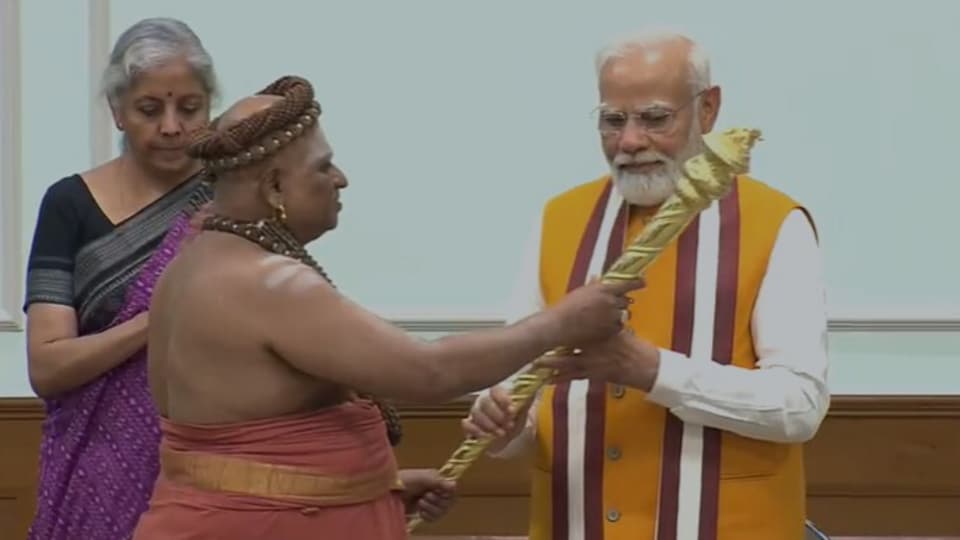
What is ‘Sengol’, whose installation in new Parliament triggered row?
The Sengol, a 5 foot long sceptre, has become the centre of a battle of words between the government and the opposition.

 Prefer HTon Google


As President Droupadi Murmu entered to address both houses of parliament for the first time in the 18th Lok Sabha, she was led in by a golden, 5 feet long sceptre - the Sengol.
Samajwadi party MP RK Chaudhary in a letter to Speaker Om Birla remarked that the Sengol should be replaced with a copy of the Constitution of India.
According to news agency ANI, Chaudhary said, “The Constitution is the symbol of democracy. Will the country be run by 'Raja ka danda' or the Constitution? I demand that Sengol be removed from Parliament to save the Constitution.”
BJP spokesperson Shehzad Poonawalla fired back, questioning why Nehru accepted the Sengol if it was so objectionable in the first place. "This shows the mindset of the Samajwadi Party. First, they attack and abuse Ramcharitmanas, now Sengol, which is part of Indian and Tamil culture,” Poonawalla told ANI.
What is the sengol?
The word Sengol - derives from the Tamil word 'Semmai', which means righteousness. The silver and gold plated sceptre is 5 feet long, with an orb at the top that features a bull. According to India's Press Information Bureau, the bull is Nandi - the vehicle of the Hindu god Shiva, and is meant to symbolise justice.
The Sengol was built by Vummidi Ethirajulu and Vummidi Sudhakar, and manufactured by Vummidi Bangaru Chetty Jewellers in 1947 to be gifted to Jawaharlal Nehru.
Read more: ‘Very nostalgic’: Makers of historic 'Sengol' on its installation in new Parliament
According to the government, C Rajagopalachari, the last Governor-General of India, reached out to Thiruvaduthurai Atheenam, a Tamil monastery, to create the Sengol, which would be offered to Nehru on the day of India's Independence, in imitation of a Chola dynasty ritual, where transfer of power was marked by a symbol passing from one ‘ruler’ to the next.
Union Home Minister Amit Shah said, “It was precisely the moment in which power was transferred by the British into the hands of Indians. What we are celebrating as independence is actually marked by the very moment of handing over the 'Sengol'.”
After the ceremony, it was kept in the Nehru Gallery of the Allahabad Museum, where it was labelled as ‘ Golden Walking stick gifted to Pandit Jawaharlal Nehru.’
The revival of the Sengol
The sengol did not grab much attention until it was brought back to limelight by Prime Minister Modi who sought to adopt it as a symbol for the new parliament's inauguration on May 28, 2023.
The prime minister was presented with the sceptre in the presence of 20 Hindu priests conducting the ritual, in celebration of 75 years of Independence.
The ceremony was seen by many in the opposition as a step away from the secular fabric of Indian parliament. Dravida Munnetra Kazhagam (DMK) leader TKS Elangovan had called it a symbol of ‘monarchy, not democracy’, according to ANI.
The Sengol is now permanently installed at the Lok Sabha speaker's seat and will be brought out during special events, such as on Thursday, when President Murmu's delivered her first address to parliament at the start of a new term.
Divided opinions on the Sengol
Even when the Sengol was first presented to President Nehru, there were qualms about whether the sceptre was a symbol that emphasised Indian freedom or diminished it.
According to the Wire, an archival article written in Dravida Nadu by CN Annadurai of the DMK in 1947, showed that the Tamil leader disagreed with the use of the Sengol in a democracy. In the article he addressed Nehru and said, “You are also aware of the historical necessity that for democracy – people’s rule – to flourish, these elements must be eliminated.”
Further, the government claimed that the sceptre was a symbol of transfer of power from Lord Mountbatten, standing in for the British , to Nehru, standing in for India - for which no official source of information is available to verify.
According to Union Home Minister Amit Shah, the Sengol is merely an attempt to link India's cultural traditions, specifically Tamil traditions with a modern parliament. "We want the administration to run by the rule of law, and this will always remind us of that," he said.


