
 E-Paper



Who is Mirza Shadab Baig, missing Mujahideen operative linked to Delhi blast?
Mirza Shadab Baig has remained missing since September 19, 2008, the day of the Batla House encounter.

 Prefer HTon Google


Mirza Shadab Baig, an Indian Mujahideen operative missing since 2008, is back on the radar after investigators found fresh links between him and the Delhi Red Fort blast case.
Officials say the newly uncovered Jaish-e-Mohammed “white collar module” has also brought back the spectre of the Azamgarh IM network that surfaced during the 2008 Batla House encounter.
Baig, originally from Azamgarh and considered a key recruiter, studied at the Al-Falah School of Engineering and Technology. He earned a BTech in electronics and instrumentation in 2007 and vanished soon after, travelling on his genuine passport, a senior ATS official confirmed, HT earlier reported.
He has remained missing since September 19, 2008, the day of the Batla House encounter, an official added.
Also Read | Explosives specialist, Al-Falah links: Delhi blast case puts focus on Indian Mujahideen fugitive Baig
1 lakh reward, wanted in multiple blast cases
The official added that Baig carries a ₹1 lakh reward and was wanted in multiple bombings: the 2008 Jaipur serial blasts, the Ahmedabad-Surat bombings and the 2007 Gorakhpur explosions.
The Jaipur bombings in 2008 involved nine blasts within 15 minutes across different locations in the Rajasthan capital. Official reports recorded 63 deaths and more than 216 injuries.
Mirza Shadab Baig was accused of procuring explosives and aiding IM modules.
“According to intelligence reports, Baig acted as an explosives specialist, sourcing detonators and ball bearings from Udupi (Karnataka) for the Jaipur attack and assisting IM founders Riyaz and Yasin Bhatkal. In the Gujarat blasts, he led reconnaissance, prepared explosives and trained recruits. UP Police earlier attached his properties after his name surfaced in the 2007 Gorakhpur serial blasts. Baig was reportedly last traced to Afghanistan in 2019,” the official emphasized.
Al-Falah under scrutiny
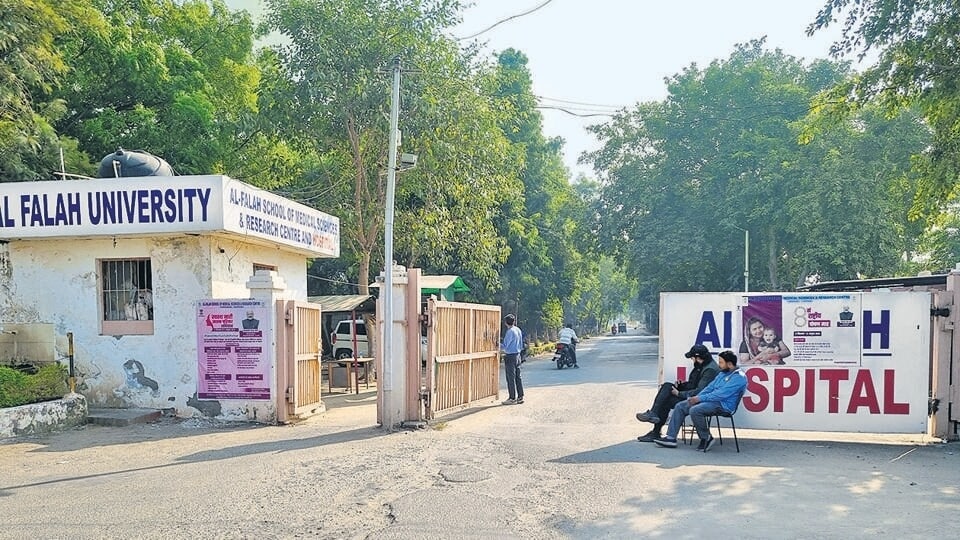
Haryana’s Al-Falah in Faridabad allegedly ties both the modules together.
Al-Falah is under the scanner after multiple operatives linked to the November 10 Delhi blast were found to have been a part of the institution’s medical college.
The pattern points to a years-long link between UP-based operatives and the Al-Falah ecosystem, suggesting a possible recruitment or “radicalisation pipeline” stretching nearly two decades.
“Besides, the arrested suspect Dr Muzammil Shakeel, an alumnus who allegedly travelled to Afghanistan for terror training, has brought the institution under nationwide scrutiny. Another suspect, Dr Shaheen Saeed, arrested in the Delhi blast case, was also part of the medical faculty,” he explained.
2007-8 blasts and current blast could be linked
“The links between the 2007–08 blasts and the current module cannot be ruled out,” said a senior UP-based officer.
With strong connections to Uttar Pradesh resurfacing, from Azamgarh to Gorakhpur and fresh leads emerging from Lucknow, agencies are examining whether the university was systematically exploited by terror operatives.
The alleged trail now spans Uttar Pradesh, Haryana, Delhi, Karnataka and Afghanistan, and officials say deeper linkages could emerge as the investigation widens.


