
 E-Paper



Why cloud seeding trials didn't work in Delhi? IIT Kanpur Director explains
The cloud seeding trials were conducted in the national capital using a Cessna aircraft fitted with salt-based and silver iodide flares to induce rain.

 Prefer HTon Google


The Delhi government conducted two cloud seeding trials on Tuesday to induce artificial rain in the capital as part of measures to curb deteriorating pollution levels.
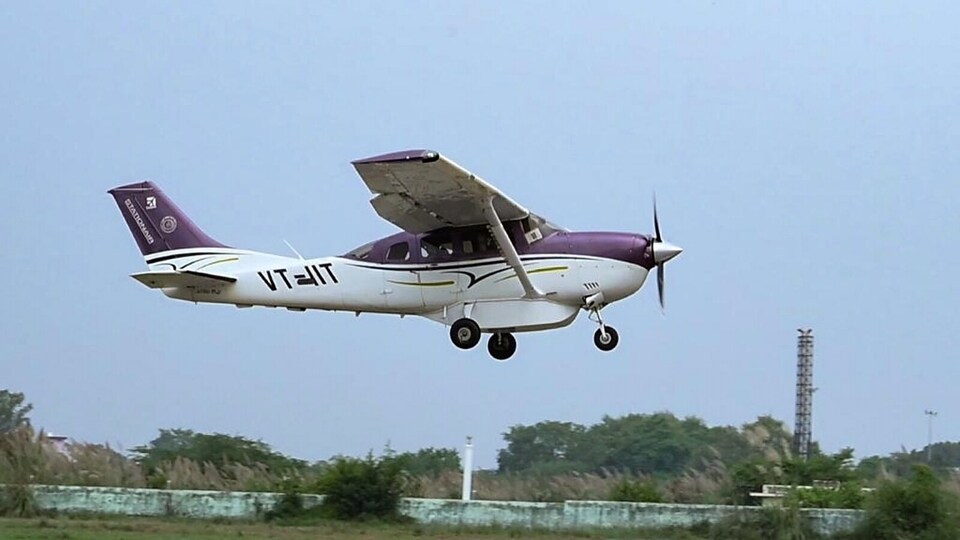
However, the two sorties from Kanpur and Meerut failed to induce rain as of Tuesday evening.
Manindra Agrawal, Director of IIT Kanpur, said the trials were "not completely successful" as the flares fired from the aircraft failed to produce any rain.
Also Read | Cloud-seeding fails to induce rain in Delhi, precipitates political row
"We did two sorties, one in the afternoon and one slightly later in the evening. A total of, I believe, 14 flares were fired...These were fired, and the aircraft returned to Meerut. There hasn't been any rains so far. So, in that sense, it is not completely successful," Manindra Agrawal told NDTV.
The trials were conducted in the national capital using a Cessna aircraft fitted with salt-based and silver iodide flares to induce rain. A similar trial was also conducted last week over Burari.
Delhi Minister Manjinder Singh Sirsa said two trials were conducted on Tuesday, and the areas of the outer regions of the capital were covered.
"Two cloud seeding trials were conducted in Delhi today, this was the third overall. The first took off from Kanpur this morning, and the second from Meerut. Today’s trial covered areas in outer Delhi... So far, this has been a historic trial," the minister said.
He said the areas covered during the trials are Khekra, Burari, North Karol Bagh, and Mayur Vihar. He further said that eight flares, each weighing between 2 and 2.5 kilograms, were used during the process.
Why cloud seeding trials didn't work?
A Delhi government report on the cloud seeding trials reasoned that the moisture content predicted by IMD was low, at around 10-15 per cent, which is not ideal for cloud seeding.
Manindra Agrawal echoed similar concerns and said that though the capital had decent cloud cover, the moisture content was not sufficient to induce rain.
Also Read: Delhi cloud-seeding trials helped reduce particulate matter, says govt report
"The clouds that are present today do not have very high moisture content. I was told that it was only 15-20%. So, the possibility of causing rain with such low moisture content is not very high," Agarwal told NDTV.
The IIT Director has suggested that the third round of trials is likely to be conducted on Wednesday.
"We hope that at least this trial has given more confidence to our team that we can continue conducting these trials. We will again try tomorrow," he added.
How cloud seeding helped in reducing pollution
The Delhi government report released on Tuesday evening said that the cloud seeding trials helped reduce particulate matter at targeted locations.
Also Read: Watch | Aircraft takes off from Kanpur for cloud seeding over parts of Delhi
The report also said that two precipitation events were recorded -- Noida at 4 pm (0.1 mm of rain) and Greater Noida at 4 pm (0.2 mm). It further said that particulate matter PM2.5 and PM10 were directly impacted after cloud seeding.
"The PM2.5 was 221, 230 and 229 reported from Mayur Vihar, Karol Bagh and Burari respectively before cloud seeding, which reduced to 207, 206 and 203 respectively after the first seeding. Similarly, PM10 was 207, 206 and 209, which got reduced to 177, 163 and 177 at Mayur Vihar, Karol Bagh and Burari respectively," the report said, according to PTI.
The first trial started after the Cessna plane took off from IIT Kanpur airstrip at 12.13 pm and covered Khekra, Burari, North Karol Bagh, Mayur Vihar, Sadakpur and Bhojpur.
The second seeding sortie was conducted from Meerut airstrip, carrying four kilograms of seeding material and covered Khekra, Burari, Mayur Vihar, Pavi Sadakpur, Noida, Bhojpur, Modinagar and Meerut.


