
 E-Paper



Why Constitution bench case is key for future of property rights
Supreme Court's nine-judge bench deliberates on State's authority to acquire private property in public interest, amid political discourse.

 Prefer HTon Google


A nine-judge constitution bench of the Supreme Court is currently deliberating on a crucial issue concerning the State’s authority to acquire privately owned property of citizens, as outlined in Article 39(b) of the Constitution, in the interest of the greater common good.
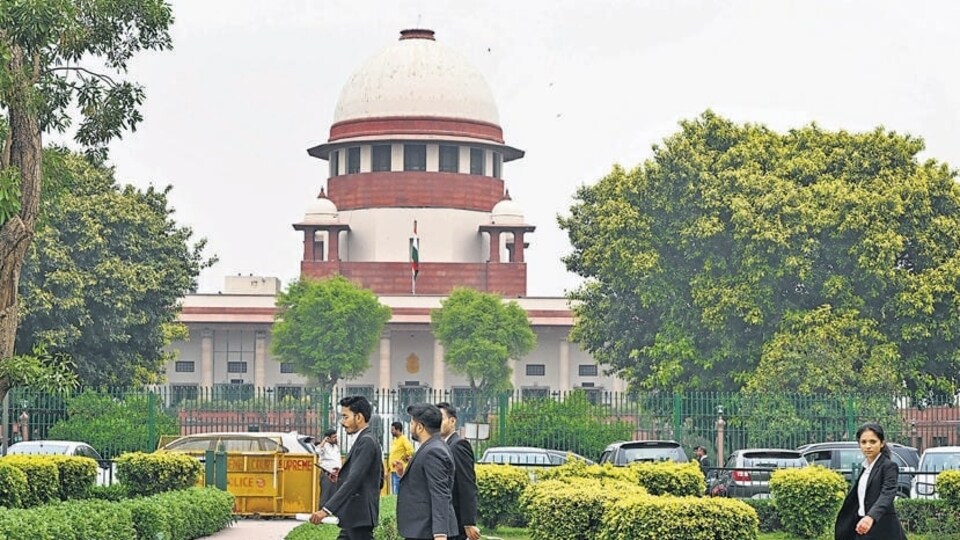
This matter has been pending before the apex court since 1992, when the first batch of cases was filed. Over the years, it has traversed through different benches, progressing from a five-judge bench to a seven-judge bench before reaching the present nine-judge bench. However, it has recently garnered heightened attention, particularly in an election year, following a significant political discourse.
The catalyst for this renewed focus was a speech by Prime Minister Narendra Modi on April 21, wherein he accused the Congress party of advocating redistribution of common citizens’ wealth if elected to power. This assertion was based on an earlier address by Congress leader Rahul Gandhi on April 20, where he proposed conducting a comprehensive caste survey to determine the demographics and socio-economic status of various communities, including backward classes, SCs, STs, minorities, and others. Gandhi further outlined plans for subsequent distribution of wealth, job opportunities, and welfare schemes based on these findings.
While these political statements may seem disconnected from the ongoing legal proceedings, they have spurred public interest in the case being heard by the Supreme Court. Understanding the complexities of the issues under consideration, the associated controversies, and the diverse perspectives of stakeholders is essential to grasp the significance of this matter.
Understanding Article 39(b)
At the heart of the current controversy lies the interpretation of Article 39(b) of the Constitution. It is one of the directive principles of state policy (DPSP) which says, “the State shall direct its policy towards securing that the ownership and control of the material resources of the community are so distributed as best to subserve the common good.”
Article 39(b) has existed from the time the Constitution came to be enacted. At that time, the right to property was a fundamental right under Article 19(1)(f). The right to property came to be deleted as a fundamental right by the Constitution (Forty-fourth Amendment) Act, 1978, and a modified version of this right was inserted in Article 300A which says that “no person shall be deprived of his property save by authority of law.”
The nine-judge bench headed by chief justice of India (CJI) Dhananjaya Y Chandrachud, which is currently hearing the matter, has to determine whether the classification “material resources of community” includes private property within its fold.
It is not the first time that the top court has been called upon to decide this issue. But the uncertainty in law has arisen due to a contentious interpretation by a seven-judge bench in State of Karnataka v Ranganatha Reddy (1977) that considered the application of Article 39(b) in the context of nationalisation of contract carriages. The majority view of four judges did not favour private property to fall under Article 39(b). However, the minority view pronounced by justice VR Krishna Iyer held to the contrary.
Justice Iyer said: “Material resources of the community in the context of reordering the national economy embraces all the national wealth, not merely natural resources, all the private and public sources of meeting material needs, not merely public possessions...To exclude ownership of private resources from the coils of Article 39(b) is to cipherise its very purpose of redistribution the socialist way.”
This minority view became the basis of a five-judge bench in Sanjeev Coke case (1982), where the issue of Article 39(b) arose in the context of nationalisation of coke oven plants and private property was held to be part of material resources of community. Later, in 1997 a nine-judge bench in Mafatlal Industries case underscored this conclusion when it said, “the material resources of the community are not confined to public resources but include all resources, natural and man-made, public and private owned.”
To be sure, the laws relating to Article 39(b) that have travelled in the past to the top court have related to natural or public resources such as land, mines, forest, electricity, coke oven plants, sick textile industry, contract carriages, excise duty, natural gas, etc. However, this is perhaps the first time the court has been confronted with an issue on housing and building belonging to urban landlords, considered so germane to private citizens, in the present challenge under Article 39(b) heard by the nine judges.
The present controversy
The present bench of nine judges, also including justices Hrishikesh Roy, BV Nagarathna, Sudhanshu Dhulia, JB Pardiwala, Manoj Misra, Rajesh Bindal, SC Sharma and Augustine George Masih, has been called upon to reconcile the various judicial dictums on this question.
The occasion for the court to consider this issue has arisen in a challenge by property owners association of Mumbai to Chapter VIII-A of the Maharashtra Housing and Area Development Authority (MHADA) Act, introduced in 1986, which allows the state to acquire Mumbai’s old, dilapidated buildings termed as “cessed properties” in favour of cooperative societies of occupiers. This amendment contained a declaration that the Act seeks to give effect to the state policy for securing the objective specified in Article 39(b) of the Constitution.
The state has claimed that “housing stock” is a material resource of the community and the reconstruction of the building is for the common good as the old buildings are unsafe. The MHAD authority is also before the court and has argued that the owners of the buildings have refused to effect repairs on account of the freezing of rents from September 1, 1940, due to which they get very little rent which is less than the taxes they have to pay on these properties.
However, the property owners have opposed the state’s move by arguing that Article 39(b) cannot envisage private-owned property. They have even challenged the Maharashtra Rent Control Act for fixing abysmally low standard rent.
What falls for the consideration before the nine judges can be gauged from the two reference orders in this case by which the matter was first sent by a five-judge bench to seven judges in 2001, and subsequently to a nine-judge bench in February 2002.
The order referring the matter to seven judges was passed by a bench of five judges that said: “We are of the opinion that the views expressed in Sanjeev Coke case (19830 require reconsideration. Keeping in view the importance of the point in issue, namely, the interpretation of Article 39(b), it will be appropriate if these cases are heard by a larger bench of not less than seven judges.” While passing this order, the court was conscious that Sanjeev Coke case relied on the minority view penned by justice Iyer in the Ranganatha Reddy case.
Before the seven-judge bench, a similar issue arose as the Centre and Maharashtra government cited the Mafatlal case decided by a bench of nine-judges. The order sending the matter to nine judges said: “Having given due consideration, we are of the opinion that this interpretation of Article 39(b) requires to be reconsidered by a bench of nine judges; we have some difficulty in sharing the broad view that material resources of the community under Article 39(b) covers what is privately owned.”
The arguments by the property owners and other intervenors have concluded and the Attorney general R Venkataramani appearing for MHADA has argued that 39(b) should be given the widest possible meaning to include private property as well. Solicitor general Tushar Mehta, appearing for Maharashtra, is yet to make submissions. In his written submission, the S-G said: “The only issue before the present bench is whether the phrase “material resources of the community” under Article 39(b) covers what is privately owned.”
A related issue of Article 31C
While the reference order in the Maharashtra matter only seeks to settle the judicial dichotomy on Article 39(b), a related issue has arisen in the present proceedings with the bench willing to go into a related aspect of Article 31C of the Constitution.
This provision was introduced by the Constitution (Twenty-fifth Amendment) Act, 1971, giving a “safe harbour” or protective umbrella to any law giving effect to the policy of the state towards securing the principles of Article 39(b) and 39(c) if it is inconsistent with or takes away any rights conferred by Articles 14 and 19 relating to equality and fundamental freedoms.
The core protection of this provision was upheld by the 13-judge bench landmark decision in Kesavananda Bharati case (1973), famous for laying down the basic structure doctrine. The court had untouched 31C protection to laws furthering the objective of Article 39(b) but struck down that part which barred judicial review of such laws.
Later, by the Constitution (Forty-second Amendment) Act, 1976, the scope of protection offered under Article 31C was extended not only to Articles 39(b) and (c), but all directive principles of state policy (DPSP), meaning thereby that any law based on DPSP violating Articles 14 and 19 could not be challenged in courts.
In July 1980, a five-judge bench in Minerva Mills case, deciding a challenge to the Constitution (42nd Amendment) Act, 1976 struck down the amendments to Article 31C on the ground that it violates basic structure. The judgment even cast a shadow on whether the unamended 31C, as upheld by the Kesavananda Bharti decision, will continue to operate.
On the day when the operative portion in Minerva Mills case was pronounced on May 9, 1980, the same day, another five-judge bench pronounced its operative judgment in Waman Rao case which dealt with a challenge to the Maharashtra Agricultural Lands (Ceiling and Holding) Act, 1961 that enjoyed the protection under the unamended 31C (as it existed prior to the 1976 amendment) and Article 31A.
The detailed judgment in Waman Rao came in November 1980 when the bench held the unamended 31C to be valid, making clear that Minerva case was limited to the Constitution (42nd Amendment) Act, 1976. The bench in Waman Rao said, “If we are right in upholding the validity of Article 31-A on its own merits, it must follow logically that the unamended Article 31C is also valid.”
Since this decision came after Minerva judgment, the judges distinguished the two cases and said that the “unamended portion of Article 31C is not like an unchartered sea” as it gives protection to a limited category of laws giving effect to clause (b) and (c) of Article 39. “These clauses of Article 39 contain directive principles which are vital to the well-being of the country and welfare of its people,” it held.
The present nine-judge bench has to decide whether the unamended 31C continues to exist as argued by Maharashtra or the Minerva judgment has rendered it a “dead letter” as the property owners claim it to be.
In light of recent political statements suggesting the redistribution of wealth and resources, the Constitution bench’s scrutiny of this issue gains more relevance. The court’s interpretation is set to serve as a crucial guideline for achieving the delicate balance between individual property rights and the state’s responsibility towards achieving socioeconomic justice.


