
 E-Paper



What's Tamil Nadu doing in Mumbai poll mix? Raj Thackeray recycles 'lungi' jibe from Shiv Sena history
Annamalai's name twisted by Raj Thackeray to ‘rasmalai’ over his remark that Mumbai is global city, not just of Maharashtra; he hits back

 Prefer HTon Google


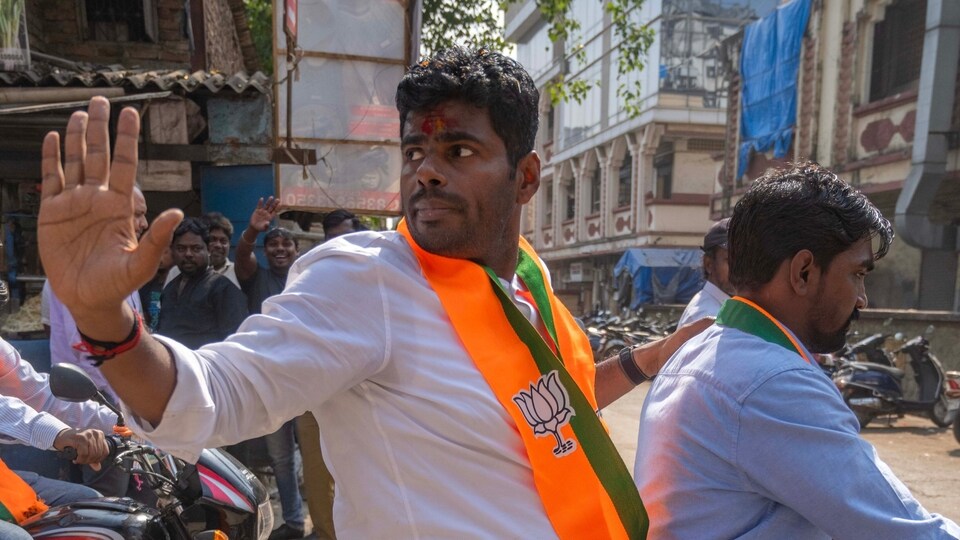
BJP leader K Annamalai from Tamil Nadu has landed squarely in the middle of election rhetoric in Mumbai, where the municipal election campaigns have turned into a contest over who's a true citizen and who's an outsider to India's financial capital.
Follow | Live updates on the BMC election
Shiv Sena (UBT) leader Aaditya Thackeray said on Monday that Annamalai's statements show his party "only wants to insult and loot" Mumbai and Maharashtra. “Annamalai is the face of the BJP, which is ‘zero’. He could not win there (in Tamil Nadu) and save his own deposit,” Aaditya Thackeray told reporters, as per news agency ANI.
“It was shown that the next PM will be him only; but actually, they are a zero, which is what Tamil Nadu has shown,” he added. The young ex-minister, whose father Uddhav and uncle Raj Thackeray have come together after two decades to fight the marquee Mumbai election together, praised Tamil Nadu CM MK Stalin of the DMK. “CM Stalin has been bringing forward Tamil Nadu at such a speed, while these people are only fighting, hurling abuses."
Annamalai responds to Aaditya
Annamalai has defended his statement in which he had called Mumbai “an international city”, and not a city of Maharashtra alone, while addressing a campaign rally in Dharavi for the Brihanmumbai Municipal Corporation (BMC).
"If I say Kamaraj (freedom fighter and ex-CM) is one of India's greatest leaders, does that mean he is no longer a Tamil? If I say Mumbai is a world-class city, does that mean Maharashtrians didn't build it?" Annamalai, a former IPS officer, asked rhetorically, rejecting accusations that his remarks undermined Marathi pride.
Raj revives controversial slogan from Bal Thackeray's time
The strongest of reaction to Annamalai came unsurprisingly from Raj Thackeray of the Maharashtra Navnirman Sena (MNS).
He harked back to a controversial slogan from the 1960s and ’70s of the Shiv Sena founded by Raj Thackeray's uncle and Uddhav's father, the late Bal Thackeray.
"Hatao lungi bajao pungi," Raj Thackeray said, referencing the clothing of Tamil people and asking locals to oust them.
He also twisted Annamalai's name: “One rasmalai came from Tamil Nadu. What is your connection to here?”
Annamalai hit back: "Who are Aditya Thackeray and Raj Thackeray to threaten me? I am proud to be a farmer's son. They have organised meetings just to abuse me. I don't know whether I have become that important."
Tamils in Mumbai, and the history of ‘lungi’ slogan
The Tamil-speaking population in Mumbai is largely spread across half a dozen corporation seats, and is estimated to be around 4% of the total voters, India Today has reported, though official data is scarce. A huge chunk of this Tamil population in Mumbai stays in slums, especially in Dharavi. The BJP may not have a seat in Tamil Nadu but it has a Tamil-origin MLA in Maharashtra, R Tamil Selvan, from the Sion-Koliwada constituency of Mumbai.
Tamils are part of wider South Indian population that faced the "lungi" when anti-migrant against them sentiment was a foundational factor in the rise of Bal Thackeray's Shiv Sena in 1960s Bombay (now Mumbai). For unemployment among the local Marathi-speaking population, Thackeray pointed towards South Indian such as Tamils, Malayalis, and Kannadigas, through his cartoon weekly Marmik.
The "lungi" became a derogatory shorthand for South Indians, used to mock their traditional attire and brand them as "outsiders" who did not belong in Maharashtra.
He accused them of "stealing" jobs in banks, government offices, and the private sector at the expense of the “Marathi manoos”. Violence against these communities was reported, with workers of the Shiv Sena, founded in 1966, often being accused. This campaign is often analysed as having consolidated a Marathi vote bank, transforming the Shiv Sena into a potent political force.
The party later shifted its focus towards Hindutva, and its anti-migrant sentiment reoriented towards North Indians from Bihar and other places, but the "lungi" jibe is indicative of the Thackerays-led Sena's history.
Raj Thackeray, who has revived the slogan, is generally seen as a more aggressive proponent of the anti-migrant sentiment than a relatively moderate Uddhav.
Elections to 29 municipal corporations across Maharashtra, including Pune and Mumbai, will be held on January 15, with counting scheduled for January 16.
Tamil Nadu is also set for assembly polls this year.
(with ANI inputs)


