
 E-Paper



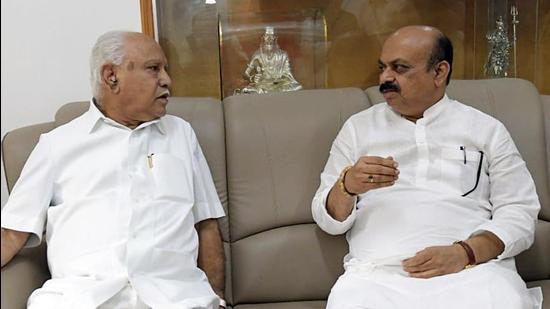
Will CM Bommai continue on the path followed by BSY in K’taka?
Despite being one of the oldest members of the Rashtriya Swayamsevak Sangh (RSS) in the state, the perception remained that Yediyurappa didn’t represent the right-wing ideology of the party


In the first week of April 2020, former Karnataka chief minister and one of the founding members of the BJP in the state, BS Yediyurappa, was trolled by several right-wing social media accounts. The reason for the outrage was Yediyurappa’s statement in support of the Muslim community.
“Nobody should speak a word against Muslims. This is a warning. If anyone blames the entire Muslim community for some isolated incident, I’ll act against them also without a second thought. Will not allow that to happen,” he said on April 6, 2020, against the hate campaign targeting the state’s Muslim community over the Covid pandemic and Tablighi Jamaat event held in Delhi in April 2020,which turned into a super-spreader.
Despite being one of the oldest members of the Rashtriya Swayamsevak Sangh (RSS) in the state, the perception remained that Yediyurappa didn’t represent the right-wing ideology of the party. With his exit from chief minister’s post, the question remains whether this would make way for more right-wing influenced policies in the state, especially since BJP leaders in Karnataka have proposed a law against inter-faith marriages (termed love jihad by RSS) and population control laws, which are perceived as anti-minority, or a softer BJP, which Yediyurappa showcased, would continue.
Experts and party insiders say that Yediyurappa’s presence didn’t make a big impact on the implementation of the BJP’s right-wing agenda. “I really don’t understand the notion that Yediyurappa is secular. If he was secular, how did the anti-cow slaughter bill go through? You are talking about an instance where he spoke for the Muslim community during the Tablighi (Jamaat) incident. Did you know Karnataka registered the highest number of sedition cases, most of them against the minorities, during Yediyurappa’s time?” asked a Bengaluru-based lawyer, who didn’t want to be named.
A senior bureaucrat who worked with Yediyurappa, disagreed and said that the former chief minister indeed had more secular ideas compared to the RSS faction of the party. However, he added that he didn’t take a stand against the RSS at any point. “Let us look at the Mangaluru incident. During the anti-CAA (Citizenship Amazement Act) three people were shot dead (on December 19, 2019). Yediyurappa’s initial reaction was to reach out to a member of the (Muslim) community to bring the situation under control. He even announced a compensation of ₹10 lakh,” pointed out a bureaucrat from Karnataka, who didn’t want to be named.
He added that even though Yediyurappa’s first reaction may sound secular, it didn’t last long. “Within two days, the compensation offer was withdrawn. Even though he could have taken a stand when there was pressure on him, he listened to what he was told,” said the IAS officer.
The difference between Yediyurappa and Basavaraj Bommai, according to political analyst A Narayana, is that Yediyurappa had a stature in the party to say no to policy decisions that came with a right-wing agenda. “It was not because it was a right-wing agenda or because he believed less in Hindutva. It is because he had a mind of his own and he didn’t like being told what to do. At the end of the day, he is an RSS man. Most importantly he was suspicious of everyone,” said Narayana.
Bommai, whose rose from socialist ranks in Janata Dal and replaced Yediyurappa as chief minister, has been known to taking controversial, right-wing stances.
During the anti-CAA protest in October 2019, Bommai had called the protestors traitors, and had announced that the state would undertake the controversial National Registry of Citizens (NRC) even before the central government announced it. “Unlike Yediyurappa, Bommai doesn’t have the stature to speak against a decision made by the RSS or the central high command. If Hindutva becomes a bigger campaign issue for the BJP in the upcoming elections, there wouldn’t be any resistance from Bommai in implementing any decisions,” said Narayana.
However, those aware of the developments suspect Yediyurappa to be in charge despite the change in leadership and is likely to have a big say in how things play out in the state.
The core-BJP legislators or those who identify closely with the saffron outfit’s Hindutva agenda have met with the central leadership even during Yediyurappa’s administration to demand that more bills like anti-love jihad law are introduced that are in line with the Sangh’s vision for the state, people aware of the developments said.
Despite the experts and activists questioning Yediyurappa’s secular credentials, party insiders feel that Yediyurappa has largely remained a secular face when compared to his contemporaries like KS Eshwarappa, which is likely to make it harder for the Bommai government to introduce such bills, people aware of the developments said.
Yediyurappa’s unwillingness to toe the line against minorities and disagreeing with provocative statements made by his own party men has also been one of the reasons why the 78-year-old was considered a misfit for BJP’s hardline and long-term vision for Karnataka and its other plans for southern India.
“Yediyurappa was never into communal politics or seen to be siding with them like Eshwarappa,” said one north-Karnataka-based political analyst, requesting not to be named. Yediyurappa, the analyst, said was also forced to take a tough stance against Tipu Sultan Jayanthi celebrations which the former had earlier endorsed.
He added that the BJP is unlikely to take risks to introduce more hardcore bills in a state where the political situation remains volatile and uncertain, especially since Yediyurappa has the influence to get legislators to back away from even bringing up such bills.
“Yediyurappa has a way to get legislators, even those against him, to do what he wants them to do,” said another Bengaluru-based analyst, also requesting anonymity.
The analyst was referring to the likes of Basanagouda Patil (Yatnal), the firebrand legislator and ardent critic of Yediyurappa, who tried to push for Hindutva but instead was seen as one of the leading forces of the Panchamasali, the largest sub-sect within the Lingayats, agitation seeking for better reservation status.
Yediyurappa, like his counterparts in the Congress (Siddaramaiah) and Janata Dal (Secular) (HD Deve Gowda) are known to be coalition builders that have seen them almost rotate power among themselves without allowing Delhi to dictate terms in the state.
The three leaders have struck regional alliances, with or without their respective high command’s approval, when convenient and have depended on each other for passage of bills and winning elections among others for mutual benefit.
“In some ways, I think the new government will very much like to distance itself from the former chief minister and do it gradually and without ruffling of too many feathers,” Sandeep Shastri, a political commentator and psephologist said.
He added that in Karnataka, the BJP has always had to walk a “tight-rope” and that a significant chunk of the BJP’s legislators (and Cabinet) comprises people who have come into the fold not more than a decade ago including Bommai, who joined the BJP only 13 years ago and have no strong roots with the ideological side of the party.
Shasti added that the BJP will be more pragmatic given the nature of the composition of the state legislature party.
“In a state assembly election, BJP have never been able to get a clear majority so they (BJP) would be more keen on strengthening their base in the state rather than doing anything else at this stage,” Shastri said.


