
 E-Paper



With fewer people, industries eye slow start after relaxations
They said the possibility of employing stranded migrant labourers, except in the construction industry, is not high because of the specific skills needed in each industry.


Industries resuming production from Monday will work much below their capacities because of restrictions imposed by states and most the workforce having left for their home states, industry leaders in different states said on Friday.
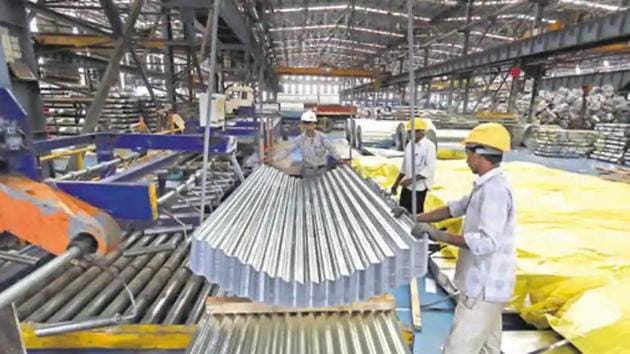
They said the possibility of employing stranded migrant labourers, except in the construction industry, is not high because of the specific skills needed in each industry. They also feared that the possibility of the stranded labourers returning home when the lockdown is lifted is high, an eventuality that will further hamper production.
The Central government had issued guidelines for allowing all industries in rural areas and certain industries in non-hotspot regions of urban areas to begin operating from Monday.
The state governments have issued specific protocols, which include boarding and lodging facility and transportation for workers, said government officials in several states.
The Karnataka government hinted that IT-BT companies could be allowed to start limited operations from Monday. Deputy Chief Minister CN Ashwath Narayan met representatives of technology companies. Later, while speaking to the media, he said that while the lockdown would continue after April 20, technology companies could start operating with 50% employees coming in every other day. Karnataka exports about $40 billion in technology services and the sector is the biggest employer in the organised sector in the state.
The minister also said that technology employees would not need the special pass required by others. “I doubt whether there would be the pass culture after April 20. Anyway, there is no public transport, no metro, no buses. In two wheelers only one person can travel and there are limits on how many can travel in a car. If the technology companies want, we can provide sanitised public transport buses.”
Narayan said the representatives of IT companies had assured him that hygiene, masks, use of sanitisers, social distancing and all other government directives will be strictly implemented. “They have said they will undertake screening and testing as well as other responsibilities,” Narayan said.
Badish Jindal, president of the Federation of Punjab Small Industries Association, said strict conditions, such as accommodating labour within the factory premises and holding the owner responsible if any worker contracts the infection, made many owners of industrial units reluctant to resume production.
“Not more than 2% of the small and medium units have the space to accommodate the workers on their premises,” he said.
Industries dealing with food, sanitisers and personal protective equipments (PPEs) were allowed to function during the lockdown period, which meant that about 1% of industries were operating during the national lockdown.
Revival of all industrial activity is being seen as a measure to provide employment to workers unemployed since March 24, when the first 21-day lockdown was announced.
Industry leaders in different states said that only about 5-10% of the industries will be operational and many small and medium industries will not function as they do not have places for workers to stay, a condition imposed by most states.
They were anticipating that the production will increase to half of the capacity even after lockdown is lifted as workers are keen to return home.
In Punjab, which has about 2,50,000 industrials units, not many will operate, said additional chief secretary, home, Satish Chandra. He said detailed guidelines for industries to function in special economic zones, industrial areas and clusters will be issued by Friday evening.
PHDCCI (Punjab) ex-chairman, RS Sachdeva, whose own unit is operating at half its capacity, said resumption of manufacturing in a substantive manner will be very difficult till the entire supply chain (availability of raw material and delivery of manufactured products) is fully established.
“Some small units can start working to create inventory for mother units, but I don’t think large units will get into production,” he said. He, too, feared labourers will return to their villages, leading to a scarcity of workers.
Maharashtra government will allow the industrial operations in about 20 districts which have none or a few Covid -19 patients from April 20 and aims to facilitate resumption of operations of at least 60% of the 4.5 lakh MSMEs by the end of April.
“We are preparing a proposal to begin industrial operations in about 20 (of 36 total) districts from next week,” said industries minister Subhash Desai.
“Industrial units in services, agriculture, pharmaceutical sectors are ready to resume the operations from next week. But, having limited skilled workforce is an impediment,” said Milind Kable, president, Dalit Indian Chamber of Commerce and Industry. Maharashtra has the highest number of Covid-19 cases (3202) and has reported 194 deaths till Thursday.
Federation of Rajasthan Trade and Industry, state president, Suresh Agarwal, said the industries will be operational by April 21-22 with around 30% labour. “I believe the garment factories will come into operations swiftly, looking to pending orders and local labour,” he said, adding that the industries will have adequate labour as half of the workers are from Rajasthan.
Some industrialists, such as Akhil Agarwal, owner of Jaipur based Auto Corp Private Limited, said 30% workers were staying in factory premises and they will start operations by April 21. “If required, the rest of the labourers, who stay within a 10km radius of the factory ,will be called,” he said, ruling out the possibility of hiring stranded labourers.
Rajasthan Industry Commissioner, Muktanand Agarwal said the industries will have to comply with the standard protocols issued by the state on basis of Central guidelines. “Passes will be required for transportation of workers who are not staying in factory premise and are coming by transport arranged by the employer,” he said.
Gautam Kothari, president of Peethampur Audyogik Sangthan in Madhya Pradesh, said, “About 70% of the workforce of industries have returned home. Industries cannot resume work until adequate workforce is present 10 to 15 days prior to the resumption of operations.” He said that there was hardly any chance of resumption of operation of automobile industries in Peethampur, which has several such industries.
Chairman of Indian Industry (CII), Bhopal zone, Siddharth Chaturvedi, expected the apparel and construction industries to have more operating capacity than other industries.
Ex-chairman of PHD Chambers of Commerce and Industry, Bhopal RG Dwivedi, said there is no data on skills of the stranded labourers. “Industries are looking for the labourers but they are facing problems at present in getting suitable data on skilled, semi-skilled and unskilled labourers,” he said.
Federation of Telangana Chamber of Commerce and Industry (FTCCI) managing committee member, Avinash Gupta, said 75% of the workforce in the jewellery making units in the state were from other states, particularly West Bengal. About 80% of workers in real estate are from UP, Bihar, Madhya Pradesh and Chhattisgarh and they will go back home once the lockdown is lifted, Confederation of Real Estate Developers’ Associations of India (CREDAI), Telangana chapter general secretary, V Rajasekhar Reddy, said.
In Bihar, the state’s industries association has decided not to start production till the government waives payment of fixed energy charge for the lockdown period. “We are not going to open our units from Monday, unless government comes out with a clear-cut directive on the two main energy related demands, which affects more than 500 energy intensive factories,” said Ram Lall Khetan, president of Bihar Industries Association.
The government, however, is ready to permit companies that are willing to resume production. “We have allowed four cement companies, 193 food processing units and one jute factory to restart manufacturing for the revival of economic activities in the state in the interest of workers,” said industries minister, Shyam Rajak. He said the government has cleared subsidy entitlements for 76 State Investment Promotion Board approved units on Thursday to make money available for entrepreneurs for tiding over the disruption in activities.
(With inputs from state bureaus)


