
 E-Paper



Yamuna water breaches 45-year-old mark at 208.08m in Delhi
Relief personnel helped evacuate 16,500 people from six districts, and housed them in 2,500 relief camps

 Prefer HTon Google


Surging water levels in the Yamuna breached a 45-year-old landmark to touch record levels on Wednesday, marooning low-lying neighbourhoods in the Capital and sparking a massive evacuation effort that stoked a political controversy.
Read here: Rising river water level leaves large areas vulnerable in Delhi
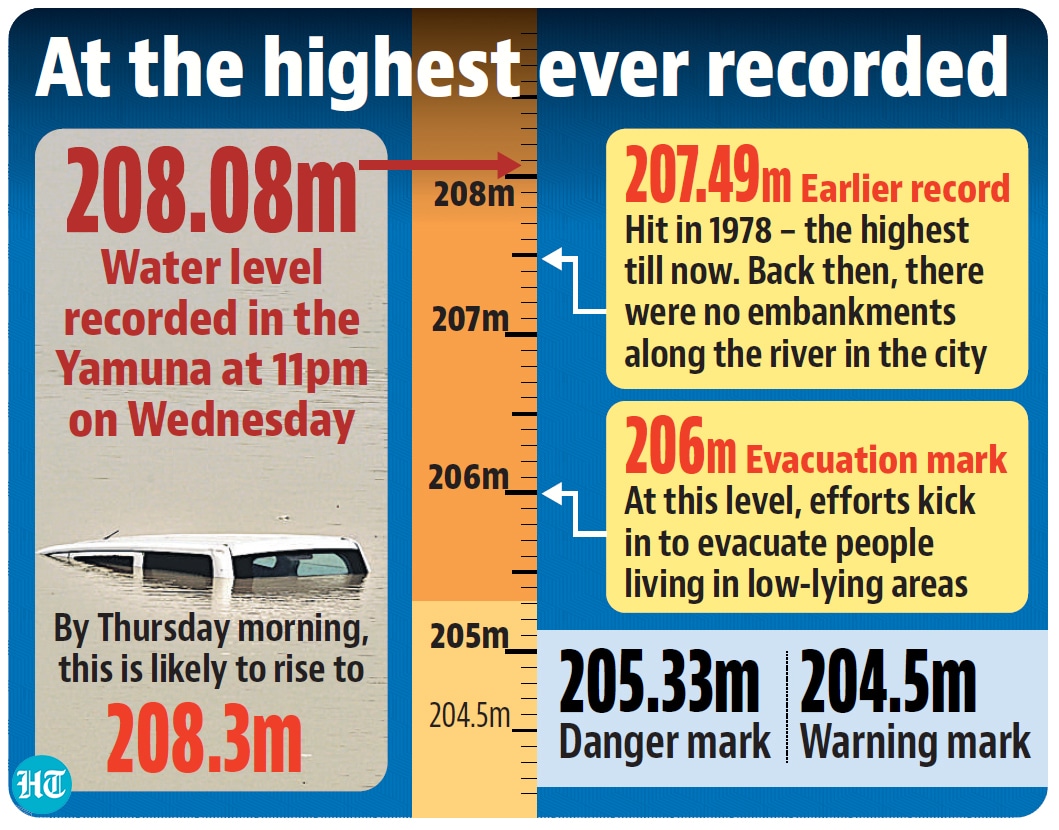
The Yamuna swelled to 208.08 metres at 11pm, breaking the previous record of 207.49 on September 6, 1978, leading to floods in the Capital.
Authorities warned that the water level will rise through the night and rise to 208.3m by 9am on Thursday as large chunks of Delhi – monastery market and Majnu ka Tila in north Delhi, Mayur Vihar Phase I and Geeta Colony in east Delhi, andmultiple patches on Ring Road near Kashmere Gate in old Delhi – were inundated. It remained unclear just how big a swathe of the city this new benchmark could submerge.By 6pm, police had closed some sections of the Ring Road and Bhairon Marg in central Delhi.
But experts pointed out that Delhi then didn’t have over 22km of embankments on each side of the Yamuna protecting the city in 1978, and added that three consecutive days of little or no rainfall in Delhi may help avoid large-scale flooding with new measures added over the past 45 years.
Relief personnel helped evacuate 16,500 people from six districts, and housed them in 2,500 relief camps, warding other people off the banks of a river that lies moribund for most of the year but one that has transformed into a gushing torrent due to heavy showers in Himachal Pradesh and water released from upstream dams bursting beyond their capacity.
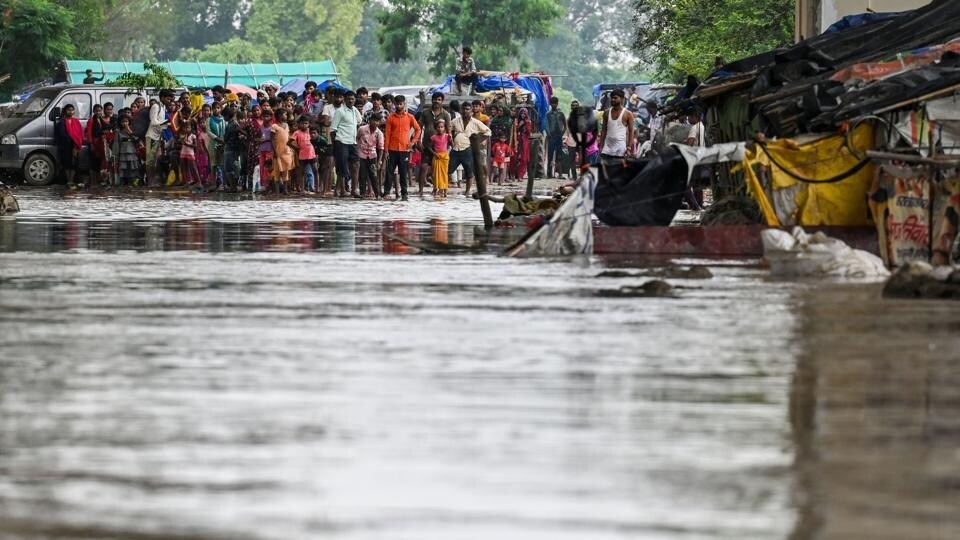
“The water started entering the market area last night and by the morning the entire market was flooded. Many store owners had removed their stuff in advance, but many could not do it. All the stores are now closed. The total damage will be known only when the shops open after the flood water recedes,” said Dawa, a worker at a store in Monastery Market.
Delhi chief minister Arvind Kejriwal called an emergency meeting and wrote to Union home minister Amit Shah, asking for his intervention in stopping the release of water from Hathni Kund barrage in Haryana, about 230km upstream. The level in the Yamuna is directly linked to the release of water in the barrage. Later in the day, he said he spoke to Union jal shakti minister Gajendra Singh Shekhawat, who assured him that while not releasing the water was not possible since the barrage did not have a reservoir, the quantum of the water being sent downstream was considerably lower than earlier because rivers upstream in Himachal were no longer in spate.
“I urge everyone living in low-lying areas to evacuate because the water level will rise suddenly and your life could be in danger,” the chief minister said at a press conference.
Read here: Ghats at Delhi’s Nigam Bodh flooded, facility shut
After an emergency meeting, Kejriwal listed out affected areas. “The areas already affected by the floods are Boat Club, Monastery Market, Neeli Chhatri Temple near Old Railway Bridge, Yamuna Bazaar, Geeta Ghat, Vishwakarma Khadda colony, Garhi Mandu, the stretch between Majnu ka Tila to Wazirabad,” he said.
The CM said people in low-lying areas in Usmanpur, Badarpur Khadar, DND, Pushta Mayur Vihar, main Yamuna Road in Jagatpur, Bhelopur Shamshaan Ghat in Sarai Kale Khan, Jain Mandir, Gyaspur, the slums around Millennium Depot, also need to start leaving their houses in the wake of further rise in water levels.
He also wrote to Shah, asking the Centre to intervene and ensure only limited discharge of water from Haryana. “The news of flooding in the capital of the country will not send a good message to the world. Together we will have to save the people of Delhi from this situation,” he said, citing the upcoming G20 summit in Delhi
Later in the day, he said Shekhawat informed him that the volume of water being released to Haryana from Himachal Pradesh had reduced, which, in turn will bring down the water level in the Yamuna.
“Following my letter (to Shah), I got a call from Union minister Gajendra Singh Shekhawat, who said that Hathnikund is just a barrage and there is no reservoir to store water and limit the water speed. The water volume being released from Himachal Pradesh has reduced and the situation will improve. But it will take time to reflect in the water level of the Yamuna,” the chief minister told reporters.
Delhi lieutenant governor (LG) VK Saxena visited flood-affected areas and called a meeting of the Delhi Disaster Management Authority on Thursday.
“Visited the inundated banks of Yamuna and witnessed the preparedness of agencies. NDRF teams have been deployed to assist in case of any eventuality. I appeal to people of the city to not panic and those stuck in flooded areas to evacuate. As in the past, water coming from Himachal Pradesh and Haryana will eventually pass on through the river, downstream. With rains subsiding in upper reaches, the danger in Delhi is expected to recede soon,” he said in tweets.
As the night deepened, flood waters submerged one section of the Ring Road near Kashmere Gate, and parts of arterial roads near Majnu Ka Tila and Metcalfe House. Flood waters also submerged a portion of busy Bhairon Marg near Ring Road by 6pm. One carriageway (towards Mathura Road) was shut, while the other was open. At 10:40pm a bus got stuck in the submerged carriageway (from Mathura road to Ring Road).
In Majnu Ka Tila, Wango, a woman who runs a shop, was seen taking out a deep freezer with the help of some locals from waist-deep water. “My shop has been submerged along with several other shops and some restaurants. I have suffered a huge loss,” she said.
At least two people in Yamuna Bazaar said they saw snakes in the water. “We rescued many people by braving the floodwater yesterday. There are many snakes in the area. There are no arrangement of lights and at night we are exposed to danger,” said Dhananjay Kumar, an auto mechanic.
The suffering brought back memories of the 1978 floods, when rain in the upper catchment areas of the Yamuna flooded many areas including Model Town and Jahangirpuri, Indiranagar, Majlis Park, Gopal Nagar, Alipur, Mukherjee Nagar, Kingsway Camp, Delhi University, Adarsh Nagar, Civil Lines, Bela Road, Okhla, Sarai Kale Khan and Maharani Bagh. Thousands were affected at the time. Since then, the Yamuna has breached the 207 metre level only twice – in 2013 and 2019.
But the situation in significant parts of the Capital remained largely normal, due to the embankments that were built in the 1960-70s, fortified over the years, an official said, ensuring that the city can withstand higher columns of river water. After two days of record-breaking showers, the city has also largely remained dry, holding out hope that even if a neighbourhood is inundated, the water will drain quickly.
Bhim Singh Rawat, a Yamuna activist and member of the South Asia Network on Dams, Rivers and People (SANDRP) says since 7am on Thursday, there has been a declining trend in the water release from the Hathnikund barrage, but even then, a drop in water levels is only expected after two days. “This is when we see no additional rain. If there is rain further up north or in Delhi, these levels may take longer to drop. At this point, the floodplains are at their saturation point.” he said.
An official in the irrigation and flood control (I&FC) department said the gates of 12 major drains which flow into the Yamuna were closed. “The water of the drains are being pumped out and drained into the Yamuna. The I&FC department is maintaining a 24 hours vigil at all vulnerable locations. At multiple places, the embankments are being strengthened with sand bags to prevent water from flowing into the residential areas close to the Yamuna embankments,” said the official, requesting anonymity.
The official added that even though the embankments were strengthened over the years, the water level remained critical. “The important part is that the unprecedented level of water will be maintained for a long time and may put the strength of the embankments on test. The engineering teams have identified some vulnerable points in the embankments and fortified them with sang bags. That is the only option available,” added the official.
The Yamuna snakes through the Capital in a 22km-long arc with natural floodplains on both banks that have been encroached to grow vegetables and flowers. Migrant labourers have also built hutments on the floodplains and homeless people have found a shelter under the bridges. In places such as Yamuna Bazaar, slums as well as concrete houses have come up close to the floodplains. Around 35,000 people are estimated to be living there.
The embankment at Yamuna bazaar was in critical condition at the time of going to press and authorities were planning to start evacuations in areas near Kashmere Gate likely to be affected in the event of a breach.
A second official said 47 boats from the boat club, and the flood and irrigation department were kept ready to meet any emergency. The irrigation and flood control department identified 17 vulnerable points including places such as Vijay Ghat, Tibet market, Metcalf house, Tonga stand area, drain number 12 and 12A, and Delhi gate, and these sites are being monitored.
Irrigation and flood control department minister Saurabh Bharadwaj inspected the flood-affected areas in the central district and instructed the department to maintain constant vigilance. “If the water level in Yamuna continues to rise at this rate, there is a possibility that it will overflow the areas that have been closed off to prevent water from reaching the roads. It could potentially breach those closures and spill onto the roads,” Bharadwaj said.
Read here: Low-lying parts of Yamuna’s northern, eastern banks in Delhi hit; rescue operation on
Delhi BJP leaders went to affected areas to meet the displaced people, and slammed the Delhi government. “The Delhi government ministers are taking boat rides in the Yamuna to show that they are working for flood relief, but the government did not make arrangement for the boats to evacuate those who stranded in the flood waters in the capital,” said BJP leader Ramvir Singh Bidhuri.
The potential crisis again brought home the impact of the climate crisis, and its power to initiate extreme weather events that take the heaviest toll on poorer communities. This cannot be tackled without inter-agency coordination and a dedicated focus on building climate-responsive policy.


