E-Paper



Younger TVK candidates led Vijay’s political coup
Vijay himself is in the early fifties, although his perceived age could well be lower thanks to his reel-life persona, where he still plays the angry young man

 Prefer HTon Google


Vijay’s Tamilaga Vettri Kazhagam (TVK) has delivered a political earthquake in Tamil Nadu by breaking the Dravidian duopoly of the Dravida Munnetra Kazhagam (DMK) and All India Dravida Munnetra Kazhagam (AIADMK) over the state’s politics. With 108 MLAs in an assembly of 234, TVK is certainly at the cusp of government formation. What really worked for TVK and its founder, a superstar in movies but a political novice? In hindsight, it might have been the demography: a party represented by a leader and candidate who was closer to the age-profile of the state’s voters than a much older lot from the establishment DMK and AIADMK alliances.
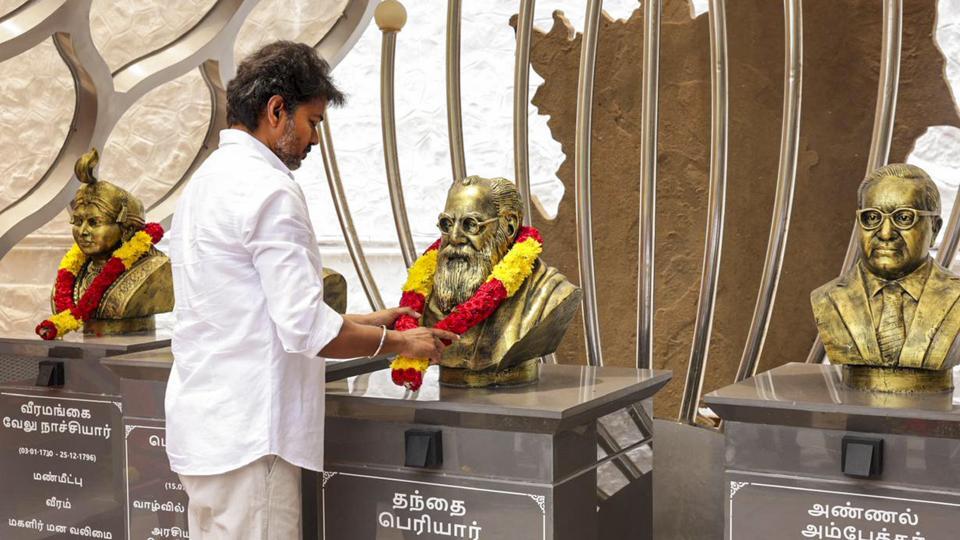
Vijay himself is in the early fifties, with his affidavits listing him at 51, although his perceived age could well be lower thanks to his reel-life persona, where he still plays the angry young man. Stalin and Edappadi K Palaniswami, the leaders of the DMK and AIADMK alliances, are listed as 72 years old by their affidavits. According to projections by the National Commission on Population, Tamil Nadu’s median age was 36.35 years on March 1, 2026, around six years older than the national average. To be sure, the median age of the population that can actually vote will be significantly higher. But this election has also seen anecdotal accounts of even non-voting-age youngsters convincing their voting-age family members to vote for Vijay and TVK. This means Vijay was much closer to the state’s average demographic age than his competitors.
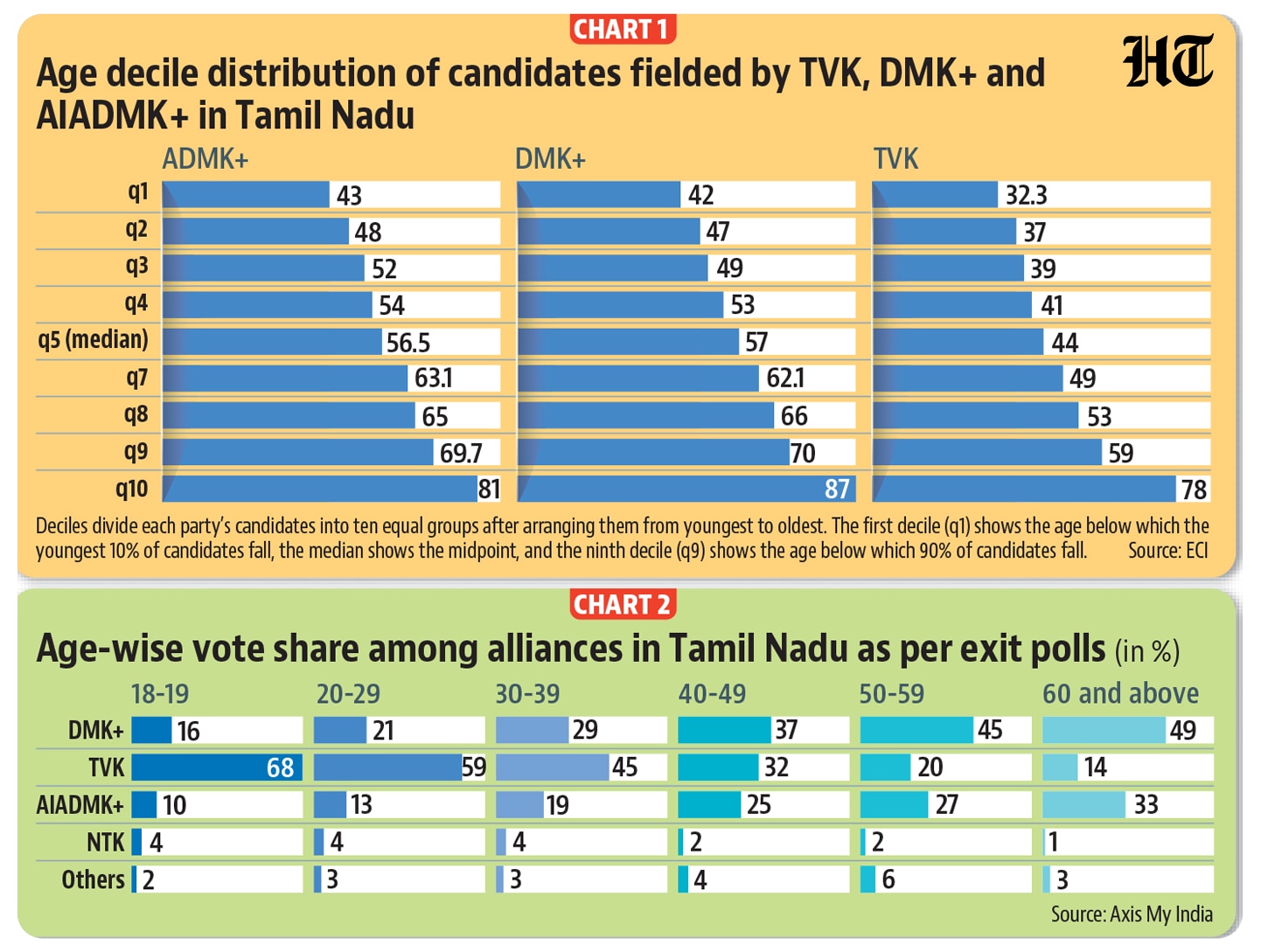
What made Vijay’s case against the establishment and the old DMK and AIADMK alliances even stronger was the choice of his candidates. HT scraped the election affidavit data of all candidates of the DMK and AIADMK alliances and TVK (it fought on its own) to compare their age profile. The median TVK candidate – the age of 117th candidate if all of TVK’s 234 candidates are arranged in ascending order by age – was 44 years old. The comparable figure was 57 for the DMK and 58 for the AIADMK. The gap remains almost unchanged at the alliance level, at 57 for DMK+ alliance and 56.5 for the ADMK+. TVK didn’t enter into any pre-poll alliance but backed an independent candidate in Edapadi. Their median age remains the same whether or not this independent candidate is included in the calculation.
Even if one were to look at age-profiles at a more disaggregated levels, the trend does not change. A decile analysis, which divides candidates into ten equal groups from youngest to oldest, shows that at almost every point in the distribution, TVK’s candidates were younger than those of the DMK and AIADMK. TVK’s candidates ranged from 28 to 78 years. The DMK’s candidates ranged from 28 to 87, while the AIADMK’s ranged from 29 to 79. More than 70% of TVK’s candidates were below 50. For the DMK, this share was about 31%, and for the AIADMK it was about 20%. Nearly one in three TVK candidates was below 40, compared with just 6% for the DMK and 5% for the AIADMK. At the other end, only about 10% of TVK candidates were aged 60 or above, against 39% for the DMK and 46% for the AIADMK. (See chart 1)
This candidate profile closely matched the age-wise voting pattern suggested by exit polls. According to Axis My India – the only poll which got TVK’s vote share almost right – TVK had its strongest support among the youngest voters, with 68% among those aged 18-19 and 59% among those aged 20-29. Its support fell with each older age group, dropping to 20% among voters aged 50-59 and 14% among those aged 60 and above. DMK+ showed the reverse pattern, rising from 16% among first-time voters to 49% among those aged 60 and above. AIADMK+ too did better among older voters than among the young. (See chart 2)
What next for Vijay from here? Governing is often more difficult than winning elections and the burden of aspirations will be huge. But his political success cannot not be compared with that of M G Ramachandran who joined DMK at the age of 45 and helped establish it as a ruling party in Tamil Nadu at the almost the same as Vijay is today. He founded the AIADMK in 1972 led it to power in 1977. Can Vijay reinvent the Dravidian political lineage for his generation of Tamilians? Only time will tell.