
 E-Paper



Prakash Javadekar clears 240 projects in 3 months
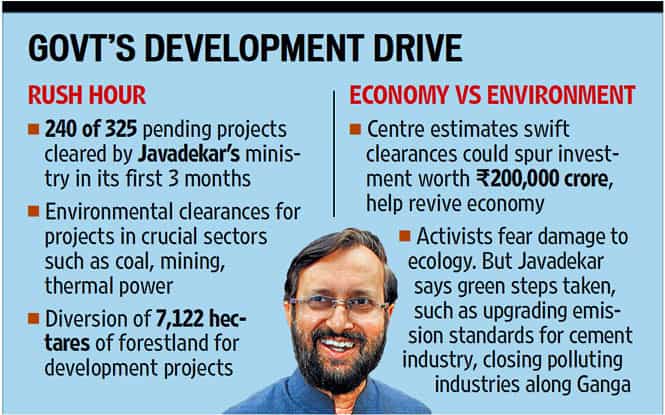
The government estimates the hastening of approvals could spur investment worth Rs 200,000 crore. The clearances are supposed to bring in fresh investment and give the infrastructure sector a boost.


Environment minister Prakash Javadekar worked at great speed in his first 100 days in office and cleared 240 of 325 projects that had been in limbo after environmental clearances slowed to a trickle under the previous government, ministry documents show.
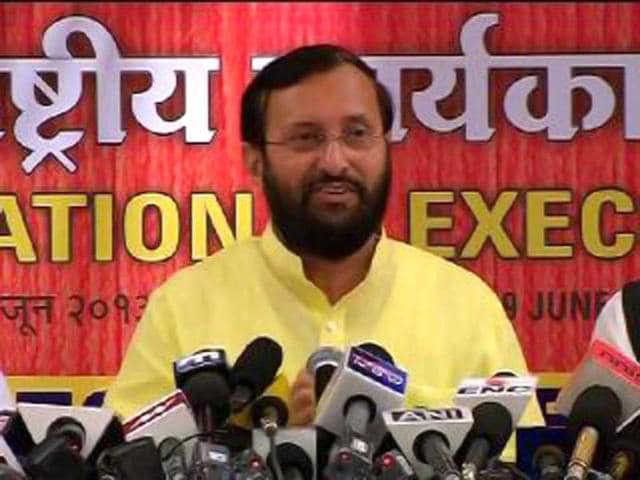
The government estimates the hastening of approvals could spur investment worth Rs 200,000 crore and help revive the economy. The clearances are supposed to bring in fresh investment and give infrastructure sectors like roads, power plants and oil exploration a boost.
HT and Delhi-based advocacy group Environment Impact Assessment Resource and Response Centre analysed minutes of two key environment committees that cleared 240 projects. The committees are the Expert Appraisal Committee (EAC), a body of experts to examine projects for environmental impact, and the Forest Advisory Committee (FAC), which decides on diversion of forestland.
The EAC approved 217 projects in six crucial sectors such as coal, mining and thermal power in three months, five more than what was approved in the first seven months of former environment minister Jairam Ramesh’s term.
Most public sector companies such as Oil and Natural Gas Corp-oration and National Thermal Power Corporation got approval to expand capacity, start new projects and conduct surveys for new projects. The ministry also okayed major private sector projects such as a plan to increase Cairn Energy’s oil production capacity by 50% in Rajasthan.
Industry also received a boost after the FAC approved the diversion of a massive 7,122 hectares of forestland for development projects in the Narendra Modi government’s first three months. The committee approved 33 of 41 projects it considered, including six salt leases to companies in Gujarat --- held back for the last two years because of its adverse impact on the livelihood of locals.
The FAC in Javadekar’s three months allowed diversion of forestland equal to what it did in the first year of Ramesh as environment minister, monthly data for forestland diversion compiled by the Centre for Science and Environment (CSE) shows.
The fast approvals became possible after easing norms including expansion of coal mining projects from mandatory public hearing, and keeping the decision on no-development zones in abeyance.
Javadekar said the NDA government was pursuing the goal of higher economic growth with environmental protection. He listed a series of steps taken by his ministry for environment protection, including upgrading emission standards for the highly polluting cement industry and closing of polluting industries on the banks of the Ganga.
“The steps are pro-environment… See the steps we are taking to protect the environment. Earlier, environment protection was ideological discourse and now we care for nature,” Javadekar said, when asked to respond to the HT analysis on project approvals.
Environmentalists say the ministry’s project approval spree in dense forest areas in Maoist-affected regions in Chhattisgarh, Odisha and Jharkhand would not have been possible without the easing of stringent green norms.
“Will new minister Prakash Javadekar keep perpetuating a bad system or make a real difference for real change?” asked Sunita Narain, director general of the Centre for Science and Environment.


