
 E-Paper



Reservoirs wait for rain, power crisis threatens India
The Met has said the monsoon is 43% below average and India is staring at a drought. The government’s Economic Survey, tabled on July 9, said poor rains could trim food output and push up prices.


Water levels in India’s reservoirs have gone down drastically due to poor rains and if the monsoon doesn’t pick up soon, this could lead to a power crisis on a national scale.
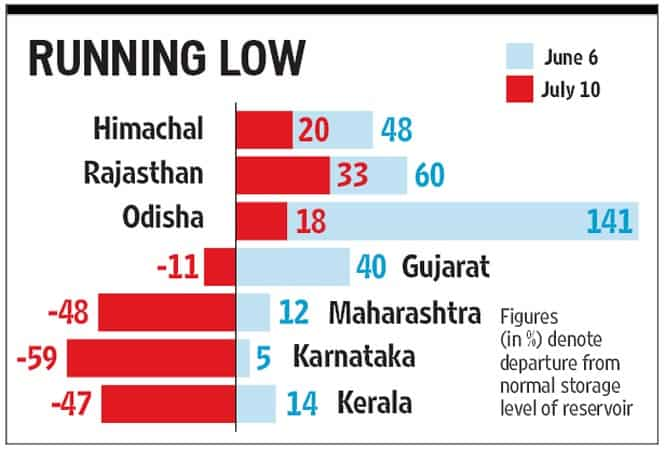
The Central Water Commission’s latest report shows water levels in the 85 major reservoirs it monitors have almost halved in one month (June 6-July 10). As of July first week, the 31 hydel projects were generating power at about 35% of their total capacity of 30,000 mega watts. If the water levels go down further, so will power production.
Read: Drought fears loom over north India
Hydropower meets 30% of India’s power demand and a dip here would increase dependence on thermal power plants, which are already facing severe coal-supply constraints. Government data shows 26 thermal power projects have less than four days of coal stocks while another 45 have reserves for about a week.
If the prospect of blackouts wasn’t bad enough, a water commission official pointed to another major problem. The emptying of the reservoirs will reduce irrigation potential — a cushion for farmers during dry spells — while low hydel generation will hamper capacity to pump groundwater to save crops.
The Met has said the monsoon is 43% below average and India is staring at a drought. The government’s Economic Survey, tabled on July 9, said poor rains could trim food output and push up prices.
Read: Why India can't get its monsoon forecast right
“As power demand for agriculture increases, there is more stress on the grid and this can lead to frequent outages. We had a similar situation in the last drought year (2009) when reservoir levels were better than they are now,” the official said.
In just a month, water levels went down to 20% (of the normal storage level) from 48% in Himachal, from 60% to 33% in Rajasthan, from 200% to 76% in Uttarakhand and from 262% to 92% in Madhya Pradesh.
Down south, levels in Karnataka, Kerala, Tamil Nadu and Andhra Pradesh went into negative figures. Normal storage level denotes water in the reservoir during the same period last year.
A senior government official confirmed there was a crisis brewing, saying, “Water levels in these projects, mostly located in south and central India, are currently much below the required level.”
Read: Moonsoon delayed; govt readies contingency plan
Government authorities are said to be keenly monitoring power supply from the northern grid to states such as Uttar Pradesh and Haryana to prevent a collapse similar to the one in August 2012, which left more than 600 million across north and east India powerless for more than 24 hours.
Long power outages in Delhi and its neighbouring towns and cities have become emblematic of north India’s crushing power shortage.
(Inputs from Anupama Airy)


