
 E-Paper



Return of the native: Kashmiri Pandits struggle to settle down
The government is set to approve a Rs 20-lakh package to help Kashmiri Pandits return to the Valley. HT travelled to Kashmir to speak to Pandits who never left and to those who have returned to live in settlement colonies.


In Kashmir, every number has a messy past — how many people were killed, who killed whom — or, a potential to create a messy present.This time round, that number is 20 lakhs. Last week, it was reported that the government was all set to approve a package of Rs 20 lakhs for migrant Kashmiri Pandits to reconstruct their houses, a significant increase from the existing Rs 7.5 lakhs per family, that was decided in 2008.

But what do these two numbers, and the accompanying idea of rehabilitation of a Kashmiri Pandit mean to another Kashmiri Pandit? If you were to ask Sanjay Tickoo, president of the Kashmiri Pandit Sangharsh Samiti, an organisation of Kashmiri Pandits in the Valley, it means more mess. “By discussing the repeal of Article 370 and the rehabilitation package in quick succession, the government has created confusion and mistrust in the minds of the majority community. All these years, civil society groups such as ours had been working to bridge the gap between the local Kashmiri Pandits and the Kashmiri Muslims. But our efforts have been jeopardised in one single stroke,” says Tickoo, one of the 3,000 Kashmiri Pandits who chose to stay on in the Valley during several phases of the community’s exodus that began in 1989.
A human rights activist in his late 40s, Tickoo says he is concerned with the number 651 — the number of Pandit families in the Valley. “We are people who never left, despite the turmoil,” he says, sitting at Coffea Arabica, a café on Srinagar’s MA Road, a posh commercial area. He gestures for me to look outside the window and says, “Until a few years back, this road used to be deserted by early evening. We have seen the worst periods of violence by state and non-state actors and now, the terror of unidentified gunmen. But has the government ever thought about us?”
Tickoo points us to the village of Lar in Ganderbal, about an hour’s drive from Srinagar, where four Pandit families live. There, Badrinath Bhat, a retired government employee in his seventies, sums up his idea of the return of fellow Kashmiri Pandits: “What’s in it (the package) for us? Nothing.”
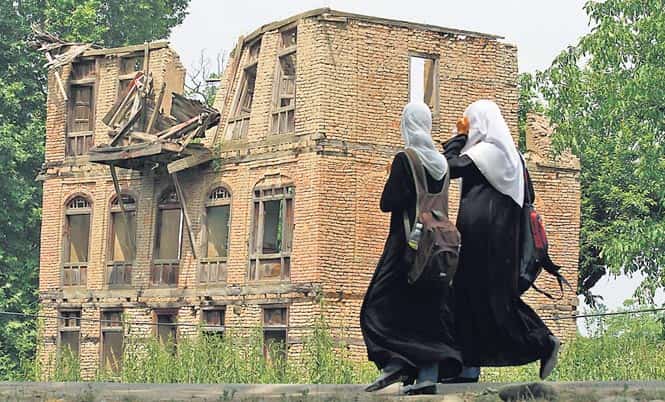
“We didn’t matter when Wandhama happened (23 Pandits were killed in the nearby town in 1998); we don’t matter when local youth tease our women about their tikka (worn on the forehead by married Pandit women). Why, until a new block officer took charge — oh, please write that he is a Kashmiri Muslim — this area didn’t even get any NREGA projects,” he says, showing us around his home. The backyard has a small enclosure for the family’s shivling. The abandoned Pandit house next door has been taken over by the police who have been entrusted with protecting the Pandits in the neighbourhood.
It’s not as though the Bhats never considered leaving. “Once, in the 1990s, when we were ready to leave, we heard that those who had fled to Jammu were sleeping on the roads. That’s when I thought, better to die in Kashmir than to suffer that fate. ”
Inside the ghetto
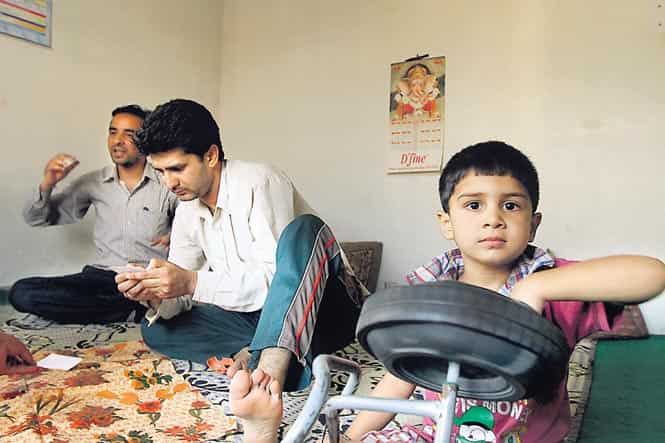
At Sheikhpora, the migrant colony in Budgam district, about 30 minutes from Srinagar, the idea of return or rehabilitation for Kashmiri Pandits means an even greater mess. “Rehabilitation is a joke,” fumes Rahul Bhat (name changed on request), 35, who works with the state education department. Here, the messy number is 1,445 – the number of Kashmiri migrant youth, such as Rahul, who were employed with the state government as part of the PM’s special package for rehabilitation announced in 2008, and implemented in 2012. Before joining, employees signed a bond that allotted accommodation for them and their families. Under the terms of the package, they could not request inter-district job transfers and could be immediately terminated if they left the Valley.
“When we came here, we were made to share the two-bedroom quarters with six families. After we made a noise, the number of families came down to four. Now there are two or three in each quarter,” he says.
At Sheikhpora and other such colonies — there’s one in every district in the Valley — the rehabilitation of Kashmiri Pandits has meant a “second migration” of sorts, and a feeling of being displaced once again. Some couples can no longer live together as spouses have been posted in different districts; others resent life in a ghetto where they are “cut-off from society”; still others say it will take them a while to get used to living under “the fear of the gun”. “If the government is serious about our return, it should be ethical. This is just bonded labour,” says Rajesh Koul (name changed on request), who works with the state education department.
At the migrant colony near Haal village in Pulwama district, rehabilitation is a temporary phase, a decision that, at least for Ajay Koul, one of its residents, will be weighed against his material aspirations. An employee with the PWD, Ajay moved to the migrant colony in 2010. “See, rehabilitation is OK, but return is impossible. Are they going to get us jobs in the corporate sector also? Kashmir doesn’t have enough companies like other states that are enjoying the fruits of industrial liberalisation. Why then should we consider returning?”

The idea of home
In conversations about displacement and migration, about rehabilitation and return, it’s not just the numbers that are messy; it’s also the idea of “home”. For Ajay Koul, home is where aspirations can be realised, and where the memories of migration don’t haunt him anymore. “I came here because I am emotional about Kashmir. But I will not return to the village where we lived, even if the government gives me 5 crore. That place will always haunt me; there’s nothing to do over there anyway,” he says.
Less than a kilometer away, in the village of Haal, is the home of 67-year-old Rani Bhat. Hers is the only Pandit family in the area because there was “never enough money to run away”. The land that the 10-member family once owned has been sold to the government, and now houses a migrant colony with prefabricated structures for those like Ajay, and Bhat’s own sons.
For others such as Sarla Bhat, Badri Nath’s 28-year-old younger daughter-in-law, home is where the climate is less fierce. Sarla grew up in Jammu, but got married in Kashmir, where her husband now works. “It was difficult getting used to living here in Lar; I can’t step out of the house that much and there’s some fear in the minds of the local Pandits. But I have adjusted and things are OK now,” she smiles. What’s been hard to adjust to, however, is the Kashmiri winter, when Sarla heads back to Jammu with her four-year-old daughter leaving her husband behind.
Outside Kashmir, some migrants whose homes were disposed of in the distress sales of the 1990s say they now have nothing to go back to. “In 1997, the Jammu and Kashmir Migrant Immovable Property Act was passed to facilitate the sale of Kashmiri Pandit properties. About 70 per cent were distress sales,” says Sanjay Tickoo. “Now, what will those people come back to?”
Migrant Kashmiri Pandits like Mumbai-based Moti Koul, president of the All Indian Kashmiri Samaj, feel that the return of his community can’t be reduced to a mere number, or a package. For him, returning “home” would mean a satellite township, political empowerment and minority status, among several other demands.
Back in Srinagar, Sanjay Tickoo says home is the place he “just couldn’t” leave. What about the idea of a separate homeland, I ask. His reply comes with a twist of Kashmiri sarcasm: “I wouldn’t mind. But I have a question: in the ‘homeland’, who would be the butchers, the milkmen and the cleaners? Kashmiri Pandits won’t do that, will they?"


