
 E-Paper



Revealed: Secrets of craftsmanship behind ancient Indian sword
The master craftsmanship behind Indian swords was highlighted when scientists and conservationists from Italy and the UK joined forces to study a curved single-edged sword called shamsheer.


The master craftsmanship behind Indian swords was highlighted when scientists and conservationists from Italy and the UK joined forces to study a curved single-edged sword called shamsheer.
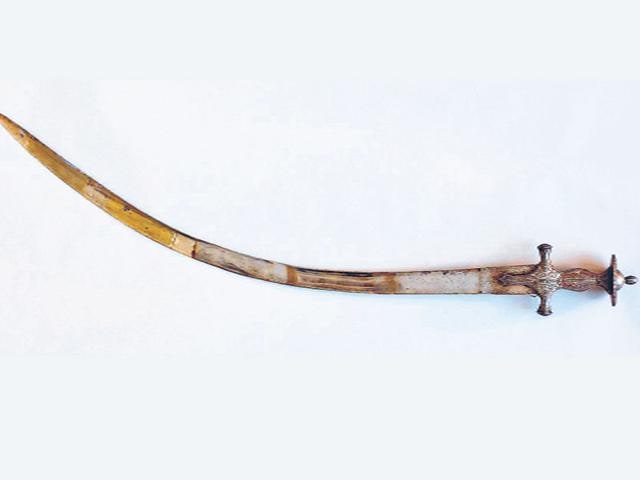
The study, led by Eliza Barzagli of the Institute for Complex Systems and the University of Florence in Italy, is published in Springer’s journal Applied Physics A-Materials Science & Processing.
The 75-cm sword from the Wallace Collection in London was made in India in the late eighteenth or early nineteenth century. The design is of Persian origin, from where it spread across Asia and eventually gave rise to a family of similar weapons, called scimitars, forged in various Southeast Asian countries.
Two different approaches were used to examine the shamsheer — metallography and a non-destructive technique, neutron diffraction — allowing researchers to test the differences and complementarities of the techniques.
“Ancient objects are scarce. The most interesting ones are usually in an excellent state of conservation. Because it is unthinkable to apply techniques with a destructive approach, neutron diffraction techniques provide an ideal solution to characterise archaeological specimens made from metal when we cannot or do not want to sample the object,” said Barzagli.
The sword’s high carbon content — of at least one percent — shows it is made of wootz steel. This type of crucible steel was historically used in India and Central Asia to make high-quality swords and other prestige objects. Its band-like pattern is caused when a mixture of iron and carbon crystalises into cementite. This forms when craftsmen allow cast pieces of metal to cool down slowly, before being forged at low temperatures.
(With agency inputs)


