
 E-Paper



A dip in the Arctic: Sanjoy Narayan on his love for ice-swimming


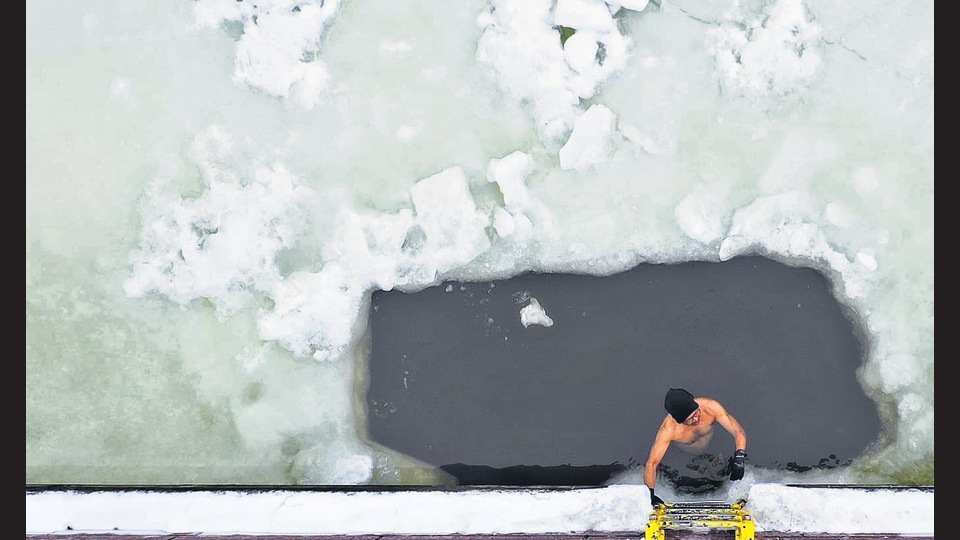
Nothing can prepare you for the shock of stripping down and descending into an ice-hole in the dead of Finland’s winter. But after the shock comes a euphoria. There’s a reason ice-swimmers are addicted, and some won’t even warm up in a sauna afterwards.
It happened in January. In Finland, the northernmost nation of the European Union, January is usually the coldest month of the long and cold winter season. Temperatures in Celsius frequently drop down to double-digit negative and the Baltic Sea, Gulf of Finland and Gulf of Bothnia that surround the country freeze. You can ski on the frozen sea, skate, walk, even drive to islands in the archipelagos, or, if you’re ballsy enough, you can take a dip in a hole cut into the frozen surface of the sea.
As I said, it happened in January. My companion, Pia, a 53-year-old feisty Finn well-versed in the art of gentle persuasion, got me to abandon all rational thinking and take the plunge with her. It was a bone-chillingly cold day. The air temperature was nudging -20 and where we were, on Eiranranta, in Helsinki’s West Harbour district, the wind made it seem even colder.
First I watched Pia climb down a ladder and dip into the ice-hole clad in a swimsuit, and gloves and booties made of neoprene to protect her fingers and toes. She was in for around a minute and then back up to quickly change into dry warm clothes.
I mustered all the courage I could and stripped down to my swimming trunks, borrowed her neoprene gloves and went down the ladder to the hole in the ice. It’s not easy to describe what you feel when your body first hits the cold water. It’s important to breathe, Pia had told me, and I did, but the cold rush that hit me wasn’t something you can prepare for. A few seconds after that numbing shock, though, you start feeling good. The water in the ice-hole is warmer than the air. It ranges from 0.2 to around 2 degrees C. The cold really hits you again when you climb out of the hole and get dressed.
The cult of ice-swimmers that go to Eiranranta are a bit more masochistic than most others, who prefer to get into a sauna, then go for a dip, and finish it off with another visit to the warmth of the sauna. At Eiranranta there is no sauna!
As I got back into my fleeces and gargantuan parka, I could feel a surge of freshness and a glow of happiness, partly I suppose because of the endorphin rush that ice-swimmers swear by, but also because I knew that I now had bragging rights. My bragging didn’t go exactly as I’d expected. That evening, when I somewhat conceitedly Instagrammed a picture of me in the ice-hole, many of my Finnish friends commented asking if I’d lost my mind.
Not everybody is into ice-swimming in Finland. Most people think anyone’s a lunatic to do it. But those who are into it are obsessive about it. Janne, 43, is an engineer in Helsinki. Every morning around 10, he cycles down to the seaside where the ladders lead down for the dips. He started swimming in the lakes (there are 188,000 of them in Finland) and the sea in the summer of 2018. He said it was so cold for him even in summer (Finnish summers, as you might have guessed, are mild) that he used to wear a neoprene bodysuit. But by October that year, when it turned to autumn, Janne started getting used to the cold and soon shed the bodysuit. By the time the sea started freezing, he was hooked.
He thinks the dips give him a mental boost. Some studies, including one conducted at the University of Oulu by Pirkko Huttunen and Hannu Rintamäki, have found that ice-hole swimming can boost self-confidence, alleviate chronic pain and help manage stress. Regular ice-swimming is believed to raise overall levels of endorphins and dopamine, both considered “happy hormones”. Deeper research has indicated that it can also help produce more serotonin, which balances mood, and oxytocin, which is associated with sexual activity.
Janne is more pragmatic about why he goes ice-swimming: it’s a mental boost, of course, and a natural antidepressant, but it also gives him a chance to get out of the house — he has two young children — and have some time to himself. For someone who started swimming in a bodysuit in summer, he’s now able to stay much longer in the cold water than anyone else I’ve met. “He’s not human,” one ice-hole swimmer said to me, “he’s a seal.”
Sami Kero, a photojournalist with Helsingin Sanomat, Finland’s largest-circulated newspaper, has been working for years on a project to document ice-swimmers, sometimes using drones to photograph the cult of people who are his subjects. Last week, after shooting me with his drone, he sent me a message: “Please let me know if you find some new nice ice hole locations. We can try to get better shots.” He doesn’t swim himself but his mission is to do a book on the practice, which an estimated 150,000 people in Finland (pop. 5.5 million) are believed to follow.
Some get addicted easily. When Pia started going for a daily swim to the sea it was last summer and she didn’t think she’d carry on after October, when the sea started turning cold, but she just kept going. It has helped her arthritis, her skin feels better, and menopause related symptoms are more manageable, she says. Not everyone is driven by the health benefits. Toni, 41, who owns a street fashion brand and has been at it for three years, cradles a coffee cup to warm his fingers after a dip, and says: “The internet has much to read about how it helps, but for me it’s that jolt of freshness that I get.” Whether it’s good for your health or not, one thing is clear: It can hook you. I know. I am an addict.


