
 E-Paper



A host of mini-me’s: The history of the tiny bio, and what makes it so hard to frame

 Prefer HTon Google


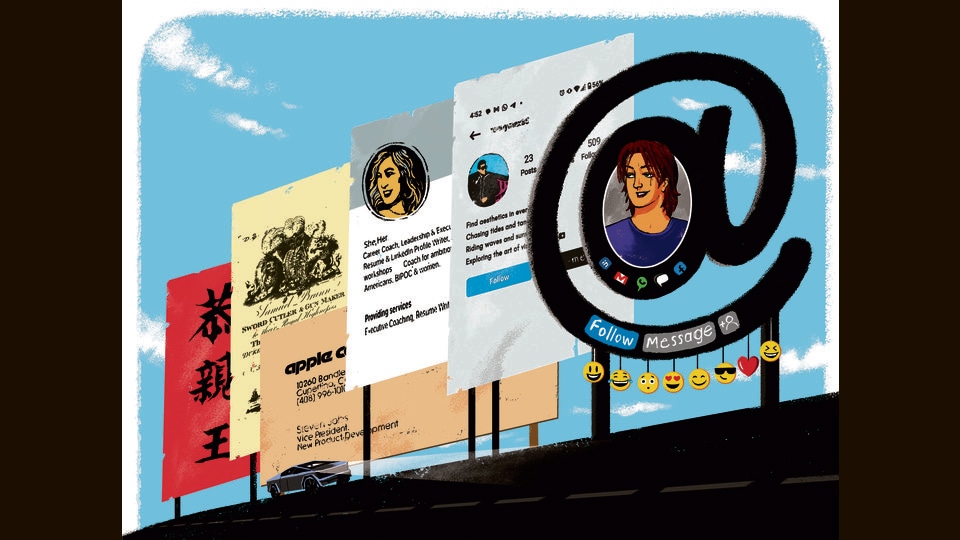
Chinese traders struggled to describe themselves in a few characters, in 300 CE. Such tags are battlegrounds of politics, power, delusion – even more so today.
“Cat mom. Disaster. Fuelled by coffee. Tweets my own.” The average bio on X may seem absurd, but as we’ve all found out, in one way or another, it isn’t easy to compress an entire personality into a handful of characters.
Across social-media platforms, bios become miniature stage shows; performances defined by character limits. This is our selves in shorthand; compressed, stylised and designed to achieve one goal: stand out in a crowd.
The urge to thus impress one’s identity on strangers isn’t itself new. From ancient traders’ tags to calling cards and early descriptors on SixDegrees.com (one of the world’s first social networking sites, launched in 1997), humans have sought to distil the essence of the self in order to make a quick but memorable impression.
Today, on dating apps, it’s a mix of jokes, trauma and hope. On LinkedIn, it is bare ambition. On other platforms, we remake ourselves over and over, to fit the bill.
But this urge predates the internet by a couple of centuries.
The offline world has its own absurd formats. In Delhi, it’s: “Tu jaanta hai mera baap kaun hai? (Do you know who my father is?)” And even that one isn’t original.
Bios have always been battlegrounds of power, humour and self-delusion.
Inherited power has been packed into early introductions going as far back as 17th-century Europe, when calling cards delivered something like a formal résumé of who a visitor was and what kind of call they were entitled to make on one.
The claim to status often began with the name: AB Jr or XYZ III revealed lineage (“tu jaanta hai mera baap kaun hai?”). A surname tied to someone of social standing was a key that opened doors. Occupations (John the Smith), patronymics (Geoffrey, son of Thomas), and place-based identities (of the Reginald-Dwights from Canterbury) all served to position the individual in society.
This format had a precursor too. In ancient China, tiny, ornate cards were used between traders, to log a formal request for a meeting. These pieces of paper, or wood, typically featured the person’s name, title or job description, and often a few words about themselves. The oldest of these has been dated to about 300 CE and was found on a tomb, still announcing the person’s name and trade.
Cards from as recently as the 15th century have been found to feature intricate Chinese calligraphy, and sometimes gold detailing, as instant markers of wealth and social standing.
By the 18th century, printing technology was giving such cards a fillip, particularly in booming, Industrial Revolution-era Europe. Over the next century, as the cost of printing dropped steadily, trade cards became early canvases for advertising, while calling cards became adorned with crests and flourishes.
By the 20th century and the dawn of the modern office, we were firmly in the age of “Here’s my card”, thick card paper, embossed logos and personalised typography. (Until the digital age changed all that. Today’s equivalent: the email signature).
The visiting card has long died a quiet death in the backs of office drawers. There is no one descriptor that works for all recipients any more; no one descriptor that works for the self, over an extended period.
The social-media bio and the online profile are a reflection of the living you. They are searchable, changeable, watched by others. They are still as constrained by space, character limit, attention span and etiquette. But, in a shift in keeping with our world, they are a lot less formal.
One may sneak in emojis and a joke; a tone of irony or self-deprecation. One must learn to express multiple parts of one’s personality, in ways that will still make up a composite whole, across platforms such as LinkedIn, Instagram, Substack, Medium and X.
A social-media bio is all its predecessors rolled into one: an introduction, a banner, an initial handshake, a tagline for one’s personal brand.
Where once a visiting card was updated to reflect a change in name, status or profession, today it may be altered to reflect a new relationship, a sudden burst of existential clarity. Or simply to share a new favourite joke. (“Don’t think of yourself as an ugly person; think of yourself as a beautiful monkey.”)
What looks like a quick intro is then self-deprecation, self-indulgence, branding and marketing, self-defence, and still sometimes self-delusion.
Meanwhile, in the battle over pronouns, Palestine and the right to choose, it is also a tiny battle flag: a declaration of who one is, where one stands, and how one wishes to be seen.
This is part of what makes framing one so hard. A good bio necessitates a journey inward: Who am I, to myself? How do I see my place in the world?
“Cat mom. Disaster. Fuelled by coffee”, “Poet. Patriot. They/Them” and “Husband. Father. Ally” are as much messages to the self as to the world.
“Here: look, listen…” they call into the void. “This is me.”
Is it really? How much is performance? How much is posturing? How much is make-believe?
Let it go. Few business cards have ever been totally honest.


