
 E-Paper



A rocky start: The riveting story of how Earth got its oxygen

 Prefer HTon Google


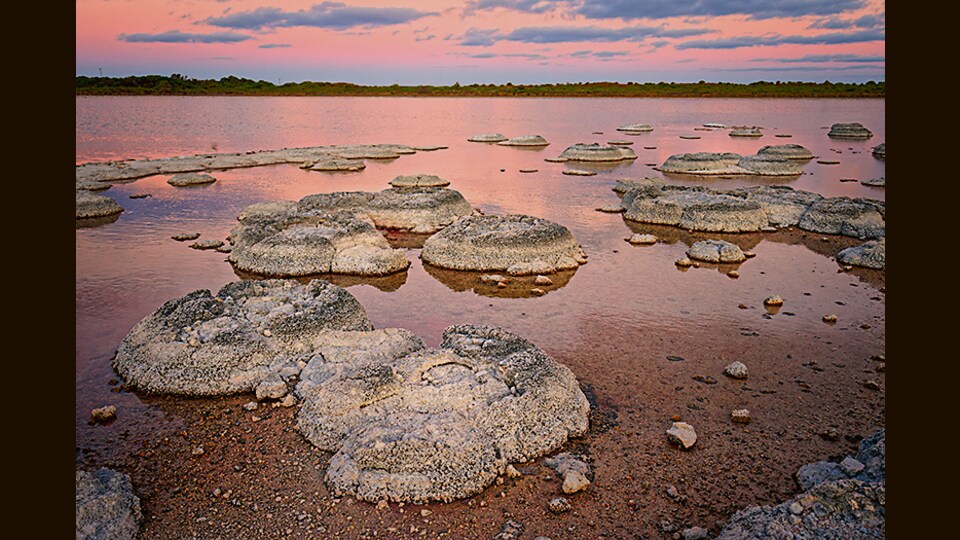
Single-cell bacteria in marine waters altered the composition of liquid and air – as the planet heaved around them. Their fossils still stand, not far from you.
They are the earliest evidence of life on Earth.
Stromatolites date to a time before oxygen. These stony structures hold the fossilised remains of cyanobacteria, a sort of ancient ancestor to us all; a single-celled organism that produced much of the oxygen in our air.
Billions of years ago, cyanobacteria grew in colonies, forming sticky, gelatinous mats in shallow water.
As cyanobacteria used sunlight for photosynthesis, they consumed dissolved carbon dioxide from the marine water (converting it into sugars for energy) and released oxygen as a byproduct. This biological activity altered the local water chemistry, specifically increasing the pH and causing the precipitation of calcium carbonate (limestone).
These formations lie scattered around the world. In India, they can be found in areas ranging from the Vindhyas and the Cuddapah Basin in parts of Andhra Pradesh and Madhya Pradesh to the limestone ridges of the Himalayas.
Cyanobacteria, incidentally, are still around in large numbers and still fossilise as stromatolites. This means that one can study the rocky formations for clues to the chemical make-up of marine environments and tidal flats going back billions of years. Going back, in fact, to a time when Earth’s atmosphere was made up largely of methane and carbon-dioxide; when the earliest supercontinents still lay submerged beneath gigantic oceans; when the skies were likely orange from volcanic activity; and when only single-celled organisms like bacteria and archaea existed.
What secrets do they reveal here at home? Take a look.
.
* 2.6 billion years ago: Chitradurga, Karnataka
The signs of early tectonic shifts are still visible in the landscape here; in its non-linear folds, faults and cracks that plunge deep into the earth.
The stromatolites here are shaped like washbowls, cylindrical with concave tops (and a wavy base). Some have ended up piled one on the other, and stand in short, squat columns.
Simply walk around the ancient Vani Vilas and Joldhal rock formations in Chitradurga to see some of the stromatolites yourself.
.
* 1.8 billion years ago: Jhamarkotra, Rajasthan
This bulbous, rocky group of fossils dates to the Proterozoic Eon, when the Indian plate was part of the massive southern supercontinent of Gondwana. Oxygen levels on the planet were still low at this time, but had stabilised and were rising.
The stromatolites here, incidentally, are rich in uranium, suggesting that they formed amid an upswell of cold water from the depths of the ocean, an upswell that flooded the shallow marine environment with new elements. In further proof of this, the stromatolites here contain cone-like structures formed by mineralised bubbles, a type of formation nicknamed “crocodile skin”.
The Stromatolite Park at Jhamarkotra (also known as Bhojunda) near Udaipur is a recognised geoheritage site and is accessible to the public.
.
* 1.6 billion years ago: Chitrakoot, Madhya Pradesh
Earth’s atmosphere still had only 1% to 10% of the oxygen it contains today, but the Great Oxygenation Event had begun by the time these stromatolites took shape.
The Chitrakoot fossils are particularly significant because they contain evidence of what may be the oldest known multicellular organisms (red algae), a discovery only made in 2017 — and one that caused considerable excitement around the world, since it pushed the date for estimated onset of multicellular life back by 400 million years. It was Stefan Bengtson, of the Swedish Museum of Natural History in Stockholm, who made the discovery with his team.
Though not a formal park, the stromatolites in Chitrakoot are accessible, particularly in the area near Janaki Kund temple.

* 1.4 billion years ago: Salkhan, Uttar Pradesh
The Earth was still spinning so fast at this point that a day was only 18 hours long. It was spinning this fast partly because of the gigantic moon in the sky — our satellite was so much closer, it was altering the planet’s rotation.
The seas were likely black and sludgy, as the rising levels of oxygen reacted with their high iron content. The supercontinent Columbia was beginning to break apart, influencing global geography and climate. Clues to all this and more are hidden in the Vindhyan Supergroup, one of the most extensive and well-preserved collections of Mesoproterozoic sedimentary rocks on Earth.
Amid these rocks, easily accessible at the Sonbhadra Fossil Park, are exceptionally well-preserved stromatolites. Expect to find columnar, stratiform and domal forms, shaped by the shifting landscapes and turbulent waters in which they once stood.
.
* 1.4 million years ago: Chhattisgarh
A billion years have passed and land masses have broken up and shifted, creating new pathways for oceans and waterways. Amid the flux, the stromatolites here gain sinuous patterns. Similar formations emerge, at this time, in what is now China, North America and Siberia, suggesting similar marine evolutions.
The stromatolites in the Chhattisgarh Basin are most easily accessible at Jagdalpur.


