
 E-Paper



Dream catcher: Ahead of a first-ever show in Delhi, a peek into Salvador Dali’s surreal mind


He was a divisive genius who redefined reality. See why his art matters, how surrealism was about a lot more. And how young artists are taking it forward today.
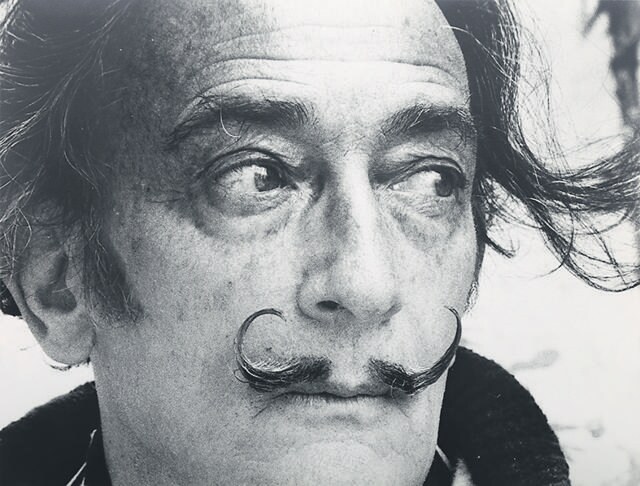
On a warm summer day in 1968, a 13-year-old named Christine Argillet sat curled up in the Royal Suite of Hotel Meurice in Paris, watching as her father Pierre Argillet, a publisher, pressed his friend and business associate, Salvador Dali, to sign a set of new etchings.
Christine was perhaps not as impressed as the noisy crowd gathered outside the hotel for a glimpse of the Catalonian, or the journalists waiting impatiently in the foyer.
But she was observant. The phone rang and Dali’s secretary answered.
“‘Someone has come to meet Mr Dali,’ the hotel concierge told the secretary. Dali, who was talking to some people, gestured that he was busy. But the visitor was quite insistent. ‘She wants Mr Dali to sign a petition,’ the concierge called again. Dali, who was a good man, allowed the visitor to come to the room,” Argillet, 70, recalls.
“A few minutes later, an old woman stooped with age walked in. She wore golden-rimmed glasses, and a wide hat with a long feather sticking out to one side. She looked very angry. Waving a paper in her hand, said, ‘Mr Dali, you need to sign this petition against torture right now!’”
After several seconds Dali said, “But madame, I’m very sorry, but I love torture!” “The lady glowered at him and left,” Argillet recounts. “The next day, most Parisian papers carried a story on their front pages: Dali admits he loves torture. My father, who had just opened a gallery in Paris, even received death threats.”
This incident is symptomatic of how easy it was to misunderstand Dali, Argillet says.
“He would say things to shock people out of their bourgeois complacency or entitlement and he would state things very seriously. Even if he was saying them only to be humorous, he wouldn’t let on,” she adds.
***
Born in 1904 in Catalonia, Spain, Salvador Dali is one of the best-known artists of the 20th century, achieving fame for works that went beyond the canvas too. He contributed articles and illustrations to magazines, wrote two autobiographies (The Secret Life of Salvador Dali, 1942, and Diary of a Genius, 1963), a novel (Hidden Faces, a love story that ends with a hallucination in which Hitler awaits his death), and a seminal work on surrealism, 50 Secrets of Magic Craftsmanship.
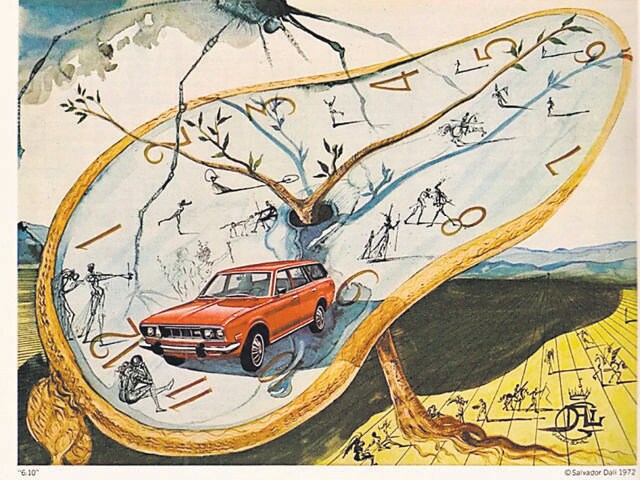
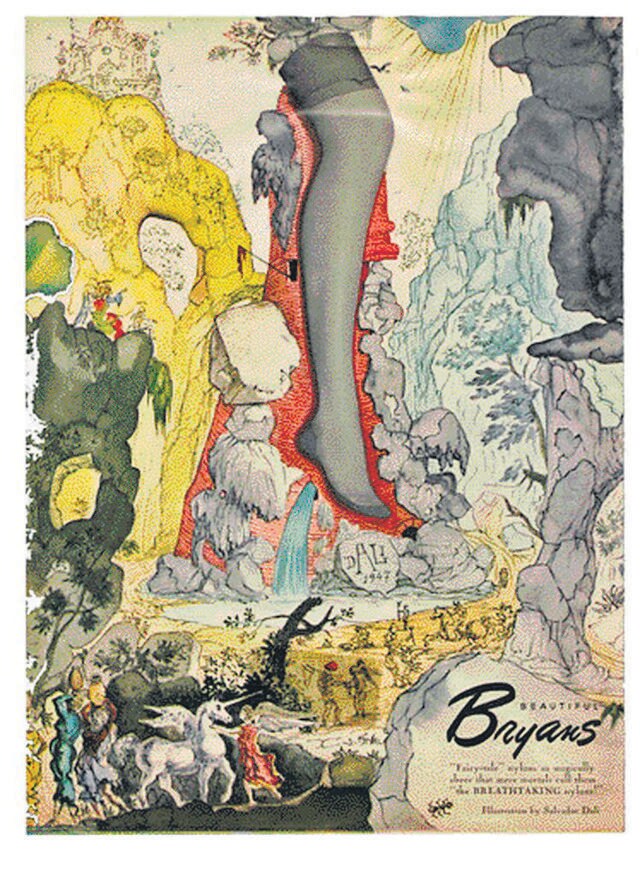
He co-wrote the screenplay for a silent film (Un Chien Andalou or An Andalusian Dog; 1929), designed four covers for Vogue and a number for other magazines, and created commercial art for brands ranging from Bryans hosiery to Datsun cars.
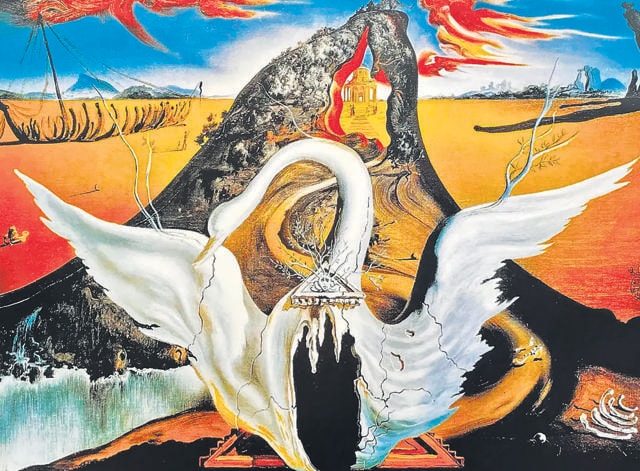
In the 1930s, he collaborated with fashion designers Elsa Schiaparelli and Coco Chanel. The former collaboration resulted in a suit meant to mimic a bureau, complete with semi-rigid drawers for pockets; and an iconic “lobster dress” (white, with the crustacean sprawled down the middle). In the latter, he designed the set and wrote the libretto for the ballet Bacchanale, performed by the Ballet Russe de Monte Carlo.
Still, it would be disingenuous to speak of Dali as though he were unique in the early 20th century. European cities of the time were filled with eccentric greats whose influence extended outside the walls of the white cube and whose collaborations bridged the worlds of art, theatre, fashion and popular culture.
Artists revolted against some ideas, and coalesced around others; they influenced people’s tastes in a way that seems surreal today. Dadaists in Zurich were sickened by the ways in which logic, reason and science were extolled to justify World War 1. Cubists imposed geometrical severity to underscore a fractured reality. Fauvists rebelled against the conventional utilisation of three-dimensional form, and used colour and brush stroke to delineate and attack the implied rigidity of the canvas. Futurists lionised the machine, and saw the restlessness of modern life as a kind of vitality. Dali, who trained at Madrid’s School of Fine Arts, was influenced by these avant-garde movements.
He burst onto the scene in a range of different ways, in what would be a turning point year for him: 1929. He was 25 when he met the poet Andre Breton, who headed a group of surrealists; showcased his silent film; met his future wife, the writer Gala (then married to the surrealist French poet Paul Eluard); and held his first exhibition in Paris.
He would soon outstrip them all, with art that distilled his approach to the world down to a single, dramatic idea: Reality wasn’t real; it was a construct of the psyche.
***
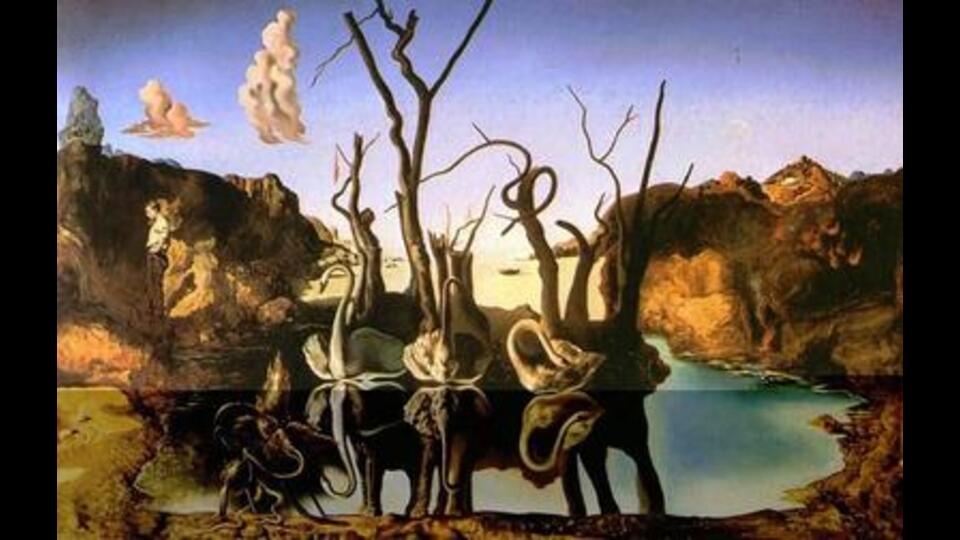
Surrealists wanted to bring the unconscious and the irrational of the psyche to light, no matter the artistic medium. Dali would become its most famous proponent. One of his best-known works, The Persistence of Memory (1931), remains a universal metaphor for the experience of living in our world.
Yet, it is essential to place Dali in the context of his time.
He painted at a time when fascism was on the rise in Italy and Germany. His canvases made fellow surrealists — many of whom were opposed to Adolf Hitler and Benito Mussolini — denounce his politics.
He would eventually be shunned by other surrealists, who were using their voices and their art to speak against the rise of fascism, and were shocked that his only response seemed to be an interest in how the new fascist leaders had come to be.
In February 1934, Breton and other Paris surrealists asked Dali to rework a painting that depicted, among other things, a slumped nurse propped by a wooden crutch (The Weaning of Furniture-Nutrition). In a previous version, she wore an armband bearing the reverse swastika, which Breton and his cohort took exception to. In a terse exchange of letters, Breton denounced Dali’s “counter-revolutionary acts tending toward the glorification of Hitlerian fascism”. Dali eventually reworked the painting, but wrote back to Breton, “I am Hitlerian neither in fact nor in intention”. He argued that the Nazis would certainly burn his paintings, and probably him as well. He was nonetheless expelled from the group.
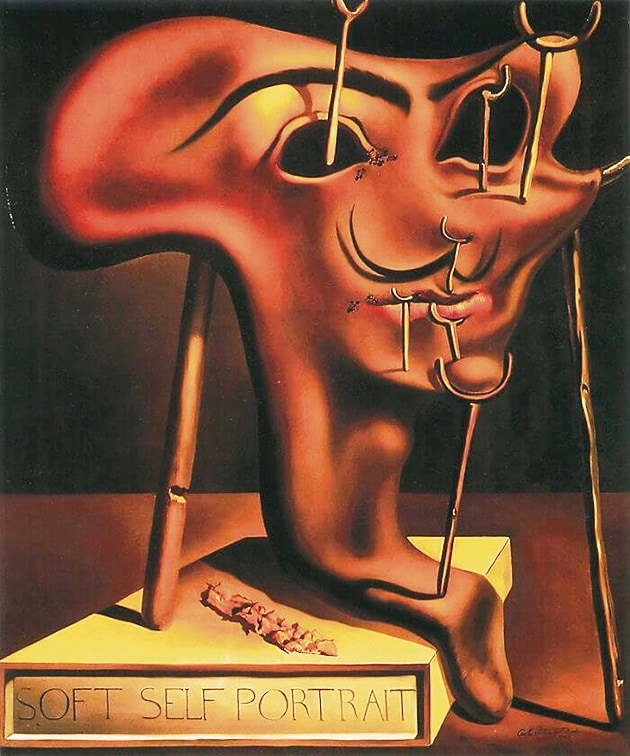
The surrealists weren’t the only ones who denounced Dali. In 1944, George Orwell wrote an essay calling him a “disgusting human being”, after reading the autobiography Dali had published two years earlier. He was referring to the artist’s stated acts of violence as a child and as an adult, as well as his fascination for corpses and excrement. Though Orwell knew that Dali’s utterances were often intended to be outrageous and fantastical, he found them disturbing.
Orwell added, however: “He has fifty times more talent than most of the people who would denounce his morals and jeer at his paintings.”
***
Within the movement, Dali created a method of his own.
The term “surrealism” was first used in a play by the poet Guillaume Apollinaire in 1917.
It was turned into a political philosophy when, in 1924, Breton published The Surrealist Manifesto.
Surrealism, Breton wrote, was “pure psychic automatism”. It called for the creation of art without conscious thought or intention, “outside all aesthetic or moral preoccupations”.
And the portals to pure psychic automatism were dreams.
“I believe in the future resolution of these two states, dream and reality, which are seemingly so contradictory, into a kind of absolute reality, a surreality, if one may so speak,” Breton wrote.
Dali’s paranoiac-critical method, however, aimed to lay bare subconscious desires that reason and Christian morality suppressed. Its focus on destabilising imagery meant themes and motifs were often repeated. The lobster in the Schiaparelli dress, for example, was also part of a sculptural object titled Lobster Telephone, a pavilion called The Dream of Venus for the New York World’s Fair in 1939, and in numerous sketches and paintings. It connoted sexual eroticism.
“All (the surrealists) were deeply interested in the destabilizing potential of (psychoanalyst Sigmund) Freud’s theories on psychology and the human unconscious. As the 1930s brought the renewed threat of totalitarianism and war to Europe, the surrealists believed that their knowledge of the mind and its processes were uniquely capable of combating the authoritarian belief systems that led to the rise of Franco, Hitler, and Mussolini,” art critic Andrew L Shea writes, in a review of a 2019 exhibition on surrealism in the 1930s and ’40s, held at the Baltimore Museum of Art.
By June 1936, when the International Exhibition of Surrealism was held in London, Dali was arguably the biggest name on the list of artists featured. The others included painters René Magritte, Marcel Duchamp, Joan Miró, Man Ray and Max Ernst, sculptor Alexander Calder, and writer Dylan Thomas.
By this time, Dali had fallen out of favour with most of them.
***
Argillet has only fond memories of the man, she says. “He was very elegant, very well-read, very respectful. At the same time his mind was extremely free in a sort of Marcel Duchamp kind of way. But then, the two artists were very close.”
Part of the Pierre Argillet collection, which comprises several etchings, sketches and watercolours by Dali, will be showcased in New Delhi across February and March, in an exhibition hosted by Bruno Art Group.
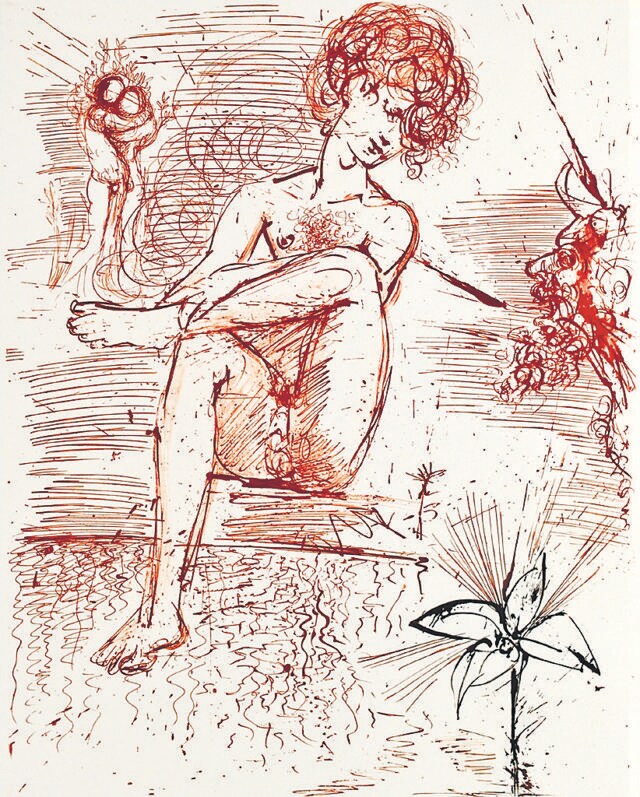
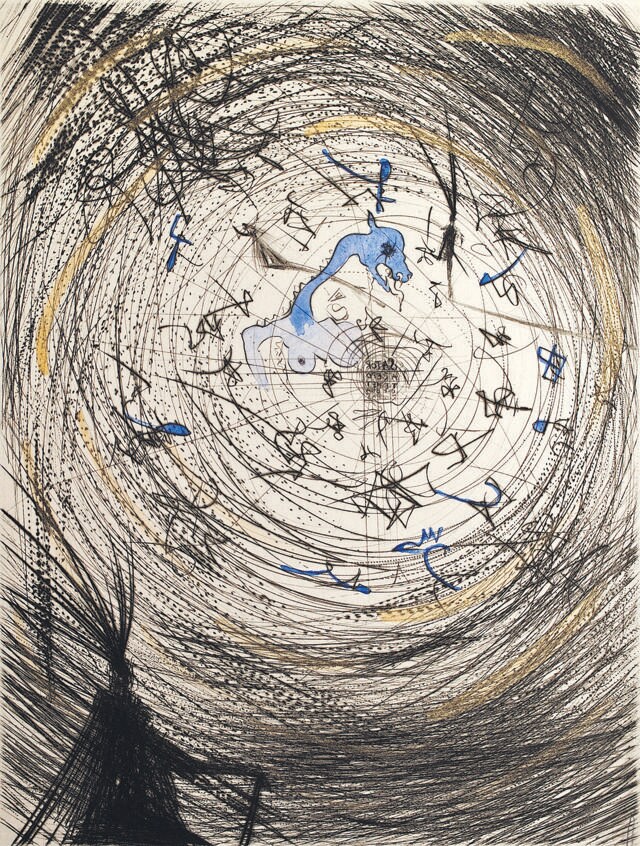
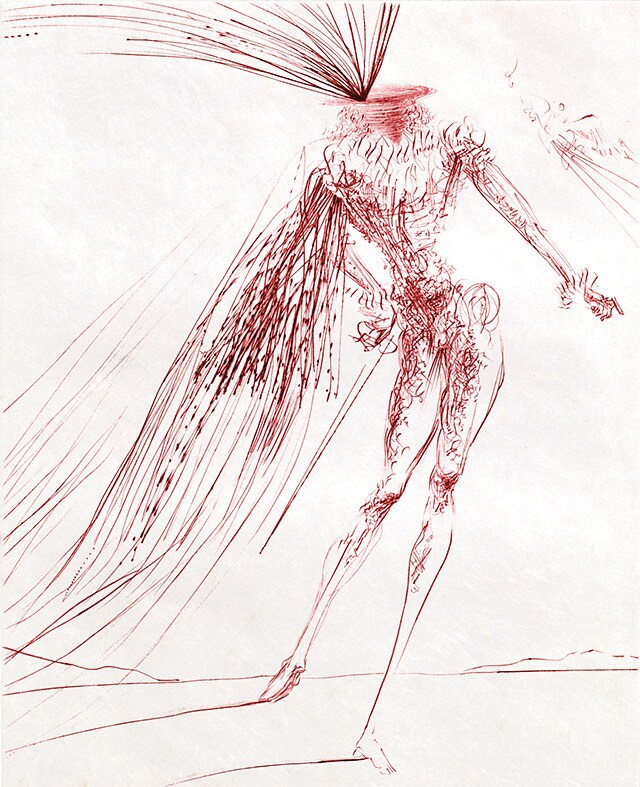
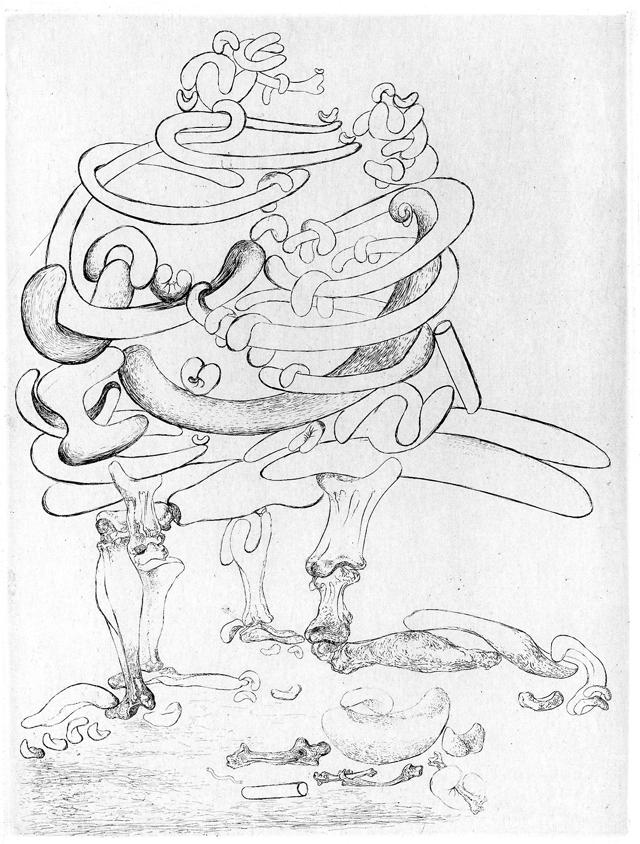
The show will include etchings from series such as Faust (which brilliantly illustrate Goethe’s masterpiece with the use of magic circles and alchemical symbols), Don Juan (etchings on themes of seduction, love and death), The Songs of Maldoror (a set of 50 prints, including eight reworked plates where Dalí elaborated on visions of his childhood traumas) and Mythologie (etchings drawing closely on the symbolism of ancient Greek legends).
“Each time I present our collection in galleries, I meet people who show me an element in some work that I had not noticed earlier. There are so many layers, different cultures through history, that are linked as elements of his psyche,” Argillet says. “There’s always some element of his imagination that isn’t really represented in one’s mind, and which one discovers (through others who see it). That, for me, is the most beautiful part of Dali’s work.”


