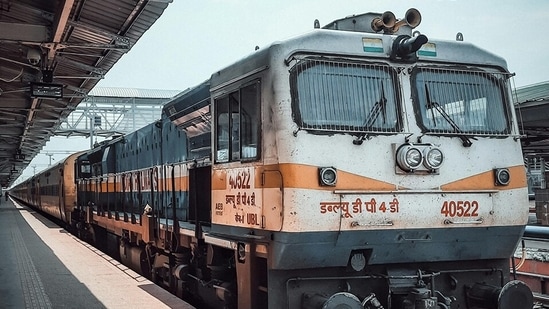
Every day, lakhs of Indians take a train to travel across the country. Even our childhoods have been defined by train journeys – from finding which platform your train will arrive on to figuring out your coach and seat, and arriving hours before at the railway station.
Also Read | Everyday explained: Why LPG cylinders are painted red
Each train you have taken in your life has always had a different number assigned to it. Moreover, each coach had a different number. But have you ever wondered how and why the trains are numbered? What do these numbers mean? Let's find out their hidden meaning:
How are train numbers allotted to Indian trains?
From the years 1989 to 2010, a four-digit scheme was used for long-distance passenger trains, and they were called ‘Universal Numbers’.
However, in the old train numbering system, these numbers were not unique across zones. So, in 2010, the Indian Railways switched to a new system in which all its train numbers were converted to a five-digit numbering scheme. The Ministry of Railways called this move more scientific, logical, uniform, and computer-friendly.
According to Press Information Bureau, to make the transition smooth, only a prefix of the digit ‘1’ (one) was added to the ‘four’-digit numbers of the existing trains.
{{/usCountry}}According to Press Information Bureau, to make the transition smooth, only a prefix of the digit ‘1’ (one) was added to the ‘four’-digit numbers of the existing trains.
{{/usCountry}}Meanwhile, the special trains run by the Railways to clear holiday or festival rush, etc., were numbered on the pattern of the mail/express trains except that they were given the prefix of digit ‘0’ (zero).
What do the numbers on train coaches mean?
The first digit indicates the type of train, the second and third digits tell the zonal code or division, and the fourth and fifth digits are the unique serial number of the train.
- First digit
0: special (short-term) trains (summer specials, holiday specials)
1: long-distance scheduled, regular express/mail, and superfast trains like Duronto, Yuva, Rajdhani Express, Shatabdi Express, Jan Shatabdi Express, Garibrath Express, Sampark Kranti Express, and all categories of trains that have an express/mail character at any point in their journey.
2: also for long-distance trains, but these are used when train numbers starting with 1 are exhausted in any series.
3: Kolkata suburban trains.
4: suburban trains in Chennai, New Delhi and other metropolitan areas.
5: passenger trains with conventional coaches.
6: MEMU trains.
7: DMU (DEMU) and railcar services.
8: currently reserved.
9: Mumbai area suburban trains
- Second and third digit
The second digit indicates the headquarters of the zone (Eastern, Northern, West-Central, etc.) and the third digit indicates the end destination of the train (Howrah, Delhi, Mumbai, etc.). The second and third digits work together as a geographic identifier.
0: Konkan Railway
1: Central Railway, West-Central Railway and North Central Railway
2: Superfast trains and some other classes of trains, regardless of zones. For these, the next digit is usually the zone code.
3: Eastern Railway and East-Central Railway
4: Northern Railway, North Central Railway and North Western Railway
5: North Eastern Railway and North-east Frontier Railway
6: Southern Railway and South Western Railway
7: South Central Railway and South Western Railway
8: South Eastern Railway and East Coast Railway
9: Western Railway, North Western Railway and West Central Railway
Another theory states that the first two digits written outside the train bogie simply indicate the year the train was made, and the last three digits indicate the type of coach/compartment you are travelling in.
Why were trains assigned 5-digit numbers?
According to a notice released by PIB in 2010, the Indian Railways shifted to a 5-digit train numbering scheme from a 4-digit one to capture all passenger trains running over Indian Railways on various software applications.
Note to readers: This article is for informational purposes only.