
 E-Paper



Is tomorrow here already?: Here’s what science-fiction predicted for 2024

 Prefer HTon Google


Echoes of our world abound, as whistleblowers turn up dead and corporate greed costs lives. There are some happy endings too. It is the movies after all.
May you live in interesting times, goes the Chinese curse, so subtle one could mistake it for the opposite. But interesting times aren’t stable; stability is dull.
Well, we certainly live in interesting times today. How do they compare with what science-fiction predicted, for 2024?
Nuclear war hasn’t materialised, in our world; unbridled industrial pollution has, but it hasn’t ended hope (far from it). Extreme virtual reality is in the making; well-funded efforts are striving to prove we live in a simulation.
We aren’t yet a world where all recreational drugs are legal; we aren’t, at least not this year, a world in which our species is barely holding on.
But there are deep truths hidden even in the more outlandish films made over half a century ago. There are a few happy endings too. It is the movies, after all. From Beyond the Time Barrier (1960) to Narcopolis (2015), take a look.
Quantum leap
In Beyond the Time Barrier (1960), the year 2024 looks bleak. Competitive nuclear-weapons testing has damaged Earth’s atmosphere and let in dangerous cosmic rays. The rays have caused disease, rendering everyone sterile except one telepathic woman named Trirene, granddaughter of the Supreme, leader of the underground city known as the Citadel.
Everyone except the Supreme and his second-in-command, the Captain, is also deaf and mute.
Into this world crash-lands US Air Force pilot William Allison, who was on a sub-orbital test flight in 1960 when he zoomed through a tear in the space-time continuum. (This was nearly a decade before the Moon landing, and some were still clearly a little hazy on what was possible in sub-orbital flight.)
Allison is first imprisoned, then released as a vital resource, with the mission of repopulating the city. He has other plans. First, of course, he falls in love with Trirene. Together, they frame a new mission: to help him return to his own time.
There is a grand battle, a grand betrayal, a heart-breaking death and an almost-happy homegoing. Can he alter history enough to change 2024?
The (very)-low-budget sci-fi effort was directed by Edgar G Ulmer.
Given today’s rising incidence of skin cancer and falling fertility rates, his low-fi effort may have had the cause wrong, but was rather on the money on at least some of the effects. As for the deaf and mute detail, he could have substituted it with blind and got that largely right too.
Bleak and bloody
The sci-fi black comedy A Boy and his Dog (1975) follows a teenager and his telepathic canine as they scramble to survive in a post-apocalyptic 2024.
Wipe thoughts of Pixar and This is Us from your mind. These are neither do-or-die heroes nor even etched-in-shades-of-grey anti-heroes; they are violent, amoral miscreants. They don’t even like each other very much, but depend on each other to survive in their wasteland of a world, populated by military robots gone rogue.
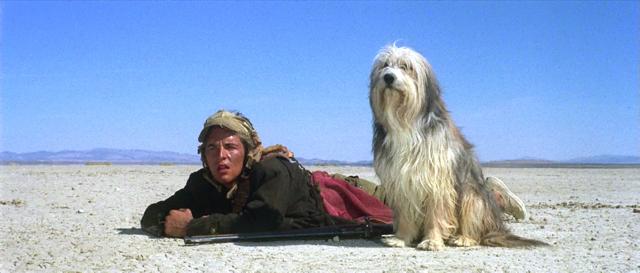
Eighteen-year-old Vic (played by a young Don Johnson) cannot tell right from wrong. He steals; kills; attacks and rapes women. The dog, Blood, is supremely intelligent, but suffering the quirks of imperfect genetic engineering.
As the plot unfolds, it turns out that one of Vic’s victims, a teenage girl, is from an underground settlement that has achieved some degree of stability. They need someone to help add to the gene pool.
Vic’s dream of sex with multiple women is short-lived; he is to provide his contribution through the excruciating method of electroejaculation (currently used on cattle and certain other animals, mainly endangered ones).
Vic eventually escapes, even begins to feel real love. Then he kills his love interest so he and his now-starving dog can eat her.
The movie was based on a wild ride of a novella, written in 1969 by fantasy author Harlan Ellison. We’ve avoided the nuclear war that was so feared in this time. There are Vics in our world, but they are not unique to our time. One thing the movie got wrong: There are no bad dogs (at most, misunderstood ones).
Infinite goop
The Highlander film series (there were six movies made between 1986 and 2007) started out strong.
Starring Christopher Lambert (as Connor MacLeod) and Sean Connery (as Juan Sánchez-Villalobos Ramírez), the first film told the story of a group of immortals born with an energy called the quickening. It centred on MacLeod, as he discovered he was immortal and prepared to fight another immortal to the death.
Then came Highlander II: The Quickening (1991). Set in 2024, it veered off into so many new directions, muddying the waters as it went, that it was called one of the worst movies of all time. To begin with, it announced that the immortals were really aliens expelled from another planet for leading a rebellion against their corrupt leader.
It then dove into a plot that was dense and plodding; punctuated by special effects that hinged on explosions, sparks and lightning bolts.
“If there is a planet somewhere whose civilization is based on the worst movies of all time, Highlander 2: The Quickening deserves a sacred place among their most treasured artifacts,” the film critic Roger Ebert wrote, in the Chicago Sun-Times.
Look closely, though, and it does offer prescient lessons in corporate greed.
In this 2024, the ozone layer has been destroyed by industrial pollution (the film was released six years after the ozone hole was first noticed over Antarctica). An electromagnetic shield invented by MacLeod, but now owned and run at immense profit by the Shield Corporation, has replaced it.
The shield blocks out light and retains humidity, so no one’s really happy.
Then, MacLeod comes upon new research that indicates the ozone layer has repaired itself (as indeed it has been doing, thanks to policies that targeted chlorofluorocarbons decades ago) and the shield may no longer be necessary. Shield Corporation is determined to keep this news from getting out.
Highlander II was considered so bad that part three took off from part one, ignoring it completely. But in this cheesy, action-packed, unhinged mess are echoes of where we are today, and how we got here.
Is any of it real?
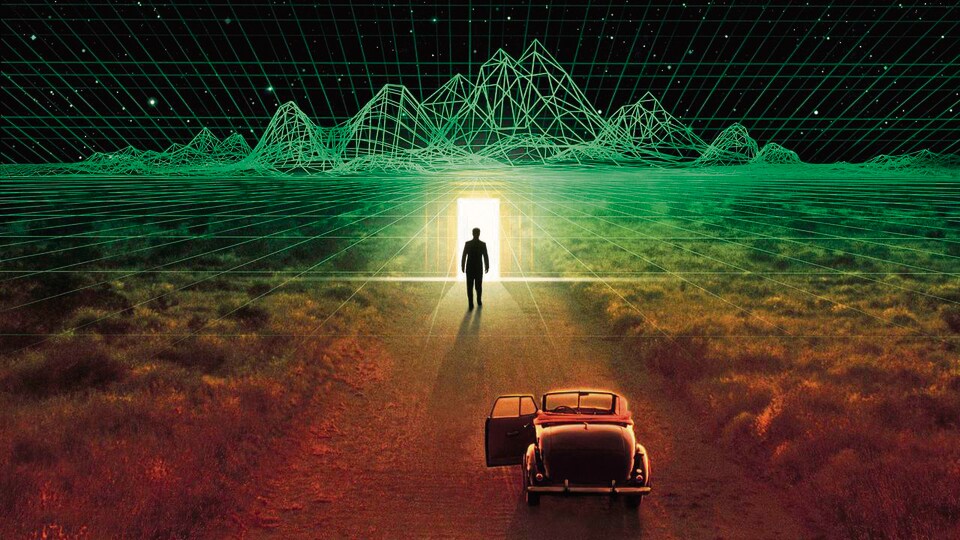
The Thirteenth Floor (1999) starts out as a relatively straightforward murder mystery. A tech billionaire named Hannon Fuller is murdered.
He had been building a virtual-reality simulation called 1937 Los Angeles, populated by characters who believe they are real people. (This film was released in the same year as The Matrix, so a fairly good year for this subgenre).
Fuller’s protege and heir, Douglas Hall, also chief scientist on the project, finds a message his mentor left for him in the simulation. Jane Fuller, an estranged daughter, is trying to destroy it.
Hall deciphers the cryptic message to learn that his own world is unreal too. It is really 1999 Los Angeles, another simulation, one of thousands.
Hall is now determined to find the people running these programs. His first step: to reach the world running his simulation, 2024 Los Angeles. Here, he meets the real Jane Fuller. She wants to tell him all about the universe of simulations, but our screens collapse into black, like an old-school TV set switching off. Make of that what you will.
Time lapse
Narcopolis (2015) is a noir time-travel thriller that starts off in the distant future, 2044, before quickly shooting back to a 2024 London in which all narcotic substances have been legalised.
The recreational drugs industry is controlled, as one would expect, by big pharma. The black market is still out there, but quickly shrinking. As companies peddle addictives, addicts are everywhere. A murder at the headquarters of Ambro, the world’s biggest drug company, leads a policeman and recovering addict named Frank Grieves to a secret new drug they have been testing. It seems to have played a role in multiple mysterious deaths and disappearances.
The drug, it turns out, lets humans travel through time, but they only survive at their destination for a few minutes, then die. The company is racing to fix the formula, but Grieves intends to expose them first. Especially after he discovers that the corpse at Ambro is his grown son Ben, come back from the future, murdered as he was about to blow the whistle. Can Grieves save himself, and his son?
As it turns out, whistleblowers, in real and fictional 2024, all too often turn up dead.


