Painted over, never seen: How new tech makes old canvases reveal secrets
With sophisticated X-ray and infra-red tech coupled with AI, it’s now possible to view paintings that lie under existing works, offering new insights into artists and their processes
It’s always been a tricky process, trying to recreate a painting beneath a painting. Once an artist has reused a canvas (usually to save money), or painted over a part-done work (because they changed their mind midway), it was only possible to guess at what those earlier works looked like.
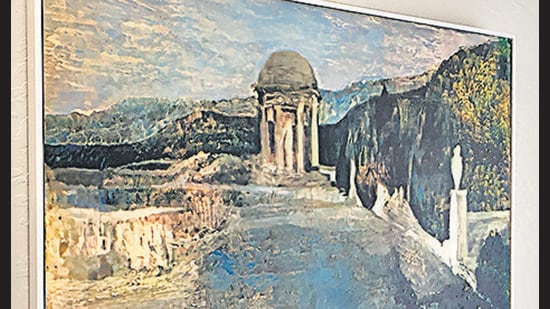
X-ray and infrared tech show that beneath Picasso’s The Crouching Beggar is this hidden work, Parc del Laberint d’Horta, by Catalan Modernist Santiago Rusiñol. (MORF Gallery)
In recent years, X-ray and infrared scans, combined with human expertise and some guesswork, have helped recreate some of these lost works. Frédéric Bazille’s famous Young Woman at the Piano, which he had written about but was nowhere to be found, was discovered in 2017 using radiography, under his 1865 painting, Ruth and Boaz.
French engineer Pascal Cotte spent over 3,000 hours making multispectral 240-megapixel digital scans of every layer of the 500-year-old Mona Lisa. In 2014, after poring over the painting for 10 years, he showed that she had both eyebrows, eyelashes, and a wider smile in earlier iterations.
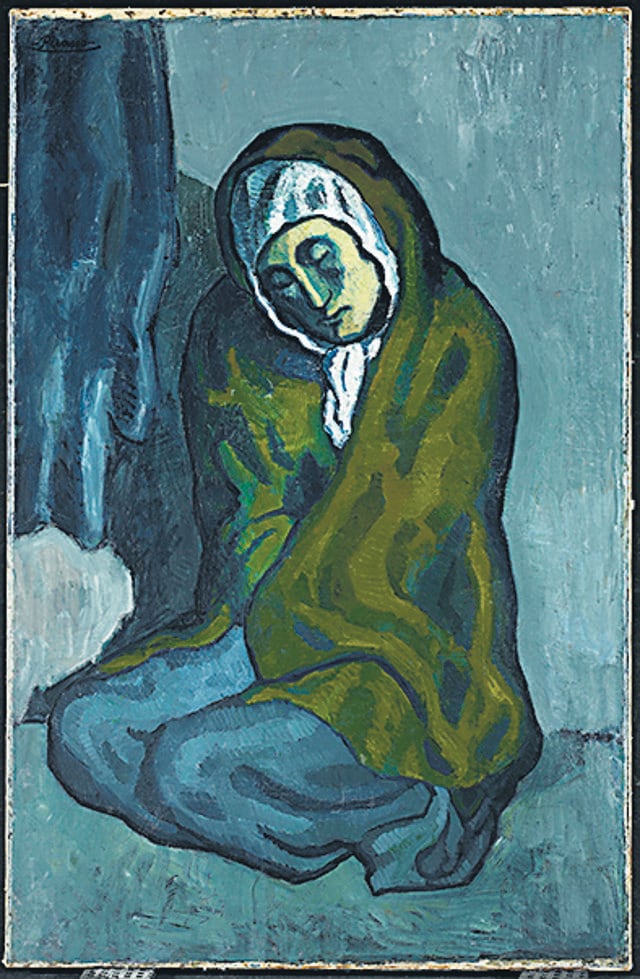
It look a decade of peeks under the layers of paint beneath this Pable Picasso work, The Crouching Beggar, to get a good visualisation of another painting that was created on the lower layers of the canvas. (MORF Gallery)
X-ray and infrared technologies interact differently with the metals in different pigments. So the presence of zinc, copper, iron, cadmium, chromium, etc would hint to researchers what the shades in the hidden painting might be. Rembrandts, Van Goghs and Raja Ravi Varmas have all been found to conceal such colourful secrets.
Now, new technology, driven by artificial intelligence (AI), is allowing researchers to recreate — much more exactly — these works that lie hidden under masterpieces.
Pablo Picasso’s 1902 The Crouching Beggar (La Miséreuse accroupie), for instance, hides a painting by another artist, Santiago Rusiñol, Picasso’s contemporary and a leader of the Catalan Modernism movement. Twenty-nine years after the painting beneath the painting was first discovered using radiography, it has been resurrected using AI- and 3D-based technology. The resurrection (it is being called a NeoMaster) was a collaboration between the UK-based Oxia Palus, an AI startup on a mission to resurrect lost art, and US-based MORF, a digital art gallery.
“Rusiñol is a lesser-known but very significant artist,” says Anthony Bourached, co-founder of Oxia Palus. “We thought it emphasised the extreme value of our technique, to bring to light artists and work that didn’t get the visibility they deserved.”
The hidden painting is of a garden believed to be the Parc del Laberint d’Horta near Barcelona. A machine learning program scanned several Rusiñol paintings and, combined with the latest in image analysis, a three-dimensional height map (essentially a 3D print) enabled paint to be layered onto canvas and the textures of brushstrokes to be replicated.
“Several Rusiñol paintings were used for different aspects of this NeoMaster, including techniques for the sky, objects and natural scenery, and another for his impasto style (a style where paint is layered on thick with a brush or knife),” says Bourached.
A second Neomaster has leveraged hundreds of Amedeo Modigliani works to reveal the portrait of a woman believed to be his lover, Beatrice Hastings, hidden under his 1917 work, Portrait of a Girl.
“These paintings are the first of an era of reinterpreting and resurrecting art that will lead to a better and deeper understanding of our history and culture,” says Bourached.
Limited edition paintings on canvas of both NeoMasters are available for prices starting at $11,111 (about ₹8.2 lakh). “There are thousands of lost artworks ready to be rediscovered,” says Scott Birnbaum, co-founder of MORF.

 E-Paper