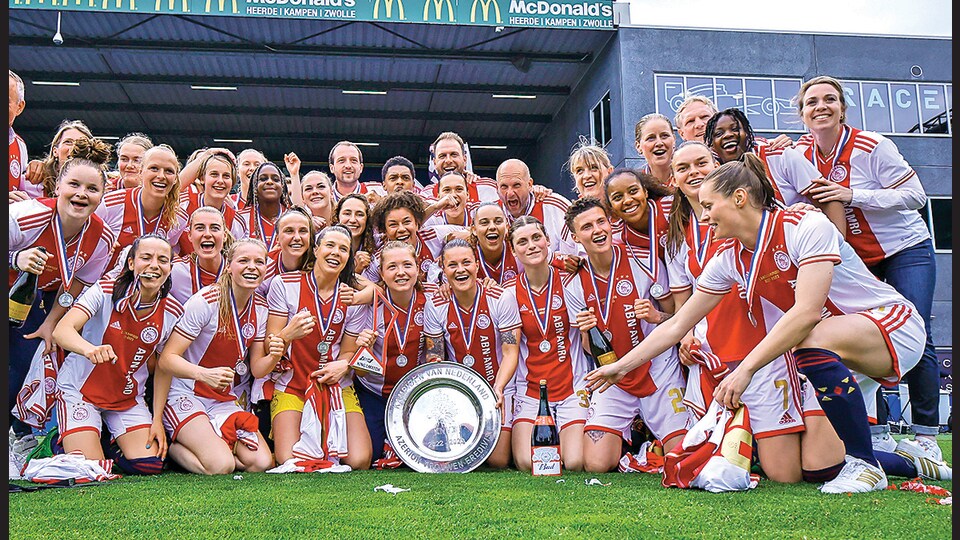
Separated by continents, three recent events are changing the football story.
In May, the Netherlands’ Ajax women’s football team, which won the league title for the first time in five years, turned down the Amsterdam mayor’s invitation to celebrate their victory with the usual balcony ceremony at the town square. “The lack of a celebratory mood around Ajax in general, which is linked to the performance of the men’s team this season, plays its part,” the club said. Ajax’s men’s team, a record 36-time winners of the Dutch league, finished third last season. So celebrations would be muted, “which would not be good for the image of women’s football”.
Early in June, the Kerala Blasters Football Club paused the women’s team activities because it was facing a financial crunch arising from a fine imposed on the club after the men’s team walked out of an Indian Super League semi-final.
And on June 14, Fatma Samoura the first woman secretary-general in FIFA (and the first Black, the first Muslim and the first non-European in that role) announced that she was stepping down. Even after seven years in the job, the highest-profile woman working in the world football was still struggling to break out of FIFA’s president Gianni Infantino’s shadow.
Gender bias is deep in sport, perhaps because it has run unchecked for so long. In 1896 Pierre de Coubertin, the founder of the modern Olympic Games, said: “No matter how toughened a sportswoman may be, her organism is not cut out to sustain certain shocks.” Even 23 years ago, when a Wimbledon champion from the 1980s, on a private visit to Kolkata, was asked by HT about women players earning less at Grand Slams, he had a tone-deaf reply: “How about them working as much?”
So, what needs to change for gender parity to be a reality? The arrival of a prodigy helps. Seven perfect 10s from Romanian gymnast Nadia Comaneci at the 1976 Olympics helped the sport shift from the balletic form into an acrobatic one. It also popularised women’s artistic gymnastics around the world and made it a rare sport where women are paid more than men.
With 23 Grand Slam titles, including one during which she was two months pregnant, Serena Williams, and older sister Venus, have helped change perceptions about women in sport. Ditto the Phogat sisters, who’ve won multiple medals at world championships, Commonwealth and Asian Games and helped forge a path where wrestling became a career and, through government jobs and awards for international podium finishes, a life-changing opportunity for women.
Doing well in a high-profile event helps too. Women’s cricket in India experienced a surge in popularity after the Mithali Raj-led team played the 2017 50-over World Cup final, and the one captained by Harmanpreet Kaur made the title round in the 2020 T20 World Cup.
More women coaches can bridge gender disparity too. What is common to former cricketer Deep Dasgupta, and tennis players Andy Murray and Novak Djokovic? They learnt the ropes under Sunita Sharma, Judy Murray and Jelena Gencic respectively. In 2014, Murray appointed former world No. 1 Amelie Mauresmo as coach saying he looked up to her. Exactly how odd this was in elite tennis can be gauged by only two men’s top-100 players having women coaches in 2019. And there were only five in the top-100 women then who had a woman as their main coach.
So, what needs to change most is our mindset. Men questioning the disparity and being partners in driving change can help. Because as Megan Rapinoe, who fought the good fight for equal share of earnings among the men’s and women’s football teams in the US, said: “A collective bargaining agreement is just words on paper… It’s the enforcement on both sides that actually makes that happen.”

 E-Paper




 Prefer HTon Google