
 E-Paper



Scenes of a textual nature: The changing language of work
In the workplace, emojis are now loaded with layers of meaning. Jargon carries more baggage. Full stops can give away your age. Didn’t you get the memo?


Do you find yourself reaching for the tears-of-joy emoji when you want to text someone that you’re amused? Or the thumbs up to show you understand? Have you sent across the dancing man or woman figure as a sign of celebration?
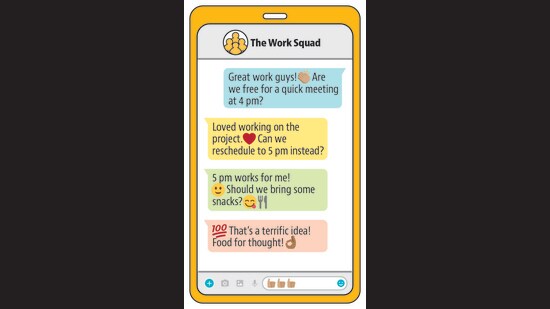
Emojis became a convenient texting shorthand because they cut across cultures and languages. Then came stickers and gifs. But with more people working remotely in the pandemic and the months since, workplace communication has taken even more unusual journeys. Emojis are now loaded with layers of meaning, jargon carries more baggage, and how you punctuate can give away your age.
Emojis which started out in casual personal texts, are now part of workplace e-mails and team messaging, even in newsletters from companies. “It’s reasonable to think a lot of people were feeling very stressed through the pandemic,” says Miriam Meyerhoff, professor of sociolinguistics at the University of Oxford. “They were also aware that the people they were communicating with might be as stressed, making them more inclined to carefully add this kind of social information to messages.”
In 2022, the instant messaging platform Slack commissioned a survey of 2000 American workers. They found that 75% of hybrid or remote workers in the survey felt that showing their personality through informal work messages helped them better connect with colleagues. About 73% believed that it helped them navigate the transition to remote and hybrid work effectively.
“Leaders and team members have adopted more informal language, peppering their messages with creative gifs, emojis, and emotive shorthand to show deeper appreciation for their staff’s contributions and connect on an equal footing,” says Erica Dhawan, leadership expert and author of Digital Body Language: How to Build Trust & Connection No Matter the Distance (2021). “Now, an email with three exclamation points and two emojis could easily come from a CEO.”
Circling back on jargon
Corporate buzzwords have been around for decades. Modern jargon, however, was born in the ‘50s and ‘60s, in the aftermath of World War II, when managers worried about competition, began focusing on creating an emotionally expressive atmosphere for employees. American historian Thomas Kuhn is credited for popularising the term “paradigm shift” in his 1962 book, The Structure of Scientific Revolutions. The start-up favourite “disruptive innovation” was coined in the mid-1990s by Harvard Business School professor Clayton Christensen.
In the new normal, no one quite has the patience for it anymore. “It negatively impacts trust and increases irritation and causes misunderstandings,” says Dhawan. “My best advice is to know your audience and adjust your tone and language, just like you would with body-language cues.”
Even without jargon, age and cultural differences increase chances misinterpretation. Gen Z users (born between 1997 and 2012) consider the smiley emoji as ironic. They view a full stop at the end of a sentence as passive-aggressive. “People from different cultures have different expectations about politeness,” says Lieke Verheijen, an assistant professor who studies interpersonal and professional digital communication at Radboud University in the Netherlands. It’s not uncommon for someone to add a blushing smiley emoji to a message that expresses criticism, to make it sound less harsh.
Don’t let the smileys intimidate you. “Emojis are like new words, or vocabulary items, in the language,” says Meyerhoff. “If the norms for providing explicit social information in our messages are changing, older users will have no trouble catching up –– if they want to!”
And account for the fact that not everyone you text or email has got the memo. “Informal communication gives us the opportunity to create team spirit outside of body language, in a hybrid or remote work set up. At the same time, it’s important to train employees to be mindful and not slip into unprofessional behaviours at work,” says Dhawan.
Sign language: What to mind while using emojis at work
Think before you emoji. Before you hit send, consider the seriousness of the conversation and your trust level with that individual. If this is a new relationship, err on the side of formality. If it’s a longtime friend, emojis are the new friendship bracelet.
Consider your platform. Will the receiver’s device display the emoji exactly as you intended? Different phones and computers display emojis differently. There’s a good chance your smiley face sent on MS Outlook could look like a pained scowl on your employer’s iPhone.
Be conscious of cultural differences. The thumbs-up emoji commonly means approval but in countries like Iran and Afghanistan, it can be offensive, translating into a vulgar insult.
Less is more. Don’t use too many in a work message and don’t repeat them. Multiple smiley faces, however happy you are, seem a bit excessive.
Curate your set. Adapt your emoji use to the colleagues with whom you are communicating. It might also help to clarify your tone of voice in follow-up statements. If you are unsure of a cool, trendy emoji, check its many meanings on Emojipedia.
Surviving the jargon wave
According to e-learning platform Preply, which surveyed 1,551 people aged 38 on average, across all the American states, working in-office or remotely in October, one in five of the respondents disclosed that they disliked corporate jargon, although seven out of ten agreed that they use them regularly. Here’s a look at some of the most off-putting buzz words on their list.
Circling back: The idea of a passive, unwelcoming, endless loop makes it one of the most commonly used and hated phrases. When used in terms of a deadline, it can sound dismissive and non-committal. Cutting to the chase might be more efficient.
Company culture: If the company isn’t willing to explain itself, it just might be another empty word thrown at you.
Giving a 110%: It’s now seen as either a brag or an unhealthy expectation that has no place in the modern office. Far from motivating, its usage can instead feel burdensome, encouraging you to work beyond your capacity.
Thinking outside the box: This cliché implies that you are boxed-in, which is unfair to begin with. It doesn’t provide any real direction and only piles on unnecessary pressure to perform unconventionally.
Rockstar: Responders to Preply’s survey found this phrase, often seen in try-hard job descriptions, to be a common red flag. It offers no real insight into what is expected of a candidate and makes the role sound unnecessarily challenging.
 ABOUT THE AUTHORAnesha George
Anesha is a features writer, sometimes a reader, who loves to eat and plan fitness goals she can never keep. She writes on food, culture and youth trends.


