
 E-Paper



The Gill guide to leadership: Kunal Pradhan writes on India’s captain acing the Test

 Prefer HTon Google


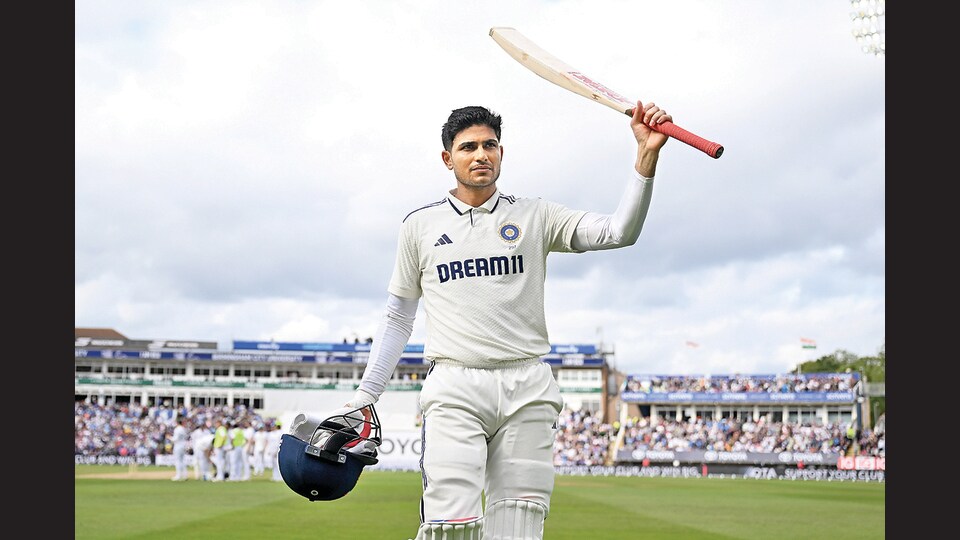
Amid the pressure and the criticism, Shubman Gill’s showing, on his first tour as captain, is a clear statement to pundits: Thank you for your input, but I’m in charge now.
Shubman Gill was stranded, rather calmly, for about 10 minutes and nearly three overs, on 199 during the second Test against England at Edgbaston.
A cricketing journey that began in Fazilka, Punjab (where he was born), traversed Mohali (where he was raised) and Ahmedabad (where he leads the Gujarat Titans IPL team), and made him India’s Test captain just weeks ago, was on the cusp of a glorious milestone. In the days leading up to the match, Gill, 25, was offered harsh lessons in leadership by pundits of every hue: on team selection, on the balance between defence and offence, on how to rotate bowlers. But Gill was in a different mood; instead of being schooled, he wanted to dole out a key leadership lesson of his own.
So when he got his turn at the crease after the longish wait, he fought off all temptation for theatrics. A single swatted to fine leg, measured and easy, was all he needed in order to raise a maiden double-hundred.
Then a different chase began. One that would evoke Sunil Gavaskar’s floppy hat, Vinoo Mankad’s horizontal bat, Rahul Dravid’s body blows, Sachin Tendulkar’s straight drive, Virender Sehwag’s hand-eye coordination, VVS Laxman’s radiant flick, and Virat Kohli’s perfectly measured singles. For whenever an Indian batsman crosses the 200 mark, particularly overseas, it becomes an expedition through history. With every few runs, as he crosses landmarks set by doyens of the past, a time gone by starts to appear in flashback.
History, etched in runs
It began, as it always does, with Dilip Sardesai’s unbeaten 200 at the Brabourne against New Zealand in 1965, which Gill crossed with a quick single at point, to sit alongside Navjot Singh Sidhu’s stodgy 201 against West Indies at Port of Spain in 1997.
When he glided Shoaib Bashir through third man for four, he went past Ravi Shastri’s resilient 206 at the Sydney Cricket Ground in 1992 (a knock in which Shastri nurtured a young Tendulkar to his first Test century in Australia). Three smooth boundaries to go from 210 to 222 eclipsed another Sardesai masterclass (212) at Kingston in 1971, Sanjay Manjrekar’s defiant 218 against the might of Imran Khan and Wasim Akram at Lahore in 1989, and Gavaskar’s holy grail 221 at the Oval in 1979, which, until that moment, was the highest score by an Indian in England.
Now officially a trailblazer, Gill cut for a triple to race past Mankad’s 231 against New Zealand in Chennai — the highest score by an Indian batter between 1956 and 1983 — and Dravid’s match-winning 233 at Adelaide in 2003. He then danced down the track for a massive six to surpass Gavaskar’s 236 not out, also in Chennai, the highest ever by an Indian batter between 1983 and 2001. Tendulkar’s defining 241 not out at Sydney, scored almost entirely on the leg side, was crossed with an immaculate cover-driven four. Kohli’s 254 not out against South Africa in Pune, until then the highest score by an Indian captain, was topped with a smooth single off his hips.
When Gill eventually got out at 269, a soft dismissal at short square-leg, one short of Dravid’s 270 at Rawalpindi, it was a landmark for the ages. Only three other scores by Sehwag (319 at the Chepauk, 309 in Multan and 293 in Mumbai), Karun Nair’s freakish 303 not out against England in 2016, and Laxman’s gold standard 281 against Australia at the Eden Gardens in 2001 are higher on the list.
Aye aye, captain
Yet, this wasn’t just about the innings. An Indian captain on his first tour, the weight of the world on his shoulders after being hunted down in the opening Test, had stepped out to mark his territory.
The team management under Gill and coach Gautam Gambhir made what seemed to be ultra-defensive blunders between the first and second Tests. They rested pace spearhead Jasprit Bumrah though he was fit, did not select attacking spinner Kuldeep Yadav, and packed the team with all-rounders who looked capable of boosting runs but not of taking the 20 wickets it takes to win a Test match.
But there is an X-factor in captaincy that is often overlooked: the power of a skipper to galvanise his troops by stepping out and making a stand. A stamp of individuality, if you will, that truly marks the start of an era.
In his third Test in charge, MS Dhoni set a bizarre 8-1 leg-side field that choked Australia at Nagpur in 2008, revealing his mantra as a captain who could do whatever it took, culminating in India winning the 2011 World Cup. In the home series in 2001, Sourav Ganguly made the great Steve Waugh wait for the toss in a gesture that played a part in turning the series on its head; and, in 2003, he stroked a blistering 144 on a bouncy Gabba to set the template for the tour. In the 1983 World Cup, Kapil Dev’s statement 175 not out when all seemed lost against Zimbabwe became a talisman for victory.
And so, Gill — he went on to score another century in the second innings, to shatter a dozen more Test records — did at Edgbaston what leaders must when their flock seeks inspiration. He charged the dressing room, drove his team to rise to the occasion, and propelled Akash Deep and Mohammed Siraj to seal a famous victory.
The Test series is still wide open and there will be other challenges along the way, but Gill has sent a message to the pundits, calmly yet emphatically: Thank you for your input, but I’m the captain now.


