
 E-Paper



Thread lightly: An arched look at what has shaped the eyebrow across centuries

 Prefer HTon Google


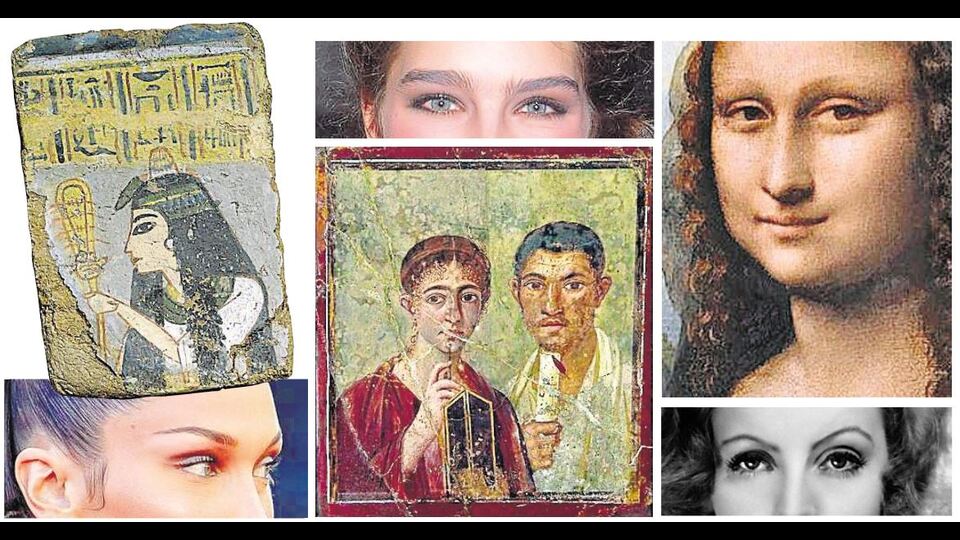
Power politics, silent films, flapper-girl culture, even Ancient Egyptians mourning the death of a pet cat, have all played a role.
It has quite the arc, the story of the eyebrow. Distinct styles through millennia can be traced to evolving ideas of bravery and beauty, even evolving technologies such as cinema and sound. All the way back to Ancient Egypt, eyebrows have served as a canvas for creativity.
Experimenting with them is easy, in the quest for finding one’s personal style. They also grow back easily. “As a result, for centuries, both men and women across social classes have shaped and coloured their eyebrows,” says Jill Burke, a beauty and art historian and professor at the University of Edinburgh.
Her latest book, How to Be a Renaissance Woman: The Untold History of Beauty and Female Creativity (August 2023), examines how hairstyles and fashion have served as tools of identity, as well as dissent and rebellion, over the past 600 years.
Ancient Egyptians, for instance (both men and women), complemented their heavily-kohl-lined eyes with thick, bold brows in an aesthetic choice inspired by the falcon deity Horus, the god of healing. Using a paste of burnt almond or mesdemet, a pigment that repelled insects and had disinfecting properties, they created strong, expressive arches that are still visible in temple carvings and hieroglyphic art and were perhaps best represented in the modern era by Elizabeth Taylor in her portrayal of the 1st-century-BCE Egyptian queen Cleopatra, in the 1963 film of that name.
Interestingly, according to the writings of the Greek historian Herodotus, eyebrows also intersected with the Egyptians’ famous reverence of cats. On the demise of a beloved cat, the same Egyptian women who prided themselves on their well-defined brows would shave these off, as a sign of mourning.
In nearby Ancient Greece, meanwhile, the desire for lush brows, even a unibrow (which was considered a symbol of high intelligence and beauty), was so strong, that some took to gluing dyed goat hair onto their foreheads, says writer Victoria Sherrow, in her 1996 book Encyclopedia of Hair: A Cultural History.
In ancient China, poets such as Qu Yuan (339-278 BCE) wrote of beautiful women who kept “brows that trailed like the tail of a moth”.
Between the 14th and 17th centuries CE in Europe, feminine beauty was defined by the expanse of a woman’s forehead. Eyebrows were trimmed until they were barely visible. Hair was also plucked along the hairline, making it recede. In a stylish woman, eyebrows were also always coloured black, using soot from walnut oil mixed with animal fat. The brows were also threaded into smooth arches, using sticky tree gums such as pine resin.
By this time, hairiness in women had come to be associated with a lack of femininity, even infertility, and certainly a gruff and argumentative nature, Burke says. Across classes, women were stripping the hair off their bodies.
Interestingly, in India, among men and women, heavily accentuated brows — and knowing how to wield them — have been a vital element of conveying emotion in classical theatre and dance forms such as Bharatnatyam, for millennia.
Heavily drawn eyebrows came back into fashion in the 1920s, amid the era of the silent film. These brows stretched high and broad (think of the actresses Marion Davies, Greta Garbo and Clara Bow), and there was a practical reason for the look. It helped actors emote more easily, in a time before dialogue and sound. Additionally, each time they wanted help conveying a different dramatic emotion in a scene, they could just have the brows redrawn to help.
In these free-spirited post-war years of swing dancing, dance halls and jazz, flapper girls took to maintaining angular brows to evoke a liberated, masculine energy.
“In misogynistic, patriarchal societies, women often have limited means to express creativity. Caring for the hair, face and body can give them that agency, and an arena for expression and inventiveness,” says Burke.
The bushy brow would make another comeback in the 1980s, a rebellious statement among icons such as the singer Madonna and the model and actor Brooke Shields. The unibrow made a comeback too, as the focus shifted to effortless, natural beauty with minimal pain and expense.
In 2009, amid the economic downturn, the sense of “anything goes” intensified. People took to shaving their brows or bleaching them to invisibility.
Today, amid selfies and social media among some individuals, and indifference and an unwillingness to spend on beauty among others, the brow is different things to different people.
In malls and beauty stores, one can find brow bars dedicated to “perfecting” the arch. Cosmetics stores stock eyebrow gels, pens, tints, serums, extensions and pomades. Benefit, a cosmetics brand owned by the fashion house LVMH, which launched its first brow bar in 1976, now has over 1,800 across 40 countries, including India.
At the brow bars and far beyond them, some women may tend towards a thicker, feathery look, others to microblading, bleaching or semi-permanent-make-up via pigmented tattoo lines.
Experimentation continues. A popular trend this year, sported by model Bella Hadid and actor Florence Pugh, is the straight brow (with the bit that curves downward cut off). It’s easy to maintain, and gives the face a dramatic, futuristic appeal.
“We will continue to see eyebrow trends change and vary as people see their own faces more often, because of the selfie camera and social media,” says Burke. “The lack of these is also probably why eyebrow trends changed only every few centuries or so, in the eras that came before.”


