
 E-Paper



What kind of magic was that at the Oval?: Kunal Pradhan writes on India’s Test turnaround

 Prefer HTon Google


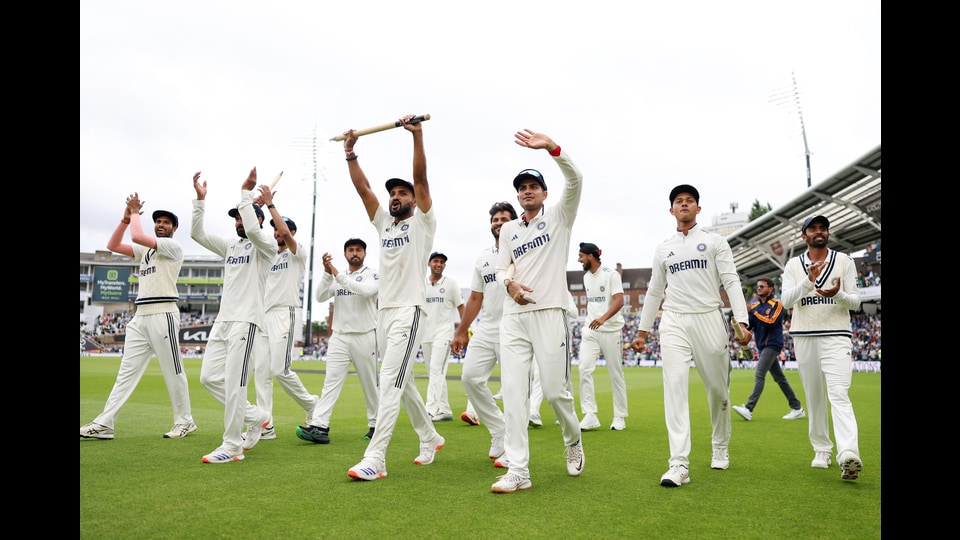
A young team, not given a whiff of a chance, is coming of age before our eyes. Writing its own script, ready to go its own way.
Thirty-five runs, four wickets, and the biggest battle of their sporting lives. While the rest of India nervously watched this ethereal equation unfold through the gaps in their fingers, paceman Mohammed Siraj and his band of brothers refused to believe they were beaten.
Over the next hour, every ball became an event, every boundary a knife through the heart, and every wicket delirium. Finally, after 53 remarkable deliveries at an Oval packed to the rafters on an overcast south London morning, Indian cricket turned a corner on August 4, 2025.
It is a date that will live on in the sport’s annals. The headline may itself be unremarkable — a 2-2 draw in England — but it will live on whenever new generations of followers unearth the magic numbers hidden beneath the surface. And it will live on because those at the stadium, and the tens of millions who watched on television, will be able to recall where they were when Siraj uprooted Gus Atkinson’s off-stump with just seven needed for victory after 25 days of gladiatorial Test cricket.
Twenty-five days of a young team, who weren’t given a whiff of a chance, slowly coming of age.
The magic numbers
India’s batters were at the crease for a staggering 1,054 overs over the five-Test English summer. They scored an unprecedented 3,809 runs, including a record 754 by captain Shubman Gill and 500-plus aggregates by two others. Five Indians scored more than 400 runs in a series for the first time; and the team struck 12 hundreds, the most ever, home or away.
India’s bowlers captured 84 wickets, taking turns to raise their hands at key moments when all seemed lost. If it was Akash Deep in the second Test, it was Washington Sundar in the third and Prasidh Krishna in the fifth. Twenty-three of the wickets were grabbed by the tireless Siraj, who has spent the last three years in the shadow of his pace partner Jasprit Bumrah but had the tenacity to send down the final ball after hurling a total of 1,113 deliveries across 10 innings at over 85 kmph each.
Yet it was neither these exploits, nor five bitterly fought Tests, that made the series memorable. It was the larger context — a team weighed down by the departure of talismans Virat Kohli and Rohit Sharma, led by a 25-year-old captain on his first tour, written off as too indisciplined in their shot-making to survive the English swing, up against Bazball in its own backyard — that sets the tour apart.
The effort would have been remarkable even if India had lost 3-1, but the fightback in the final few hours to level the scales has injected an everlasting appeal. This is a new-age Team India writing its own script. A David vs Goliath story in which no one other than David believes he has a shot.
Sum of its parts
Just to set the record straight, it wasn’t about tactics.
Coach Gautam Gambhir may want us to think that his sharp selections and clever combinations were the real building blocks of success. Instead, India got their strategies horribly wrong right through the series. They picked batters where bowlers were needed, and all-rounders when wicket-takers were the need of the hour.
Rather than reaping the dividends of meticulous planning in the dressing room, this series was about a group of cricketers raising the bar, playing outside their skin, responding in real time to challenges on the field, and refusing to surrender. In a nutshell, the results came despite Gambhir’s machinations, not because of them.
They came through Yashasvi Jaiswal and KL Rahul not letting up at the top of the order, through Gill’s relentless hunger for runs (as batter) and results (as captain), through Ravindra Jadeja digging in, through Washington Sundar defying the odds, and through Siraj taking on the mantle from Bumrah in the Tests where he wasn’t playing second fiddle to him.
It’s no small matter that this team is made up of players who offer a more vivid reflection of India than ever before. It still hasn’t assimilated the entire country — some disparities are harder to overcome — but larger swathes are now within its fold. If Mahendra Singh Dhoni’s rise two decades ago propelled a new breed of players from smaller towns to break barriers, the current team is proof of the success of that movement.
A young man from Bhadohi, Uttar Pradesh, who once sold pani-puri in Mumbai to make ends meet; the son of a professor couple from Bengaluru; a farmer’s boy from rural Punjab with leadership thrust upon him; a trailblazer from Roorkee, Uttarakhand, determined to challenge the laws of physics; a tireless crusader whose father drove an autorickshaw in Hyderabad; a Sikh boy who chiselled his craft in Gujarat; and the son of a watchman from Jamnagar. What do you get when you throw people from such varied backgrounds, classes and religions together?
Disharmony and division may rule social media and public life today, but in Jaiswal, Rahul, Gill, Rishabh Pant, Siraj, Bumrah and Jadeja you get the core of a new Indian cricket team — as diverse and layered as the nation it represents, ready to go its own way.


