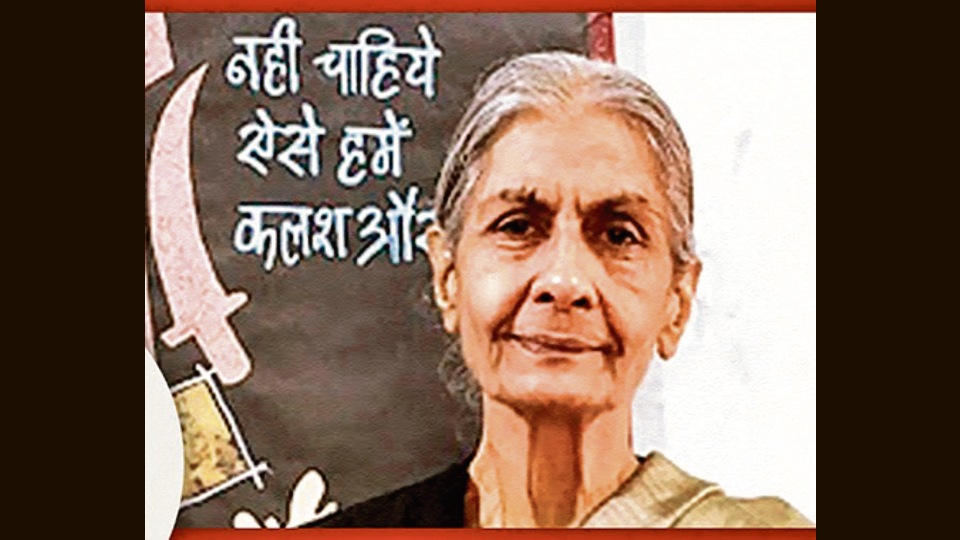
In July, a video circulating on social media showed a quick-on-her-feet sari-clad woman handing out pamphlets on the streets of Lucknow. The woman was Roop Rekha Verma, 79, former vice-chancellor of Lucknow University, former professor of philosophy, and dean of the arts faculty. The pamphlets contained a little-known story from history, dating to the 1857 Siege of Lucknow.
As revolts against the British erupted across the city (and the country), in Chinhat, the uprising was led by Lucknow’s famous Maulvi Ahmadullah Shah, alongside Hindu royalty and commanders such as Ghamandi Singh and Umrao Singh, and supported by the area’s residents.
“While the British were able to suppress the uprising more easily in other places, in Chinhat, where the people put up a united front, where all religions and castes fought together, they could not be suppressed,” Verma says. “The idea of the pamphlets is to educate people about why social structures matter, and how a country and society develop if they stand united.”
Verma has been distributing pamphlets on secularism and composite culture since the 1980s, usually alone. This time, she was joined by a small group of people, and this gathering, coupled with the fact that they were distributing 4,000 pamphlets in the age of the internet, helped pique interest in her story.
Through her career and since retiring in 2003, Verma has been a vocal advocate for the rights of people of all faiths, castes and genders. She recently stood surety for Siddique Kappan, the journalist from Kerala who was arrested by the Uttar Pradesh police while on his way to report on the gangrape of a Dalit girl by four upper-caste men in Hathras two years ago. Verma has been detained and placed under house arrest herself several times, over her public protests. “I haven’t been put in jail yet,” she says. Excerpts from an interview.
What did it feel like to go viral after all these decades?
It came as a big surprise. I’ve never made the news before. I never expected to. But technology is such that, a young friend recorded it, showed it to me and posted it on Facebook. Somehow it clicked, maybe because of my age.
Why is it so important to you that people remember this event in our history?
Most of the new generation aren’t really aware of all that happened at that time. They know about the big events, about General Dyer and “Simon Go Back”. But they don’t know the micro-level struggles, the way people stood hand-in-hand in the name of country, the way they did not allow religion or caste or gender to divide them. These micro-level social realities, which are much more vital, are not celebrated in educational discourse or in wider society. This is a tragedy.
What, to your mind, are the biggest threats to India’s secular values today?
The biggest threat is the silence of those institutions on which the major responsibility of saving the secular character of the country rests. And if you must count them, it’s the government, police and judiciary. I think there is so much silence and numbness on important issues that it can encourage perpetrators of hatred.
What is your advice to young people wanting to take a stand today?
There is a saying: “I went to the graveyard and I saw the graves of people who did not speak because they were afraid to die.” So my message is: The future is yours. The country is in your hands. If you wish to look backward in anger, the country could regress by centuries. To go forward, you have to stand together, fight to fix the problems of today, and not allow walls to be built up between you and other Indians.

 E-Paper