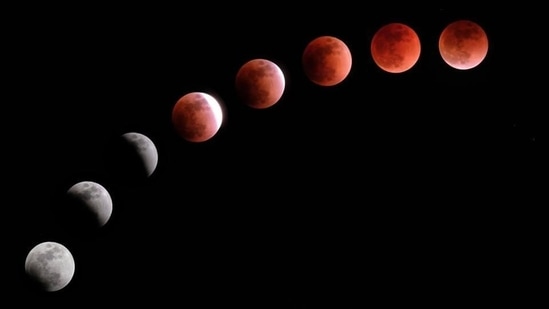
Lunar Eclipse 2022: The day is almost here. A total lunar eclipse will be seen from the world. NASA declared that this lunar eclipse is special for many reasons. It will be the last total lunar eclipse that is to happen for almost next three years. In a tweet, NASA announced that on November 8, the moon will pass into the shadows of the Earth and get a red colour – this phenomenon is also known as the Beaver Blood Moon lunar eclipse. While most parts of India will not be able to experience the total lunar eclipse, cities such as Kolkata, Kohima, Agartala and Guwahati will be able to see the total lunar eclipse clearly. As we gear up to experience the last total lunar eclipse for the next three years, here’s a look at how total and partial lunar eclipses are differentiated:
ALSO READ: Lunar Eclipse November 2022: Find out Chandra Grahan timings in cities in India
Total lunar eclipse: The total lunar eclipse happens when the moon passes through the umbra of the Earth. Umbra refers to the dark part of the shadow which reflects no light at all. As the moon passes through it, the curved edge of the moon gets hit by direct sunlight, making it appear dim. Slowly, as it gets inside the umbra more, the opposite limb of the moon gets hit by sunlight, making the overall celestial body become obscured.
Partial lunar eclipse: A partial lunar eclipse happens when only a part of the moon enters the umbra of the earth. Hence, the rest of the moon is visible from the earth.
There are two other types of lunar eclipse as well, but they are comparatively rare:
{{/usCountry}}There are two other types of lunar eclipse as well, but they are comparatively rare:
{{/usCountry}}Central lunar eclipse: This refers to the phenomenon of a total lunar eclipse when the moon passes through the centre of the shadow of the earth, contacting the antisolar point – directly opposite from the sun.
Selenelion: Also referred to as a horizontal eclipse, Selenelion is a phenomenon when both the sun and the eclipsed moon can be observed together.
Catch your daily dose of Fashion, Taylor Swift, Health, Festivals, Travel, Relationship, Recipe and all the other Latest Lifestyle News, Merry Christmas 2025 on Hindustan Times Website and APPs.
Catch your daily dose of Fashion, Taylor Swift, Health, Festivals, Travel, Relationship, Recipe and all the other Latest Lifestyle News, Merry Christmas 2025 on Hindustan Times Website and APPs.