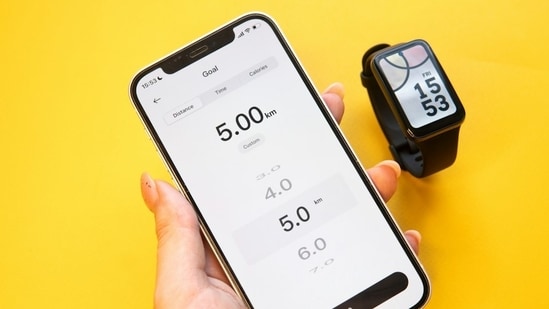
Walk into any electronics store today, and you’ll find an overwhelming range of fitness trackers, with devices claiming to monitor everything from heart rate and sleep quality to stress levels and blood pressure. With so many options and features available, choosing the right fitness tracker can quickly become confusing. In this edition of ‘Before You Buy,’ HT Lifestyle spoke to Ashwini V Rai, fitness expert at Cultfit, to break down the features worth checking before you make a choice.
Also read | Before you buy: From ingredients to skin type, here’s what to check before choosing a skincare serum
Prioritise the purpose of the tracker
The most common mistake to buy a fitness tracker is to sort through the functions and choose the most attractive one for the user instead of defining a personal goal. For example, if the primary purpose is to measure the number of steps and overall activity, it makes no sense to choose a device with a large number of extra features, such as ECG tests or blood oxygen level.
According to Ashwini, if the user wants to improve their health indicators while, say, running, it would be a good idea to choose a model with heart rate sensors. Moreover, if the person has diagnosed chronic diseases and monitors the relevant figures, more complex trackers would be more appropriate for use.
Heart rate sensors tend to be inaccurate
{{/usCountry}}According to Ashwini, if the user wants to improve their health indicators while, say, running, it would be a good idea to choose a model with heart rate sensors. Moreover, if the person has diagnosed chronic diseases and monitors the relevant figures, more complex trackers would be more appropriate for use.
Heart rate sensors tend to be inaccurate
{{/usCountry}}A device that measures heart rate at the level of the wrist by pressing light-emitting diodes against the skin has a well-known margin of error compared to, for example, a chest belt. Accordingly, the indicator may deviate by 5-10 beats per minute during intervals of intensive activity. “If the user only intends to monitor the indicators while running or doing sports, this feature is not critical,” explained Ashwini. However, for people who want more precise results and use the trackers to measure heart rate during interval training, it is essential to pay attention to this parameter.
Battery lifetime rarely reflects reality
Accordingly, the number of days indicated in the device's specifications may seem excessively optimistic as a solid battery life. If the tracker only needs to track activity without additional functions, having turned off GPS and the ability to receive notifications disabled, the battery will last longer. For example, 7-day battery life means that with all the above additions enabled, the device will only work for a day or two. Therefore, when selecting a product, it is crucial to look for information on the battery that reflects the user's experience.
Water resistance has specific nuances
“A water-resistant device does not always mean that all its components are protected against water damage,” said Ashwini. The degree of protection may vary between 5 ATM and IP68, so it is vital to watch out for technical specifications. Accordingly, swimming pools and sea swimming are only allowed if the manufacturer explicitly states that the tracker is suitable for these conditions.
A tracker is a tool to monitor trends rather than an accurate medical instrument
Ashwini highlighted that although many trackers attempt to collect extensive data about the user, measuring different indicators, they are not entirely accurate. For example, the calculation of sleep phases is based only on activity and heart rate, making such devices unsuitable for medical research. However, this data can help the user to react to how their body behaves over several nights: if the results differ significantly from the established norms, it is worth looking at the problem.
A tracker's comfort is crucial for further use
The main function of a fitness tracker is to collect information about activity and vital signs of the body, such as sleep phases and heart rate. If the device is cumbersome and uncomfortable to wear, the user may not use it. In addition, when using such gadgets to control sleep, a large number of additional functions can be inconvenient. Moreover, a cheap armband may irritate the skin, especially in hot weather. If available, it is a good idea to try the device before buying to ensure that it is comfortable to wear.
Note to readers: This article is for informational purposes only and not a substitute for professional medical advice. Always seek the advice of your doctor with any questions about a medical condition.
Catch your daily dose of Fashion, Taylor Swift, Health, Festivals, Travel, Relationship, Recipe and all the other Latest Lifestyle News on Hindustan Times Website and APPs.
Catch your daily dose of Fashion, Taylor Swift, Health, Festivals, Travel, Relationship, Recipe and all the other Latest Lifestyle News on Hindustan Times Website and APPs.