
 E-Paper



Lok Sabha elections 2019: Candidates matter little in fierce two-way UP battle
The focus on Modi is a part of the BJP’s design which is clearly reflected in its slogan, “Ek naam, ek nishan, naam Modi, kamal nishan”, which translates as “One name, one symbol; the name is Modi, the symbol is the lotus”.

 Prefer HTon Google


What started as a triangular contest in Uttar Pradesh is fast turning into a fierce two-way battle between Prime Minister Narendra Modi and the gathbandhan (the SP-BSP-RLD alliance) in a majority of the 80 constituencies in the state. This is a closely- and intensely fought election between sentiment (Modi) and arithmetic (the alliance).
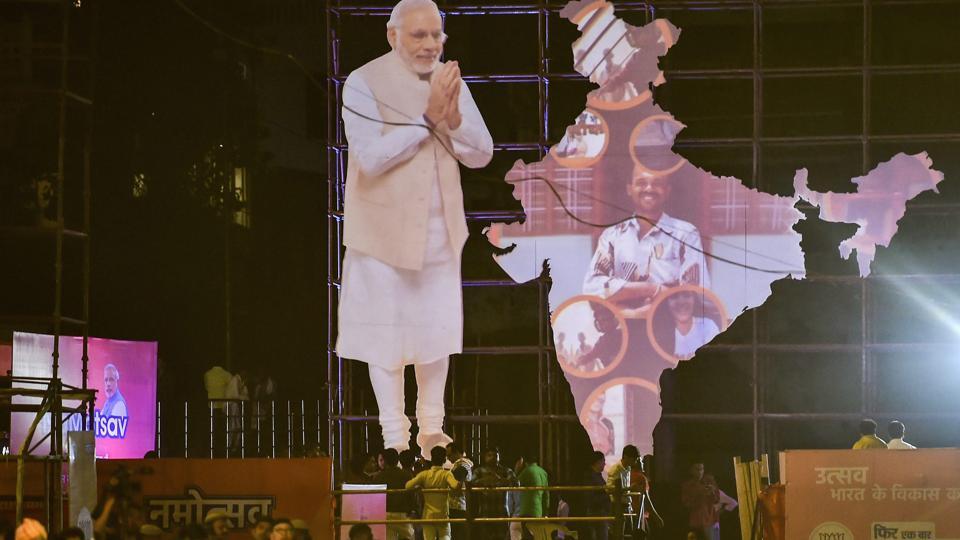
Polling in 26 constituencies is over, but candidates have literally disappeared from the scene. This could be a masterstroke on the part of the Bharatiya Janata Party (BJP) to kill dissent against the sitting MPs.
Unlike Chhattisgarh, where the party dropped all 10 sitting MPs, the BJP high command faced the compulsion of retaining around 64 of them in UP; many were elected in a Modi wave in 2014. The remaining four phases will see 54 seats going to the polls in Uttar Pradesh, including high-profile seats such as Varanasi, Amethi, Rae Bareli, Azamgarh, Kanpur, Kannauj, Lucknow and Faizabad.
The focus on Modi is a part of the BJP’s design which is clearly reflected in its slogan, “Ek naam, ek nishan, naam Modi, kamal nishan”, which translates as “One name, one symbol; the name is Modi, the symbol is the lotus”.
The party’s banners and posters, put up at vantage positions across the state, have only the picture of Modi along with the party symbol. Other star campaigners figure in posters put up at rally grounds, but nowhere else. The fact is, none of the prime ministers, including the popular ones such as Atal Bihari Vajpayee and Rajiv Gandhi, could ever become a rallying point like Modi has. Or, like Indira Gandhi did before him.
The late Vishwanath Pratap Singh, who implemented the controversial recommendations of the Mandal Commission, polarised society but could not become a rallying point himself.
Interestingly, both Indira Gandhi and Modi were proponents of social engineering, rallying points, and also the driving force behind campaigns. If Indira formed a rainbow coalition of Brahmins, Muslims
and Dalits, Modi’s popularity spreads to various castes — Brahmins, Thakurs, most
backward castes and non-Jatav Dalits.
Even at the state level, leaders such as Mayawati, Mulayam Singh Yadav, Lalu Prasad, Bal Thackeray and Mamata Bannerjee were and are polarising figures but their influence remains restricted primarily to their own castes or states.
Prof Rajesh Singh, a political analyst from Gorakhpur, says, “This election is all about Modi versus gathbandhan. I have been watching parliamentary elections since 1977. It’s the first time when even the candidates are becoming irrelevant. People are voting for Modi or gathbandhan.”
It may sound bizarre but many voters are walking to the polling booth oblivious of the candidate they will vote for. A farmer in Hathras, when asked about the candidates, pleaded ignorance and said: “I don’t know, I am voting for Modi”.
It isn’t just Modi and the BJP which has adopted the look-beyond-the-candidates strategy. So has the alliance. The catchphrase among the supporters of Mayawati and Akhilesh is “our vote is for gathbandhan”, which seems to have caught the imagination of voters even in remotest areas. The two parties sealed the alliance on January 12 this year.
Interestingly, even the banners and posters of the SP and BSP have pictures of only Akhilesh and Mayawati along with their party symbols. This is a clear shift from earlier elections when pictures of candidates featured prominently. Thus, the two popular words heard throughout the state are ‘Modi’ and ‘gathbandhan’.
In Konch town of Jalaun district, some young people complain about the non-performance of their four-time MP Bhanu Pratap Singh Verma.
“We did not see him once in the last five years. We are angry but this election is about Modi who deserves a second chance to fulfil his promises,” says Mukesh Sikarwar. Others nod in agreement.
On the other side of the equation, the Ahirwars (Jatavs) and Yadavs have always been at loggerheads in Jhansi Lok Sabha constituency. The seat has been given to the SP candidate but the Ahirwars in Mirchpur village have decided to support him, forgetting their age-old enmity. Why? “Mayawati is our leader and she has asked us to vote for him. Otherwise our vote would have gone to Modi, who gave us gas and electricity,” they say.
Barring a few constituencies where the Congress is in the race, any query about the party is met with indifference. “Yahan Congress nahin hai, yahan to bas Modi aur gathbandhan hai’ ( It’s Modi or Alliance here, there is no Congress).
The Congress is in the race only in those constituencies where it has fielded high-profile candidates.
Political expert Gyanendra Sharma says, “Campaigning does help in getting the support of indecisive voters who sometimes play a crucial role in
deciding victories. But this time, elections are being fought more on television channels than in the field.”
Sharma says it’s unfortunate that even the party manifestoes are taken flippantly by voters, who otherwise have lots of complaints of non-performance against the government in power and the sitting MPs.
Yes, 2019 polls will be remembered as an election that created noise on issues, but voted for personalities.


