
 E-Paper



More ‘hidden storeys’ in Chattar Manzil?
Unearthing history: UPRNN re-starts excavation work at iconic structure

 Prefer HTon Google


Heritage enthusiasts in the city could soon witness more history at the iconic Chattar Manzil, as restoration agencies have re-started excavation work to unearth the ‘hidden storeys’ lying buried beneath the nawabi era structure since ages.
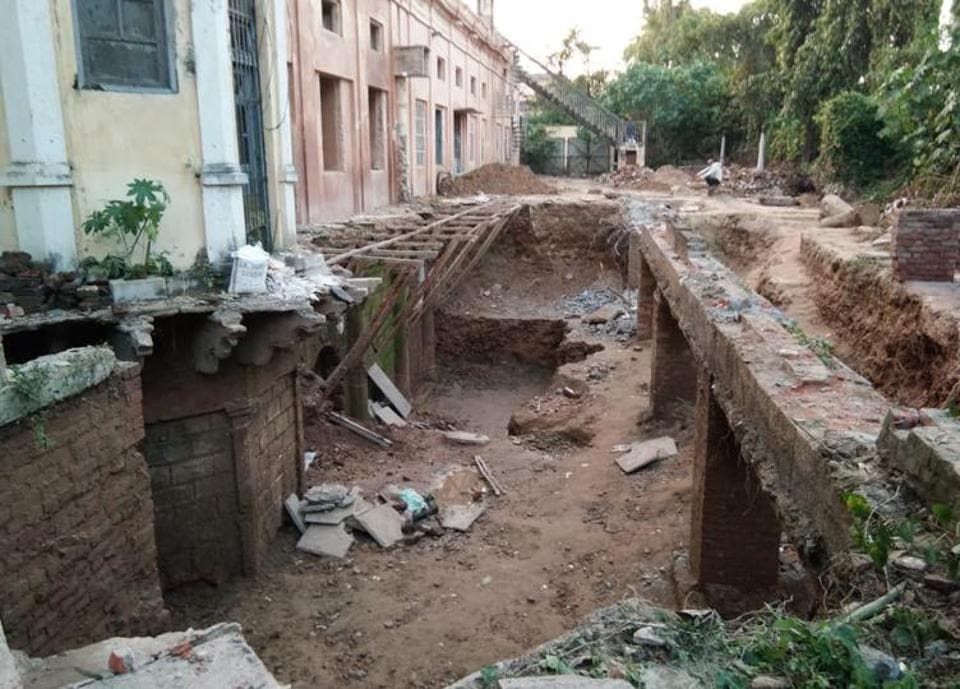
Officials with Uttar Pradesh Rajkiya Nirman Nigam (UPRNN) said there was still a lot more to be explored in Chhatar Manzil – a structure that served as a palace for nawabs and their wives.
“So far we have dug around 255 ft and have unearthed a grand 15x15 room. The excavators also recovered brackets, walls and pillars, buried deep into the ground. After a pause of two months, we have re-started the excavation work,” said Sandeep Singh, project manager, UPRNN – the agency undertaking restoration work at Chattar Manzil.
The discovery was made last year when labourers engaged in the restoration of the structure began digging Chhatar Manzil’s basement. But what was unearthed, left them all in awe.
When the foundation was being dug in order to strengthen it, the labourers found pillars going deep inside the ground, revealing another storey of the imposing structure. Similarly, they also unearthed a storey of Kothi Farhat Baksh.
However, the excavators were keeping their fingers crossed as they started the fresh excavation work.
“What we have seen in pictures or observed in our childhood is not the complete structure of the Chattar Manzil. I am happy to be a part of the entire work that would unravel the actual and complete picture of the structure,” said Nitin Kohli, a contractor who is carrying out the entire excavation work under supervision of IT-BHU experts.
One of the IIT-BHU experts, who also inspected the over 200-year-old structure, said there was every possibility of more ‘hidden storeys’ coming to fore and the excavation work would be on till the basement of the structure was completely unearthed.
The Chattar Manzil, which served as a home to the wives of the rulers of Oudh, came into existence more than 200 years back when there was no electricity, he said.
“In those days, the nearby water bodies gave a cooling effect to the structure. And the same is expected in the case of Chattar Manzil and Kothi Farhat Baksh,” said the expert.
He said as the Gomti is nearby, there is a possibility that Chattar Manzil’s lowermost storey shares the same level as that of the river.
“In those days, the nawabs probably used boats to move in basements of Chhatar Manzil. During summers, they came to the first floor to enjoy the natural cooling effect. In other seasons, they stayed on the floors above,” he added.
The structure has five floors above the ground.
“We are also looking into the possibility of discovering one more floor (beneath the earth) as this would take the count of total number of floors to six, which has perhaps given the structure the name ‘Chattar’ (probably derived from the Hindi word ‘chhay’ (six). But it’s too early to conclude,” he added.
TREASURE FOR HERITAGE LOVERS
“So far, we had dug around 255 ft and unearthed a grand 15x15 room. Excavators also recovered brackets, walls and pillars, buried deep into the ground,” said Sandeep Singh, project manager, UPRNN.
After a pause of two months, we have re-started excavation work, he said.
“We are also looking into the possibility of discovering one more floor (beneath the earth) as this would take the count of total number of floors to six, which has perhaps given the structure the name ‘Chattar’ (probably derived from the Hindi word ‘chhay’ (six). But it’s too early to conclude,” said an expert.


