The UN on September 8 said at least 270,000 Rohingyas have crossed the border since the Myanmar army launched clearance operations in the northern Rakhine State on August 25, following attacks by the Arakan Rohinya Salvation Army on police posts. The number roughly equals a third of the country’s Rohingya population, although Myanmar has not released an official figure.
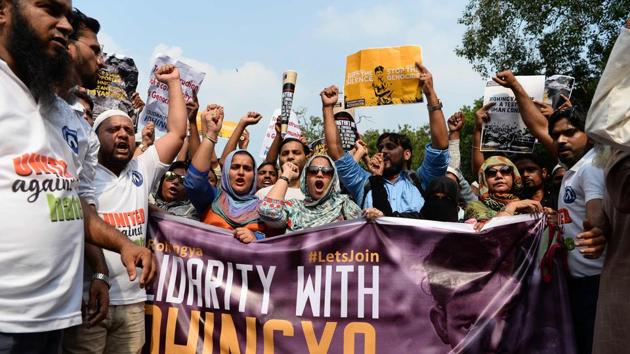
The Rohingya conundrum has two dimensions: The international community’s approach and that of the Myanmar government. The core of the conundrum lies in the identity itself. While they identify themselves as Rohingyas, neither the government nor majority of the population in Myanmar, including the Rakhine Buddhists, accept such a claim. Instead they call them illegal Bengali immigrants from Bangladesh. The problem is that neither Bangladesh nor its people are willing to accept them as their own. Instead, on several instances, their security forces forced back many of the Rohingyas who fled to their shores. The Bangladesh government has also contemplated the idea of temporarily resettling the Rohingyas to a low-lying island in the country, which many condemn.
India is wary of taking a strong stance on the Rohingya issue primarily for two reasons. It does not want a strained relationship with Myanmar when New Delhi is exploring ways to enhance its presence and influence in Myanmar and the Southeast Asia region through its Act East Policy. There are also concerns in some quarters in India that the Islamic terrorist groups may expand its networks through some hardline Rohingyas.
While the international community’s criticism is targeted toward the Myanmar government in general, the de-facto leader of the National League for Democracy (NLD) government, Aung San Suu Kyi, has been singled out. But this is unjustified. The power-sharing nature or the hybrid system in the country is such that the military can simply choose to ignore or don’t cooperate with the NLD-led civilian government. The possibility of another military takeover cannot be ruled out in case there is a threat to national sovereignty and territorial integrity, regardless of what the Constitution says.
{{/usCountry}}While the international community’s criticism is targeted toward the Myanmar government in general, the de-facto leader of the National League for Democracy (NLD) government, Aung San Suu Kyi, has been singled out. But this is unjustified. The power-sharing nature or the hybrid system in the country is such that the military can simply choose to ignore or don’t cooperate with the NLD-led civilian government. The possibility of another military takeover cannot be ruled out in case there is a threat to national sovereignty and territorial integrity, regardless of what the Constitution says.
{{/usCountry}}Moreover, many don’t seem to realise that Suu Kyi is no longer an activist or a human-rights advocate she used to be during the years of her pro-democracy movement. Many also fail to understand that Suu Kyi, like many other politicians, wants to stay in power for now and in the foreseeable future, which necessitates her to take into account the sentiments of majority voters. One clear evidence was that the NLD did not field any Muslim candidate during the 2015 general election.
Instead of directing all angers and frustration toward Aung San Suu Kyi and the NLD government, the international community, including the United Nations and the powerful Western democracies, should put pressure on the Myanmar military leadership, particularly the commander-in-chief Senior General Min Aung Hlaing, to end violence and work toward achieving a peaceful solution to the vexed Rohingya problem.
Despite the apparent difficulties and challenges, Suu Kyi and her NLD government should work with the military, community leaders of both Rohingya Muslims and Rakhine Buddhists, and the international community to end violence and resolve the conundrum. The ARSA should not engage in further armed attacks on the country’s security forces to pave a way for peace.
All political stakeholders should work toward ending the simmering tension and the cycle of violence, to prevent further loss of lives (especially the civilians) and properties, to restore law and order, as well as to prevent any communal tension or violence from spreading to other parts of the country.
A long-lasting solution should focus on the implementation of the Kofi Annan-led state advisory commission’s recommendations, including the removal of segregation or barriers between the Rohingya Muslims and the Rakhine Buddhists, and expedite the citizenship verification process for the Rohingyas.
Meanwhile, moderate leaders from both sides of the communities - Rohingya and Rakhine - should undertake all possible initiatives to build mutual trust and the spirit of peaceful co-existence.
Nehginpao Kipgen is executive director of the Center for Southeast Asian Studies, Jindal School of International Affairs, OP Jindal Global University
The views expressed are personal