
 E-Paper



Distantly Close: The similar, yet contrasting tales of Nawaz Sharif & Imran Khan
The crisis in Pakistan has about it a ring from the tumultuous 1990s. The question remains: Can Imran Khan be the fighter Nawaz Sharif was? Or will his first brush with the law be his last?


New Delhi: The crisis that has engulfed Pakistan has about it a ring from the tumultuous 1990s when too a Khan and a Sharif were locked in a power tussle that shook the country, the difference being the given first names of the protagonists in the drama.
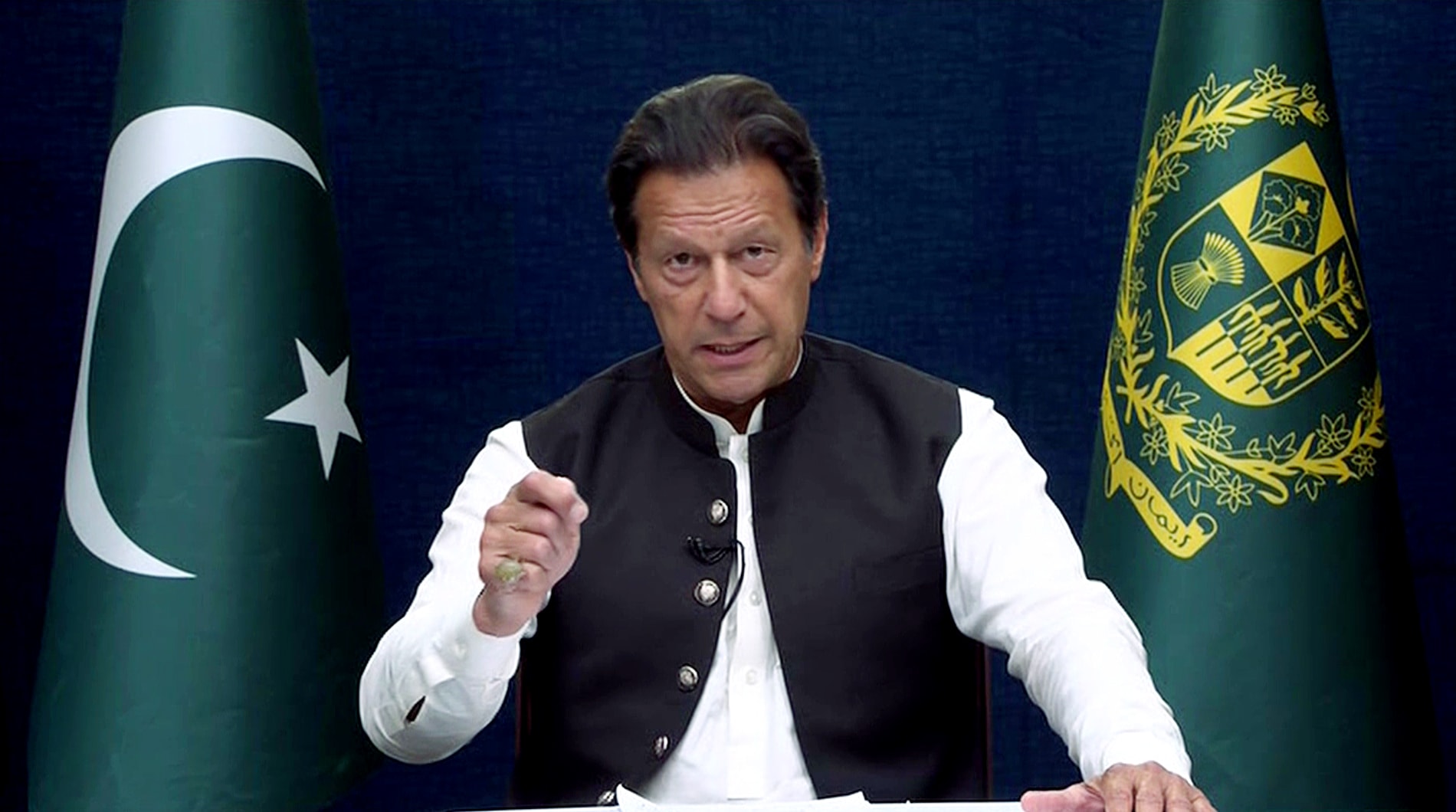
The Khan at the centre of the storm then was President Ghulam Ishaq from whom the elder among the Sharif brothers, the now self-exiled Nawaz Sharif (NS) refused to take “dictation” as Prime Minister.
That’s not the only parallel. Groomed by the Pakistani deep State, NS, the scion of Lahore’s foremost business family, had preceded Imran Khan (IK) as the establishment’s foster child. His political baptism in Punjab was the brainwork of General Ziaul Haq, the military dictator who mentored him till his death in a plane crash in 1988. The closing phase of that eventful year saw Benazir Bhutto’s rise to power. Her regime was cut short in less than two years.
Destiny and the deep state that’s a continuum in Pakistan came together in 1990 to ensure NS’s elevation as PM after Bhutto’s dismissal by Ghulam Ishaq Khan (GIK) for “corruption and horse-trading.”
That was when the Presidency was the establishment’s most potent symbol empowered by the Constitution’s since abrogated article 58-2(B) to send governments packing. The stock joke about civilian leaders in Islamabad those days was “58-2(B) or not to be!”
Nawaz Sharif’s 1993 revolt against GIK marked his transition to a rebel from being the establishment’s baby. The war he declared on the presidency in a nationally televised address made him GIK’s second victim in five years after Bhutto. The constitutional pistol, 58 2 (B) was the same, only the victim different.
Imran was a Sharif clone rolled out from the army’s factory
For his part, IK, a cricketing hero turned anti-corruption crusader who claims to be the forbearer of “aam aadmi” politics in the subcontinent, was nothing but another NS rolled out from the army’s political factory. The alliances his Pakistan Tehreek-e-Insaaf (PTI) forged and the majority it assembled after the 2018 polls in the national assembly and Punjab wouldn’t have been possible without some forceful nudging from the gumboots in Rawalpindi. For example — among his post-election allies were the fauj’s stock cheerleaders, notably a breakaway Muslim League faction, the PML (Q).
In a desperate bid to mobilise the numbers, he failed to marshal — before getting the no-trust vote unilaterally rejected by the chair in the national assembly — IK offered the Q-League’s Pervez Ilahi the chief ministership in Punjab as a price for the support of his five NA members. The move has caused another constitutional logjam with Ilahi unable to show numbers and d PML-N electing Shahbaz Sharif’s son Humza as the ‘Punjab CM’ at a hotel in Lahore.
Be that as it may, like the installation of IK’s “hybrid regime,” Nawaz Sharif’s 1990 rise on the national scene was as much a handiwork of the Army which rebooted with men and material the Islami Jamhoori Ittehad (IJI), a religious-political alliance it had founded in the 1980s to stall Bhutto. At the centre of that front was the Pakistan Muslim League, the N-faction of which is navigated now by the Sharif clan, with IK’s bête noire Shahbaz Sharif at the helm, given that the latter’s elder brother and the party’s main rallying force is in England.
Means to the end contradiction
Much of the mass appeal NS later acquired among the poor and middle-classes got plinth from his 1993 calling out of the overbearing establishment. The crucial difference between his fight and that of IK is that he waged and won a constitutional battle against the powerful presidency.
Unlike the PTI leader who ventured to force early polls by blatantly subverting a parliamentary vote he was bound to lose, Sharif won a historic Supreme Court verdict to return as PM. As the impasse lingered after the judicial order, the then army chief, Abdul Waheed Kakar intervened to make GIK demit office as a quid pro quo for early polls.
NS could have avoided going into elections by striking a middle ground with a constitutionally chastised GIK. But he didn’t, explaining to this writer at the time that co-habiting with the presidency could compromise the popular base he had created as one who fought the unpopular establishment.
IK’s ambition is no different; his comeuppance being the patently unfair means he has adopted to his supposedly laudable end-goals. He rejects his opponents as a bunch of corrupt politicians who seek immunity for their crimes and are guided by a foreign power (read the United States) that wants him out. The narrative he is building mixes religion with national pride to show Washington as having singled him out for his “independent” foreign policy while remaining soft on the identical Indian position on Russia’s invasion of Ukraine.
With his rigid position against the US and the West for what he terms their “partisan” approach to Pakistan, IK hasn’t endeared himself to the army that’s the ultimate referee in any political battle. On the face of it, he looks like a burnt-out case for Rawalpindi that’s smarting still from the affront he caused to Gen Qamar Javed Bajwa by delaying the appointment of the new ISI chief.
Can Imran win in Court and against the army?
Much of what happens in future depends on the view of the Supreme Court, which has taken suo motu notice of the assembly’s dissolution without a trust vote. The political flux of the PM’s making has come at a time when the county’s facing an economic emergency no different from Sri Lanka.
Pakistan’s foreign exchange reserves are depleting amid rising exchange rates that make hugely unsustainable the government subsidy on oil and other commodities. The road ahead isn’t easy, what with the promised International Monetary Fund (IMF) bailout put on hold. Such is the gravity of the crisis that voices have arisen from the PML (N) and PPP asking for the army’s formal take on a diplomatic cable IK is using to paint the entire Opposition as proxies in an American plot against him.
Comparisons are odious but IK’s leadership style forces one to draw parallels with Navjot Sidhu, his Indian friend from their cricketing years whose self-righteous rhetoric buried the Congress he led in the recent Punjab elections. Caged by their self-image of honesty, they see a charlatan in every critic or opponent.
Here too, perhaps, there are lessons to draw from the adventures of Nawaz Sharif. The elections that followed his faceoff with GIK saw Bhutto winning a second term and NS waiting for his second shot at power which came in 1997. As the Pakistan People’s Party leader was dismissed mid-term by Farooq Leghari, a party colleague she promoted to the presidency, NS’s first action on regaining power was to dismantle the constitutional axe of 58 2(b) the establishment so often brought down on elected regimes.
In that sense, the elbow room IK used to deny premiership to Shahbaz through a rubber-stamp presidency was created by the latter’s elder brother. It remains to be seen whether the PTI headman will be as successful in the court of law as his exiled predecessor was in 1993.
Till he was barred from practising politics or being the president of his party, NS fought four successive army chiefs for his position on the totem pole as an elected premier. The generals he was ranged against included Asif Nawaz Janjua, Abdul Waheed Kakar, Jehangir Karamat and Pervez Musharraf. As NS had done away with article 58 2(B), Musharraf had to oust him through a coup in 1999.
Yet, the PML (N) veteran was third time lucky to be PM from 2013-17, the curtains drawn on his career by the very Supreme Court which reinstalled him in office 24 years ago. What did him in was the taint of profit and profligacy.
Can IK who remains popular among younger voters, be the fighter Nawaz Sharif was? Or will his first brush with the law be his last?
HT’s veteran political editor, Vinod Sharma, brings together his four-decade-long experience of closely tracking Indian politics, his intimate knowledge of the actors who dominate the political theatre, and his keen eye which can juxtapose the past and the present in his weekly column, Distantly Close
vinodsharma@hindustantimes.com
The views expressed are personal


