
 E-Paper



Ecostani | As Opposition nominates Sinha, the politics of presidential polls
As India is set to have a new President on July 25, here are the mechanics that drive the presidential elections in India:


India will have a new President on July 25. The Bharatiya Janata Party (BJP) is unlikely to renominate the incumbent, Ramnath Kovind for the presidential polls, the process for which started on June 18 with nominations. Voting, if necessary, will take place on July 18 and the counting of votes on July 23.
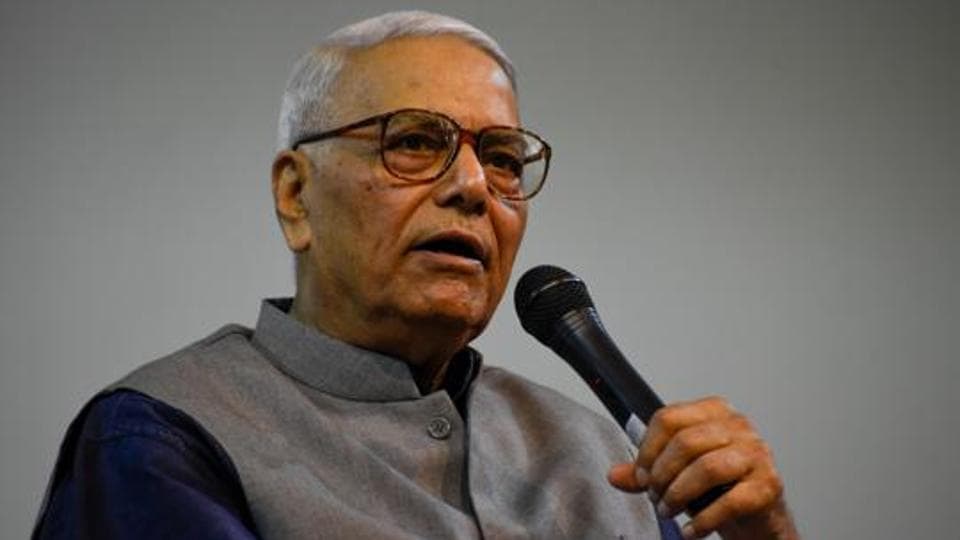
Former agriculture minister and Nationalist Communist Party supremo, Sharad Pawar, former West Bengal governor Gopalkrishna Gandhi and National Conference chief, Farooq Abdullah, refused to become opposition party candidates for the presidential election, clearly showing that they know that the opposition does not have the numbers to win. On Tuesday, the Opposition finally announced Yashwant Sinha as its joint candidate.
The ruling National Democratic Alliance (NDA) is yet to announce its candidate.
The mechanics of the election
The President is elected by members of the Electoral College comprising elected members of both Houses of Parliament and Legislative Assemblies of all states and the National Capital Territory of Delhi and the Union Territory of Puducherry. Nominated members of Rajya Sabha and the Lok Sabha or Legislative Assemblies are not part of the Electoral College. Members of legislative councils of states also cannot vote.
The Electoral College, as per the election commission’s notification, has 4,809 electors, including 776 Members of Parliament (MPs) and 4,033 Members of Legislative Assemblies (MLAs). The total value of votes will be 10,86,431. To win, a candidate needs at least 5,43,216 votes.
The value of votes of MPs and MLAs vary based on the population of states they come from. The MPs and MLAs from Uttar Pradesh have maximum weightage in the electoral college due to the state’s population and their numerical strength in Parliament and state legislative assembly. Votes of smaller Northeastern states have lesser value.
For a nomination to be valid, at least 50 MPs should propose the candidate’s name followed by another 50 from the electoral-college backing it. Voting through a secret ballot is held in Parliament and state assemblies. The vote is single transferrable. Party whip is not applicable for presidential elections, meaning cross-voting is allowed.
President, as custodian of the Constitution, head of Parliament and commander-in-chief of armed forces and visitor of Central Universities, can be a guide to the Central government. President does not have any executive powers and acts on the aid and advice of the council of ministers. President can return a file to the government with his comments, if he does not agree. The Constitution does not provide the timeframe for the President to decide on the advice of the government.
The current battle
In this President poll, the NDA commands 48% of the votes in the electoral college and the remaining 52% is divided among the opposition parties, including 23% with the United Progressive Alliance (UPA) parties. In the last election in 2017, incumbent president, Ram Nath Kovind, the NDA nominee, defeated joint opposition candidate, Meira Kumar. Kovind polled 7,02,000 votes against Kumar’s 3,67,000, out of a total of 10,69,358 votes then.
Going by the numbers and support that the NDA has from smaller parties, it should not have a problem winning the poll. The contest can only be close if all opposition parties unite. In the present circumstances, this looks highly improbable.
The Indication of this was ample at the opposition party meeting called by West Bengal chief minister, Mamata Banerjee, where five opposition parties — Aam Aadmi Party, Shiromani Akali Dal, Telangana Rashtra Samiti, Biju Janata Dal and YSR Congress — were not present.
Of these parties, AAP, TRS and Akali Dal may not go with the NDA and may prefer a non-Congress opposition candidate. With Sinha’s nomination, the possibility of AAP and Akali Dal supporting the Opposition has risen. But even in this scenario, the Congress will have to play second fiddle and allow smaller parties to anchor opposition support.
Still, it would not be enough to upset the NDA applecart as there are all indications that YSR Congress and BJD would support an NDA candidate. YSR Congress chief and Andhra Pradesh chief minister, Jagan Mohan Reddy, recently met the prime minister. So did, Odisha's chief minister, Navin Patnaik, in his first visit to Delhi after almost two years. These two parties account for about 7% of the votes in the electoral college, enough for NDA to cross the 50% mark, if there are only two candidates in the fray.
Even if the YSR Congress and BJD decide to vote for the opposition candidate, the NDA can still get through with the help of smaller parties in the Northeast, which are not part of the NDA, but are part of the BJP-led North-Eastern Democratic Alliance or NEDA. Assam's chief minister, Himanta Biswa Sarma, is convenor of NEDA and is capable of getting all NEDA parties to vote for the NDA candidate. NEDA has influence across all seven Northeastern states. The NDA candidate would benefit from the support of most independent lawmakers and abstentions.
The challenge the NDA can face is from the Janata Dal (United), which is having a troubled relationship with the BJP in Bihar. JD (U) and BJP are alliance partners in the Bihar government. For the past few months, the BJP and JD (U) leaders are speaking openly against each other. And the latest episode of acrimony was during Agnipath military recruitment scheme protests, in which homes of four BJP leaders including the state party president, Sanjay Jaiswal, were vandalised. Jaiswal and other BJP leaders blamed the state government led by JD (U) leader Nitish Kumar for this. The JD (U) has already demanded the withdrawal of the scheme. In the last Presidential election, JD (U) cross-voted. Nobody is, however, expecting JD (U) to go with the opposition candidate. At best, JD (U) would abstain.
The 2022 presidential election will show whether the entire opposition can unite against the mighty BJP, which has well-oiled election machinery, before the all-important 2024 general election. A divided opposition will not be able to take on BJP in the 2024 general election. Presidential polls provide an opportunity for the opposition to tell voters that they can unite against the BJP. Or else, BJP would again most likely tide over a divided opposition in 2024 polls.
The views expressed are personal
 ABOUT THE AUTHORChetan Chauhan
Chetan Chauhan is the National Affairs Editor looking into all aspects of news and features from across India. A Chevening scholar with over three decades of experience in reporting and news management, Chetan has extensively covered all important aspects of the social sector, political economy, environment and climate change nationally and internationally. He did a journalism course at the Reuters Institute of Journalism in Oxford and Digital Media training at Nanyang Technological University in Singapore. He started as a reporter with The Statesman in 1996 and joined the Hindustan Times in 2000 in the metro bureau covering environment, crime and Delhi politics. He covered hot local news, from the Jessica Lal murder case to the rebellion of Delhi Congress MLAs against then Chief Minister Sheila Dikshit, to the replacement of toxic vehicle fuel with cleaner compressed natural gas (CNG) in the national capital. Some of his stories on air pollution became part of the Supreme Court’s landmark MC Mehta versus Government of India case in the National Capital Region (NCR), forcing the government to take corrective measures. As part of the national political bureau since 2004, he covered important central sectors such as environment, education, social justice, labour, rural development, water resources, renewable energy, agriculture, broadcasting and the Planning Commission for more than a decade producing several exclusive and investigative breaking stories. His specialisation is the environment, having covered at least a dozen United Nations global conferences on climate change, biodiversity and wildlife including climate summits in Paris, Copenhagen and Bali. He also covered India’s two five-year plans ---11th and 12th and reported on drafting and execution of right based laws such as Right to Education, Right to Information and rural job guarantee law, MG-NREGA, now being introduced in new format as VG-RAM-G Act. He has in-depth knowledge of social sector issues. He was one of the first to report on tigers vanishing from Sariska and Panna wildlife reserves in 2004 and 2008, respectively, leading to the setting up of the National Tiger Conservation Authority (NTCA) and the introduction of stringent penal provisions for poaching. He has written extensively on the rising human-animal conflict in India and the degradation of India’s biodiversity hotspots because of mining and other activities. Since 2004, Chetan has covered Parliament comprehensively and participated in training on the nuanced coverage of Parliament proceedings. He has travelled extensively across India to cover national and provincial elections since 1998, especially in the Hindi heartland states, considered India’s road to power. He writes a regular column for Hindustan Times, Ecostani, on important national politics, economy, Himalayan ecology and environmental issues. His other responsibilities include providing inputs for edits and edit page articles for the publication, apart from managing news flow from across India.Read More


