
 E-Paper



For a fresh beginning in Jammu and Kashmir
There has been a significant reduction in terrorism-related incidents, but sporadic incidents continue. The only way to deal with this is the formation of an elected government at the earliest and restoration of full statehood. Hopefully, the dialogue in New Delhi will prove to be the change from Dilli ki doori (distance from Delhi) and dil ki doori (The distance from the heart) to something much closer. Kashmir has been waiting for a new dawn for a long time.


They invited us... He is our prime minister, we have to trust him. We the people of Kashmir know it better than anybody else that dialogue is the best way... If you lose faith in the institution of dialogue, in a place like Kashmir, an alternative to it will be violence.” These are the words of Sajjad Lone, chairman of the Jammu and Kashmir People’s Conference, after Prime Minister (PM) Narendra Modi’s all-party meet with leaders from Jammu and Kashmir on June 25.
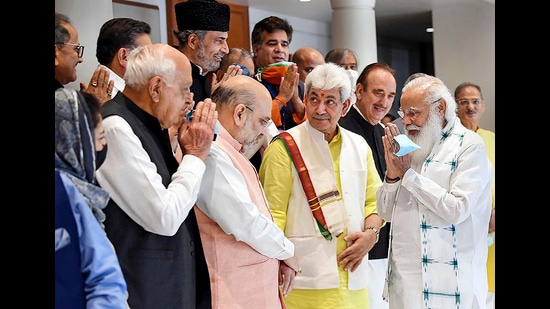
The Peoples Democratic Party (PDP) leader, Mehbooba Mufti, and the National Conference (NC) leader, Omar Abdullah, both former chief ministers (CMs), too found the talks positive and meaningful.
It would seem that there was no other option for the 14 leaders of state’s political parties. Jammu and Kashmir’s residents may not have completely accepted of the loss of full statehood along with Article 370, but they too know that changing times call for changing resolutions.
I say this based on my visit to the Kashmir Valley in March where I found that people are fed up with violence, and the young felt that this was crippling their chances at a normal life. At Tungmurg, Baramulla, a young man told me: “We know that nobody from another part of the country will come to purchase land in the Valley, but we need our statehood back and more job opportunities for local residents”.
The Modi government had done a lot of preparatory work to implement its long-standing agenda. Let us go back two years. Mehbooba Mufti had lost her political heft when she formed a government with the Bharatiya Janata Party (BJP). New parties in the Valley were waiting in the wings. Farooq Abdullah’s NC was arguably the strongest party on August 5, 2019, but the people of Jammu and Kashmir wanted something beyond these two families. This opened the doors for New Delhi to step in.
New Delhi had also done its homework on the administrative front, and kept a sharp eye on the cultural plurality of the state. Barring the Hindu-majority areas of Jammu, the Gujjars in the border areas of Poonch and Rajouri had no sympathy for the conflict in the Valley. The minority Hindus in both these districts were also expressing their opinions in full force. In Kargil and the other scattered Shia settlements in the Valley, there never was any affinity with the Wahhabi-dominated separatists. The signal was clear that the situation could change for the better.
The biggest challenge before the administration at that time were crowds gathering at the funerals of terrorists, a negative signal to the younger lot. The late Dineshwar Sharma, then the Centre’s interlocutor in Jammu and Kashmir, once asked a Kashmiri officer how to deal with this. The officer told Sharma that, often, even family members did not want funeral processions of their relatives killed in encounters. For this, graves could be prepared in relatively quiet places.
If security forces were to kill a terrorist, he could be buried there with religious rituals in the presence of his family. This would both combine respect for religious sensitivities and family sentiments. This was done. And the result was palpable.
Similarly, stone-pelting was also brought under control. The state police were given the freedom to deal with it, with a directive to find a long-term solution. Young pelters, they found, were being paid for this act. So, those who were paying this money were identified and picked up. A list of stone-pelters was made with the help of these people. Lookout posters of some of the hardcore pelters were pasted on the streets. As a result, most of them, who were not fundamentally extremist by nature, fled the Valley.
About a year ago, Manoj Sinha was appointed to streamline the administration. He made his presence felt across the state, whether it was the replacement of power transformers during inclement weather in the Valley or other issues of public interest. Every week, he made an effort to boost public confidence by holding janata darbars (public courts) to convey that the government is there for the people’s service. This also helped overcome vaccine hesitancy.
At the same time, there were other societal changes taking place. Many young people in Jammu and Kashmir were doing well in administrative examinations. This also made them feel that they could serve their people by becoming part of the power structure.
That is why when the zilla parishad elections were announced, all the political parties participated, and the 51% voter turnout proved that Kashmiriyat believes in jamhooriyat (democracy). However, it is also a fact that fewer votes were cast in the Valley than in the Jammu region. Was this because of resistance or fear?
Of course, it is too early to say that the situation is under control. In the early hours of Sunday, two explosions took place at an airport run by the Indian Air Force in Jammu, a high-security area.
This shows how separatists are now banking on desperate measures to disturb normalcy. They are clearly agitated at the beginning of the political process after a significant reduction in terrorism-related incidents. They also have financed sporadic terror attacks on security forces and political activists to show their strength. Such elements are still employing the use of rumours to spread dissonance. Despite the ceasefire at the border, the role of Pakistan’s Inter-Services Intelligence can’t be ignored in nursing such outfits and individuals as we have seen Jammu-like incidents after almost every peace effort.
The only way to deal with this is forming an elected government at the earliest and restoring full statehood. Hopefully, the dialogue in New Delhi will prove to be the change from Dilli ki doori (distance from Delhi) and dil ki doori (The distance from the heart) to something much closer. Kashmir has been waiting for a new dawn for a long time.
Shashi Shekhar is editor-in-chief, Hindustan
The views expressed are personal


