At the height of the Cold War in 1966, the American comedy film, The Russians Are Coming, The Russians Are Coming, ended on a happy note with both sides letting humanity triumph.
The real world is different. The Russian invasion of Ukraine, regardless of the reasons, has upended European security paradigms. India, which enjoys close relations with Russia, abstained on the resolution tabled by the United States (US) in the United Nations (UN) Security Council on February 25. Unsurprisingly, Russia,
At the height of the Cold War in 1966, the American comedy film, The Russians Are Coming, The Russians Are Coming, ended on a happy note with both sides letting humanity triumph.
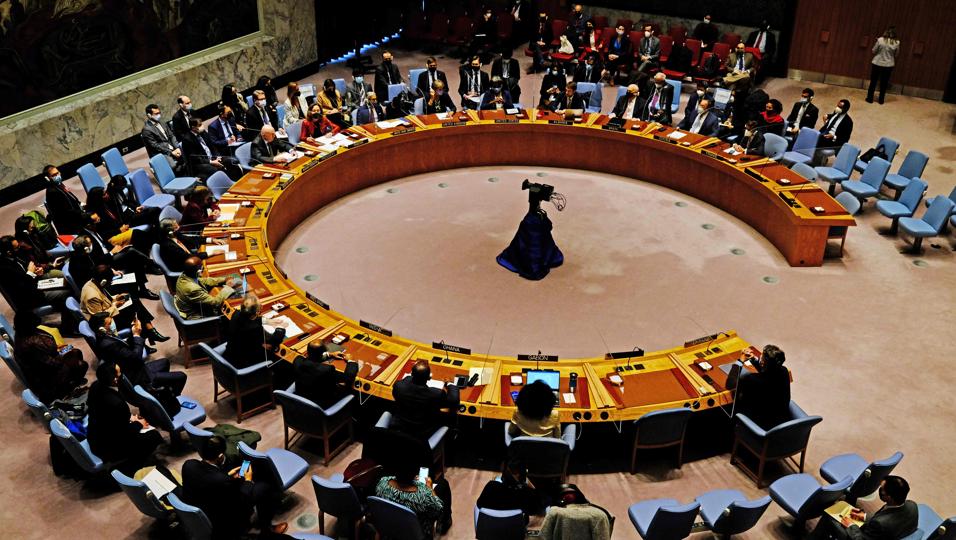
The real world is different. The Russian invasion of Ukraine, regardless of the reasons, has upended European security paradigms. India, which enjoys close relations with Russia, abstained on the resolution tabled by the United States (US) in the United Nations (UN) Security Council on February 25. Unsurprisingly, Russia, a permanent member, vetoed it.
There have been suggestions that India should have taken a “principled stand” and voted in favour of the resolution, but the government did the right thing by not taking sides.
The UN Security Council appears hoisted with its own petard. The five permanent members (P-5) have blocked every effort since 1945 to democratise and reform the archaic nature of the UN Security Council. The P-5 have long been accustomed to using the veto power to shake off any censure of their actions.
Every permanent member has thwarted resolutions which, in the eyes of a large chunk of humankind, ought to have merited support. According to research data collated by the Dag Hammarskjöld Library of the UN, the erstwhile Union of Soviet Socialist Republics (USSR) used its veto power on 90 occasions, and, after 1991, the Russian Federation exercised it 28 times, excluding the most recent one on Ukraine.
What about the others? The US used its veto 82 times to guard its own interests and that of Israel, with the large majority relating to the question of Palestine and the occupied Arab territories. The United Kingdom (UK) used its veto to block resolutions 29 times, inter alia, on the call for a ceasefire following its military intervention in the Falkland Islands in 1982. It also routinely bailed out the racist regimes in South Africa and Rhodesia, delayed the dismantling of apartheid and stalling self-determination in Namibia. In several instances, the UK, US and France acted in tandem, just as China and the Russian Federation have done in recent times on resolutions on Syria.
France exercised its veto on 16 occasions and blocked issues concerning the unity and territorial integrity of the Comoros. As for China, it entered the field a bit late in the day following its entry into the UN in 1972, and flagged off by blocking the membership of the newly founded state of Bangladesh. It has since used its veto on 16 occasions to thwart resolutions on matters relating to Guatemala, Macedonia, Myanmar and Syria, to cite a few instances.
P-5 countries use their veto to guard their strategic interests, not vague “principles”. If P-5 behaviour were put to the test against the principles enshrined in the UN Charter, they would be disqualified without exception.
Unlike the vote of a non-permanent member, even abstention by a P-5 country has its uses. In November 1990, when China abstained on UN Security Council Resolution 678, which empowered States to use “all necessary means” to force Iraq out of Kuwait upon the lapse of a deadline, it paved the way for a legal authorisation for the first Gulf War.
In choosing to abstain from voting in the UN Security Council against Russia, India has acted on the basis of its own national interest. India continues to rely on Russia for major defence supplies. The S-400 deal with Russia remains in the pipeline and is expected to boost India’s security on its northern borders. Its priority, as before in Afghanistan following the withdrawal of US troops, must be on the safe evacuation of its citizens.
When the Chinese aggressed against India in eastern Ladakh in 2020, most nations, including several of India’s strategic partners, urged restraint and dialogue. As for Ukraine, its supply of defence equipment, including T-80 tanks to Pakistan, and its support for the latter on the Kashmir issue, have not gone unnoticed in the context of public opinion in India.
India has attached importance to the principle of sovereignty and territorial integrity and called for dialogue and diplomacy to settle disputes. India’s abstention was not tantamount to an endorsement of Russian military action against Ukraine. Nor did it imply recognition of the independence of Donetsk and Luhansk, two breakaway regions that Russian President Vladimir Putin recognised as independent republics days before the invasion. Remember, India did not recognise the Kosovo Declaration of Independence in 2008 from Serbia. Earlier, former Prime Minister Atal Bihari Vajpayee withdrew recognition of the so-called Sahrawi Arab Republic, a region in western Sahara, in 2000, undoing a folly committed in 1985.
Parallels have been drawn between Ukraine and Taiwan. Taiwan is naturally apprehensive about the mounting military pressure from across the Taiwan Strait. The US policy of “strategic ambiguity” may not suffice to reassure Taiwan in the aftermath of the events in Ukraine. The current crisis will cast its shadow on the Indo-Pacific. The US preoccupation with European security is a distraction from the real challenge of China. Russia’s growing proximity to China will not help matters.
Sujan Chinoy is director general of the Manohar Parrikar Institute for Defence Studies and Analyses
The views expressed are personal
One Subscription.
Get 360° coverage—from daily headlines
to 100 year archives.
Archives
HT App & Website