Recently at the Guruvayoor temple in Kerala, a non-Hindu woman was censured for dipping her feet in the temple pond and making a video. While the woman apologised and deleted the video, it has once again brought to fore the complicated and controlling relationship between religion and women.
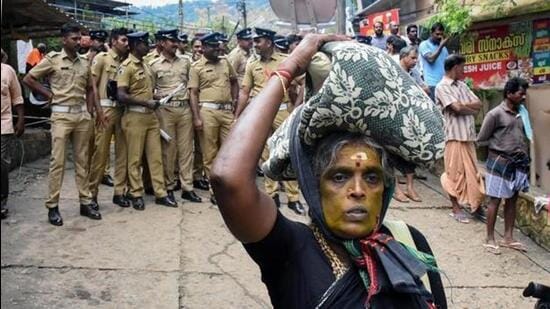
Women and their access to places of worship has been restricted or even completely denied in all ancient religions. Zoroastrianism, Vedic religion and Puranic Hinduism, Christianity, Jainism, Buddhism and Islam, no religion is innocent of this discrimination. They all contain injunctions that explicitly prohibit, regulate and at the least, disparage women because of physiological attributes like menstruation, the resultant ‘impurity’ as well as the desires evoked by their sexuality. In Jainism’s two sects, the Digambars insist that a woman has to be reborn as a male to be eligible for moksha while in Buddhism a similar inequality is professed between male and female disciples. But these are milder problems compared to other religions.
It is written in Chapter 15 of the book of Leviticus, in the Old Testament, “...and if a woman have an issue, and her issue in her flesh be blood, she shall be put apart seven days, and whosoever toucheth her shall be unclean until the even”.
In the ancient world when humans were terrified by their inability to comprehend nature and its myriad manifestations of lifeforms, and of phenomena such as thunder, disease, and even night and day, the monthly menstruation of women seems to have confounded them no end.
{{/usCountry}}In the ancient world when humans were terrified by their inability to comprehend nature and its myriad manifestations of lifeforms, and of phenomena such as thunder, disease, and even night and day, the monthly menstruation of women seems to have confounded them no end.
{{/usCountry}}In the Vasistha Dharmasutra, believed to date around the beginning of the Common era i.e about 2,000 years ago, the don’t’s for menstruating women are stated in detail. Sample this, “..a menstruating woman remains impure for three days. She should not apply collyrium on her eyes or oil on her body, or bathe in water; she should sleep on the floor and not sleep during the day; she should not touch the fire, make a rope, brush her teeth, eat meat, or look at the planets; she should not laugh, do any work, or run; and she should drink out of a large pot or from her cupped hands or a copper vessel”.
This idea of impurity was not enough to justify the exclusion of women who had been an integral and equal part of the hunter-gatherer phase of civilisation. Rock paintings at sites like Bhimbetka in Madhya Pradesh show pregnant women in headgear joining hunts which tells us that they were not disparaged but valued for their reproductive power and equal ability.
However, as humans settled down and became more civilised, the position of women came under increasing threat. The idea of impurity appears to not have been adequate. Menstruation was sought to be explained in the framework of guilt. The Vasistha Dharmasutra goes on to weave a story of how Indra’s guilt was taken by women in exchange for carnal pleasure. It states, “Indra, after he had killed the three-headed son of Tvastr, was seized by sin, and he regarded himself in this manner:An exceedingly great guilt attaches to me‖. And all creatures railed against him: ―Brahmin-killer! Brahmin-killer! He ran to the women and said: ‘Take over one-third of my guilt of killing a Brahmin.’ They asked: ‘What will we get?’ He replied: ‘Make a wish’. They said: ‘Let us obtain offspring during our season, and let us enjoy sexual intercourse freely until we give birth.’ He replied: ‘So be it!’ And they took the guilt upon themselves. That guilt of killing a Brahmin manifests itself every month. Therefore, one should not eat the food of a menstruating woman, for such a woman has put on the aspect of the guilt of killing a Brahmin.”
The landmark Sabarimala Judgement of 2016 also affirms the presence of such injunctions against women, it records on page 64, “To similar effect are Chapters 9 and 13 of Canto 6 of the Bhagavata Purana which read as follows: In return for Lord Indra‘s benediction that they would be able to enjoy lusty desires continuously, even during pregnancy for as long as sex is not injurious to the embryo, women accepted one fourth of the sinful reactions. As a result of those reactions, women manifest the signs of menstruation every month”.
Among Hindus, it is these scriptural injunctions that provide the basis of exclusion of women from certain rituals and forms of worship, and from temples. Some of the more well-known temples that prohibit women’s entry are those of Lord Kartikeya in Pehowa (he cursed all women when his younger brother Lord Ganesha was preferred by their parents Shiva and Parvati), Brahma’s temple in Pushkar, and the Bhavani Deeksha Mandapam in Vijayawada among others. Till the 2018 Supreme Court judgement women are prohibited from entering the temple where the deity is a celibate. Even after the judgement few women devotees show up given men’s opposition.
In Islam too, women have been barred from physical contact during this menstruation. In chapter 22 of the Quran, it is stated, “It is a state of hurt (and ritual impurity), so keep away from women during their menstruation and do not approach them then (you can) go to them inasmuch as God has commanded you (according to the urge He has placed in your nature, and within the terms He has enjoined upon you). Surely God loves those who turn to Him in sincere repentance (of past sins and errors), and He loves those who cleanse themselves”.
Recall the long drawn litigation over women’s access to the Haji Ali Dargah in Mumbai (earlier Bombay), and the Nizamuddin Dargah in Delhi, where women cannot enter the innermost chamber containing the Sufi saint’s grave. This general restriction holds at most Sufi dargahs across the country.